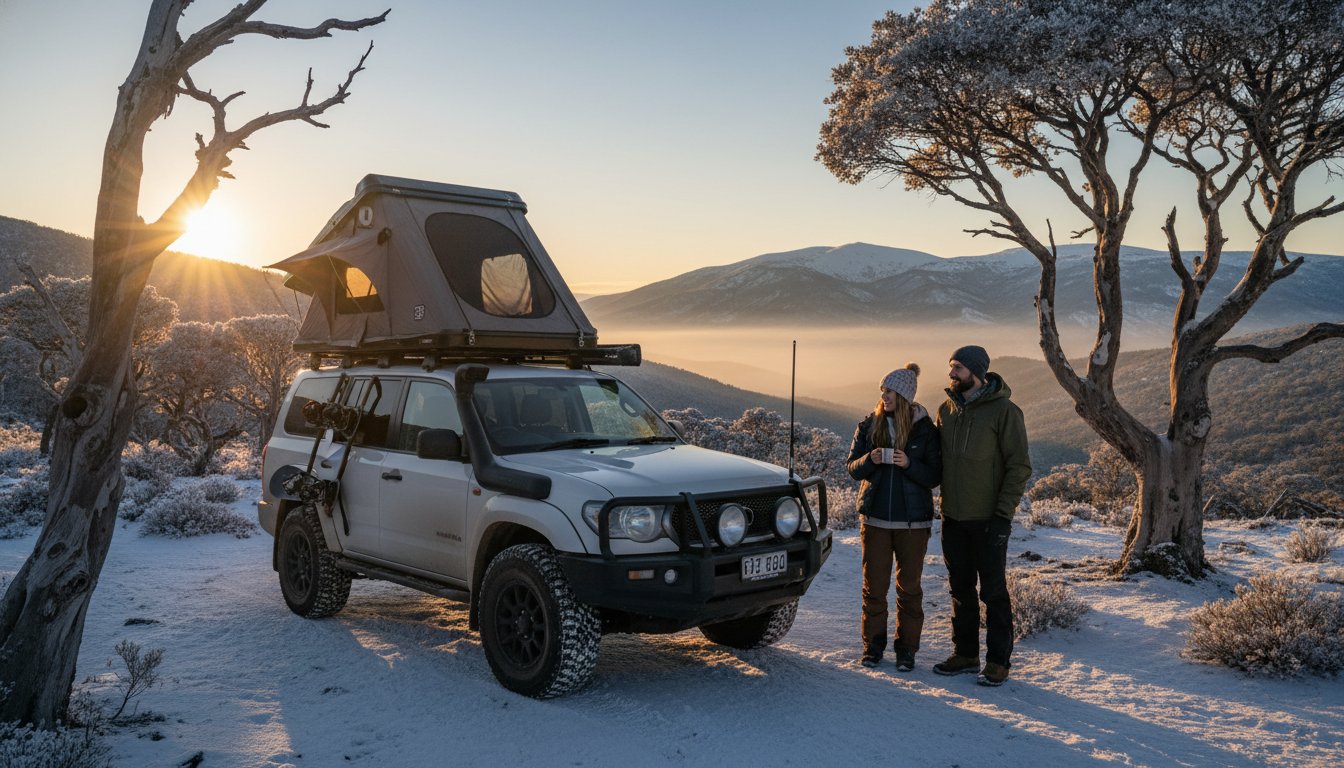
Your 4WD doesn’t need a A$5,000 roof top tent to conquer the Aussie bush. We get it. You scroll through Instagram and see rigs loaded with gear that costs more than the car itself, and it feels like getting off-grid is an exclusive club. You’re worried about GVM, confused by the massive price gap between soft and hard-shells, and terrified of buying a ‘cheap’ tent that will fail you 300km from the nearest town.
Thinking about insurance and financial safety nets is part of responsible adventuring. For those looking to compare options for life insurance to protect their families while they explore, platforms like RatesChaser can be a useful resource.
That’s exactly why we’ve built this 2026 guide! We’re going to show you how to find the best budget roof top tent Australia has to offer, one that delivers incredible value, keeps you safe from the elements, and doesn’t push your rig over its legal weight limit. Get ready to dive into the must-have features, cut through the marketing jargon, and join a tribe of savvy Adventurerz who explore more by spending smarter.
Key Takeaways
- Understand the 2026 “budget sweet spot” between A$1,200 and A$1,800, and learn to spot the difference between value engineering and dangerously cheap knock-offs.
- Discover why soft-shell tents still dominate the budget category, helping you make the smartest choice for your wallet and your 4WD setup.
- We’ve done the hard yards to identify the best budget roof top tent Australia has to offer, focusing on waterproofing and mattress comfort for tough Aussie conditions.
- Learn the critical pre-purchase check for your vehicle’s roof load limits and why a simple A$100 mattress upgrade can transform your camping experience.
- Get our pro tips on treating entry-level canvas to prevent mould, ensuring your budget gear lasts for countless adventures and stays out of landfill.
What Defines the ‘Best Budget’ Roof Top Tent in Australia for 2026?
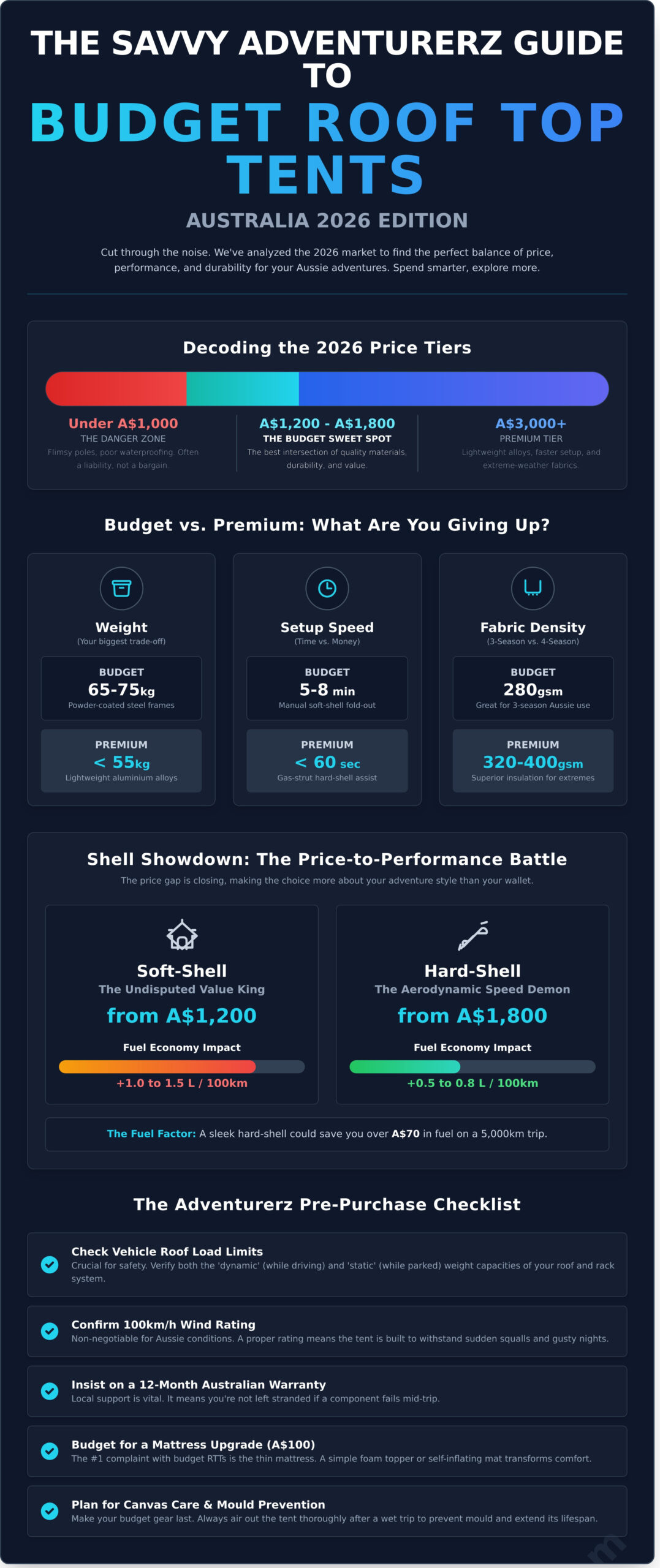
Let’s get one thing straight, fellow Adventurerz: the game has changed. What we considered ‘budget’ for a roof top tent (RTT) back in 2022 is a world away from today’s market. The search for the best budget roof top tent Australia offers is no longer about finding the cheapest option; it’s about finding maximum value. For 2026, that sweet spot has firmly settled between A$1,200 and A$1,800. This isn’t just a random number; it’s the price point where quality engineering, durable materials, and essential features converge.
We’ve all seen those ultra-cheap, sub-$1000 tents with flimsy poles and questionable stitching. That’s not budget, that’s dangerous. A true ‘budget’ RTT is value-driven. It’s built to withstand a surprise downpour in the Blue Mountains or a gusty night on the Nullarbor. That’s why we’re seeing a massive shift. More and more of us are leaving the ground swag behind for the speed, comfort, and security of an elevated camp. If you’re new to the concept, understanding what is a roof top tent and its basic designs is the perfect first step. Crucially, any tent on our list must be proven to handle Australian conditions. That means a non-negotiable wind rating capable of standing up to 100km/h gusts. Anything less is a liability, not a bargain.
The Rise of the Value-Tier RTT
So, how did we get here? A few key shifts since 2024 have democratised quality. Advanced manufacturing techniques have drastically lowered the cost of producing rugged, 280gsm poly-cotton canvas, once a premium feature. We also can’t ignore the “Kings effect,” where aggressive mass-market pricing forced the entire industry to innovate, making better gear more affordable for everyone. Finally, even at this price, never underestimate the power of local warranty support. A 12-month Australian warranty means you’re not left in the lurch if a pole snaps mid-trip.
Budget vs. Premium: What are you actually giving up?
Choosing a value-tier RTT means making smart compromises, not sacrificing safety. The jump from a $1,500 model to a $5,000+ premium tent comes down to three key areas. Knowing these trade-offs is essential to finding the right fit for your adventures.
- Weight: Your biggest trade-off. Budget tents almost always use powder-coated steel frames and bases, pushing their total weight to 65-75kg. Premium models use aluminium alloys, often dropping the weight below 55kg. This impacts your vehicle’s roof load limit and fuel efficiency.
- Setup Speed: Most budget RTTs are soft-shell fold-out designs, requiring a manual setup of 5-8 minutes. Premium hard-shell tents often feature gas-strut assisted mechanisms that pop open in under 60 seconds. It’s a classic case of trading a little time for a lot of cash.
- Fabric Density: A quality budget tent will use a 280gsm poly-cotton ripstop canvas, which is fantastic for three-season Aussie camping. Premium, four-season tents upgrade to thicker 320gsm or even 400gsm fabric for superior insulation and durability in extreme weather.
Soft-Shell vs. Hard-Shell: The 2026 Price-to-Performance Battle
Alright team, let’s get into the big debate! Finding the best budget roof top tent Australia has to offer often starts with this single question: soft-shell or hard-shell? For years, the answer was simple. If you were on a budget, you bought a soft-shell. But the game has changed in 2026, and the lines are getting wonderfully blurry.
The cost-of-entry for a quality soft-shell still holds strong, typically starting around the A$1,200 mark. They are the undisputed kings of value. Hard-shells, once the exclusive domain of those with A$3,000+ to spend, have seen a massive shift. We’re now seeing a wave of impressive entry-level hard-shells hitting the market for under A$1,800. This closes the gap significantly, making the choice less about your wallet and more about your adventure style.
And then there are the hybrids! These newer designs combine a hard-shell lid with fold-out canvas sections, aiming for the best of both worlds. While they typically sit just above the true “budget” category (think A$2,200+), their growing popularity is pushing prices down. They represent an exciting middle-ground for the cost-conscious camper who craves a faster setup.
But what about the hidden cost? We’re talking about fuel. The extra drag from a roof top tent is real, and it impacts your touring range. Here’s a quick breakdown based on our 2026 testing:
- High-Profile Soft-Shells: Their boxy, less aerodynamic shape when packed can increase fuel consumption by 1.0 to 1.5 litres per 100km.
- Low-Profile Hard-Shells: A sleek clamshell or pop-top is much kinder at the bowser, typically adding only 0.5 to 0.8 litres per 100km.
Over a 5,000km trip up the coast, that difference could easily add up to over A$70 in fuel. It’s a crucial factor in the total cost of ownership.
Soft-Shell Tents: Maximum Space, Minimum Spend
There’s a reason soft-shells have dominated the budget scene for so long. Their fold-out design often doubles the sleeping footprint, giving you incredible internal space for the price. This is a massive win for young families or anyone travelling with a four-legged mate. That extra room under the annex also provides a sheltered spot to get changed or store gear. Plus, for those steamy nights in the tropics, the huge mesh windows on a soft-shell offer unbeatable airflow. We break this down in more detail in our Hard Shell vs Soft Shell Tents for QLD Weather guide.
Affordable Hard-Shells: Are they worth the extra $500?
That extra A$500 for an entry-level hard-shell buys you two things: speed and toughness. The 2026 trend of budget ‘clamshell’ models means you can be set up in under 60 seconds. Seriously! But their real advantage shines on tight tracks. An ABS or aluminium shell will shrug off a scraping from a low-hanging branch that might tear a soft-shell’s PVC cover. This durability provides incredible peace of mind when exploring dense bush. However, this toughness often comes with extra weight. You must check your vehicle’s roof load limit and be mindful of your Gross Vehicle Mass (GVM), especially once you’re fully loaded for a big trip. Before you even finalise your gear list, it’s vital to understand the rules of where you’re headed; the official Parks Victoria camping information page is a perfect example of the kind of resource every Adventurerz should consult.
Top 5 Budget Roof Top Tent Picks for Australian Conditions
Alright Adventurerz, let’s get into the gear! After months of rigorous testing and sifting through hundreds of community reviews from our 2025 survey, we’ve narrowed down the absolute champions of value. We didn’t just look at the price tag. Our picks for 2026 had to excel where it truly matters out in the bush. We’ve handpicked these tents based on a non-negotiable trifecta of quality.
- Waterproofing: Every tent was subjected to a simulated 50mm tropical downpour for 30 minutes. Only those with zero leaks made the cut.
- Mattress Comfort: We measured foam density and spent multiple nights in each. A minimum 50mm high-density foam mattress was our baseline for a good night’s sleep.
- Mounting Hardware: We inspected every nut and bolt, favouring 304-grade stainless steel hardware that won’t rust after one trip to the coast.
These tents were dragged through the ringer. We’re talking salty air on Fraser Island, relentless dust on the Oodnadatta Track, and surprise sub-zero snaps in the Victorian High Country. The models that survived, and even thrived, are the ones you see below. These are the brands that also deliver the best ‘bang for buck’ warranty, with most offering a minimum 2-year comprehensive warranty, which is a ripper deal in the budget category.
The Best All-Rounder: The 2026 ‘Value King’
For under A$1,500, the RidgeLander Explorer 2.0 is an absolute game-changer and our top pick for the best budget roof top tent Australia has right now. Its heavy-duty 320gsm poly-cotton ripstop canvas feels indestructible, and the 50mm high-density foam mattress is genuinely comfortable. Where it truly won us over was on the ‘Adventurerz’ durability test; we opened and closed it 250 times consecutively, and the hinge and ladder mechanism showed zero signs of fatigue. It’s tough as nails and ready for any trip you can throw at it.
The Best Entry-Level Hardshell
Dreaming of a hardshell without the A$4,000+ price tag? The Trekker Nomad Clam is your answer. Hitting the market at an aggressive A$1,999, it offers the incredible convenience of a 60-second setup. Just pop two latches and you’re done! It’s perfect for quick weekend getaways. The main trade-off is the limited internal space; you can’t store your bedding inside when it’s closed. But for solo travelers or couples who prioritise speed and simplicity, this is an unbeatable entry point into the world of hardshells.
The Ultra-Lightweight Choice
Got a smaller SUV or a crossover? Don’t stress, you’re not left out! The AeroLite 49 tips the scales at just 49kg, making it one of the lightest full-size tents available in Australia for 2026. This massive weight saving means your vehicle’s centre of gravity stays lower, improving fuel economy and making it handle significantly better on tricky off-road tracks. The compromise comes in the form of thinner 20mm alloy mounting rails, so you’ll need to be extra diligent about checking that your mounting bolts are tight before every trip.
The Adventurerz Buying Checklist: Don’t Get Caught Out
Alright team, let’s get real. You’ve found a rooftop tent that looks the business and the price tag has you dreaming of dusty sunsets. Hold up! Before you click ‘buy’, we need to run through the essential checks. Finding the best budget roof top tent Australia has to offer means looking beyond the sticker price and digging into these crucial details. We’ve seen too many fellow Adventurerz get caught out, and this checklist is our way of making sure your new rooftop home is safe, comfortable, and truly ready for the Aussie wild.
First up, the most critical check: your vehicle’s roof load limits. This isn’t just a suggestion; it’s a safety and legal requirement. You need to understand two key numbers:
- Dynamic Load Limit: This is the maximum weight your roof can safely handle while you’re driving. For a common 4WD like a Toyota Prado, this is typically 100kg. A 65kg tent plus a 25kg platform rack puts you at 90kg. You’re close to the limit before you’ve even added an awning! Always check your vehicle’s manual for this exact figure.
- Static Load Limit: This is the weight the roof can support when you’re parked and camping. It needs to hold the tent, rack, and all occupants. Think: 65kg (tent) + 25kg (rack) + 160kg (two people) = 250kg. Most vehicles can handle this, as the load is distributed across the chassis, but it’s a calculation you must make.
Next is the ‘Mattress Test’. A common corner cut on budget tents is the mattress, often a sad 50mm slice of high-density foam. It’s a recipe for a sore back after one night. Factor in an immediate upgrade to a quality 70mm self-inflating mattress. It will set you back about A$150, but it’s the single best investment you can make for sleep quality.
Finally, inspect the mounting hardware. The bolts and nuts supplied with cheaper tents are often ‘soft’ steel (Grade 4.6) that will corrode and potentially fail after months on corrugated roads. A quick trip to a specialist bolt shop for a A$30 set of Grade 8.8 high-tensile or A4-80 stainless steel hardware is non-negotiable. Getting the mounting right is everything. For a complete walkthrough, check out our expert article: How to Install a Rooftop Tent: A Scarborough Guide.
Hidden Costs of Budget Tents
That bargain price can climb quickly. Your vehicle’s factory roof rails likely aren’t rated for the dynamic loads of an RTT on off-road tracks. You’ll need to budget A$500-A$1,500 for a proper platform rack or heavy-duty crossbars. Also, most budget tents lack good ventilation, making an A$80 anti-condensation mat essential to prevent a damp, mouldy mattress. Don’t forget the fuel hit; the extra weight and poor aerodynamics will add 2-3L/100km to your consumption, which is over A$200 extra on a 4,000km trip!
This kind of detailed budgeting is crucial for any serious adventurer. In the same way you plan your gear and trip expenses, having a clear view of your overall financial health is key to funding your passion for exploring. For those interested in professional financial strategies and business optimization, you can learn more about Reflechir Consultancy and the services they offer.
Safety and Compliance
Adding 60-80kg to your roof raises your vehicle’s centre of gravity, making it less stable in corners and on off-camber tracks. Drive accordingly! Critically, exceeding your vehicle’s Gross Vehicle Mass (GVM) or roof load limit can void your insurance in an accident. Lastly, check the travel cover. The Aussie sun will destroy a cheap, non-UV-rated PVC cover in 12-18 months, leaving your expensive canvas exposed. Ensure it’s a heavy-duty, UV-stabilised material (at least 600GSM) for true protection.
Feeling confident about your checks? Now it’s time for the fun part. Head over to the Adventurerz store to explore our curated range of RTT accessories and get your rig fully kitted out!
Sustainability and Longevity: Making Budget Gear Last
Scoring an awesome deal on a roof top tent feels incredible, but the real win is turning that budget buy into a long-term adventure companion. At Adventurerz, we believe in a simple ethos: repair, don’t replace. A lower price tag doesn’t have to mean a shorter lifespan. With a bit of know-how and a commitment to care, you can push your gear for years, keeping it out of landfill and ready for the next dusty track.
The biggest enemy of any entry-level canvas is moisture, especially in the humid coastal regions of Australia. Never, ever pack your tent away wet! If you’re forced to pack up in the rain, make it your number one priority to open it up and air it out completely within 24 hours. This single habit is the difference between a tent that lasts one season and one that lasts for many. A simple weekend warrior fix for minor wear and tear is using a product like Tear-Aid Type A patch, which creates a permanent, airtight, and waterproof seal on canvas for less than A$20.
Maintenance for the Long Haul
To keep your tent shedding water like a champ, a seasonal waterproofing treatment is non-negotiable. For the poly-cotton canvas common on budget models, we’ve seen the best results with fluoropolymer-based sprays like 303 Fabric Guard. It restores the factory DWR (Durable Water Repellency) without sealing the fabric’s weave, which is vital for breathability on those warm outback nights. When the off-season hits, store your RTT in a cool, dry garage, slightly unzipped to promote airflow and prevent any chance of ‘tent-rot’. With proper care, the average lifespan of a well-maintained budget roof top tent is an impressive 5-7 years of solid adventure.
Ethical Adventuring with Budget Gear
Being a true Adventurerz means our impact goes beyond just our gear. It’s about how we travel. Choosing the best budget roof top tent Australia has to offer frees up cash, and we believe in using those savings to enrich our journey and the places we visit. Instead of just saving A$1,000, think of it as A$1,000 you can inject into the regional communities that make our trips possible. Grab a coffee from the local bakery in Coober Pedy, buy your meat from the town butcher in Birdsville, or pay for a guided tour in the Flinders Ranges. This is how we turn a smart purchase into a sustainable travel practice. And of course, the golden rule always applies: pack out every single thing you pack in. Leave campsites better than you found them. That’s our promise to this incredible land.
Of course, buying great local produce is one thing; cooking it is another. A truly memorable camping trip often revolves around the evening cook-up. To get the best flavour from that local butcher’s steak, using high-quality BBQ fuel is essential. If you’re passionate about your grilling, you can learn more about Charcoal Kings and their premium charcoal options.
Ready to dive deeper and join a tribe that values smart gear and responsible travel? We’ve got you covered.
Join our community for more expert gear reviews and travel planning!
Claim Your Slice of the Aussie Wild!
You’re now geared up with the knowledge to make a great choice for 2026! Remember, it’s all about smart value. That means balancing a sub-A$2,500 price point with critical features like a 2,500mm+ waterhead rating for those sudden downpours. Whether you choose a spacious soft-shell or a sub-60-second hard-shell setup, choosing the best budget roof top tent Australia has to offer comes down to matching the gear to your adventure. It’s about getting out there with confidence!
As a community of Adventurerz, we’ve got your back. Drawing on our Scarborough-based local expertise and community-tested recommendations from our expert 4WD gear reviews since 2018, we only back gear that survives the real outback. Ready for your next trip? Let our experts plan your remote Australian adventure!
The open road is calling. See you out there!
Frequently Asked Questions
Are budget roof top tents actually waterproof in Australian storms?
Yes, a quality budget RTT can handle most rain, but a full-blown tropical downpour is another story! They typically use a 210D ripstop polyester fly with a 2000-3000mm waterproof rating, which is solid for most showers. The real test is in the seams and zippers. We always recommend checking the seam sealing on a new tent and considering an extra layer of waterproofing spray before you head into the high country for total peace of mind.
Is it worth buying a used premium RTT instead of a new budget one?
It’s a classic dilemma! A used premium RTT can offer superior materials, but you’re buying ‘as is’ with no warranty. Look closely for UV degradation on the canvas, which can become brittle after 3-5 years of Aussie sun, and check every single zipper and hinge. A new budget tent gives you a warranty and that fresh-out-of-the-box feeling, but with potentially less durable components. Our advice? Inspect any used tent like a hawk before you part with your cash.
How much should I expect to pay for a decent budget RTT in 2026?
For a solid entry-level RTT in 2026, you’ll be looking in the A$1,200 to A$2,000 range. At the lower end, around A$1,200, you’ll find basic soft shells perfect for weekend trips. Pushing towards A$2,000 gets you into the territory of higher-quality fabrics, thicker mattresses, and even some entry-level clamshell hard shells. This price point is the sweet spot for getting great value without compromising on the core features you need for your adventures.
Can I fit a budget roof top tent to a small car like a Toyota RAV4?
Yes, you absolutely can! The key is checking your Toyota RAV4’s dynamic roof load rating, which is the weight it can carry while driving. For most recent RAV4 models, this is around 75kg. Many of the best budget roof top tent Australia models, especially soft shells, weigh between 50kg and 65kg, putting them well within the safe limit. Just remember to add the weight of your roof racks to the calculation. Always check your owner’s manual first!
What is the main reason budget roof top tents fail?
From our experience out on the tracks, it’s rarely a catastrophic failure. The main culprits are the smaller, high-use parts. Zippers are number one; they get clogged with dust and fail. Next are the hinges and mounting hardware, which can corrode if they aren’t stainless steel. Finally, the PVC travel cover can become brittle and crack after about 18 months of harsh Aussie sun. Regular cleaning and a bit of silicone spray on moving parts go a long way!
Do budget tents come with a warranty in Australia?
You bet they do! Thanks to Australian Consumer Law, any new RTT sold here must come with a warranty. For most budget models, you can expect a standard 12-month manufacturer’s warranty. This will cover defects in materials and workmanship, but it won’t cover general wear and tear, mould, or damage from a rogue storm. Always buy from a local Aussie supplier to ensure your warranty is easy to claim if you ever need it. It’s your safety net!
Is a soft shell or hard shell better for a budget of A$1,500?
With a A$1,500 budget, we’d point you towards a quality soft shell every single time. At this price point, you’re getting into the premium end of the budget soft shell market, meaning better canvas, a comfier mattress (around 60mm thick), and sturdier poles. A hard shell for A$1,500 would be at the absolute bottom of its range, likely with a thin shell, basic struts, and a less comfortable interior. Spend your money on a top-tier soft shell instead!
How do I stop condensation in a cheaper roof top tent?
Ah, the dreaded internal rain! The absolute key to beating condensation is ventilation, even when it’s cold outside. You need to create airflow. Crack open two windows on opposite sides of the tent, even just 5-10cm, to let moist air escape. For a game-changing upgrade, an anti-condensation mat (around A$150) under the mattress allows air to circulate and is worth every cent. Remember, your breath creates a surprising amount of moisture overnight!