Imagine it is 5:30 AM on a crisp morning in the Blue Mountains. You reach for your phone, but your hand brushes against a damp wall and a cold drop of water hits your forehead. We have all been there, and it is a total mood killer. There is nothing more frustrating than waking up in a soggy sleeping bag or worrying about mildew ruining your expensive canvas while you are exploring off-the-grid. We invest heavily in our rigs to enjoy the Australian wilderness, not to feel like we are sleeping inside a humid rainforest.
Mastering the science of preventing condensation in a roof top tent is the ultimate secret to extending your camping season into those chilly winter months. Since a single adult can exhale up to 1 litre of water during a typical eight hour sleep, your setup needs to work hard to stay dry. We are here to help you turn your RTT into a bone-dry sanctuary, even when the coastal humidity hits 90%. This guide breaks down the exact ventilation strategies and gear setups, including essential anti-condensation mats, that keep our Adventurerz community comfortable across the continent. Let’s get your gear ready for the next big trip!
Key Takeaways
- Master the science of cross-ventilation and the “Chimney Effect” to ensure moisture escapes your RTT before it has a chance to settle.
- Discover why a 3D mesh underlay is the most critical gear investment for preventing condensation in a roof top tent during those chilly Aussie nights.
- Learn how to leverage diesel heaters to create a “dry heat” environment that keeps your bedding crisp and your interior bone-dry.
- Follow our pro pack-down protocol to safeguard your investment against mould and ensure your tent is always ready for the next off-road mission.
- Gain the expert knowledge needed to manage internal humidity, ensuring every Adventurerz member stays comfortable while exploring our rugged wilderness.
Understanding the Condensation Struggle in Your Roof Top Tent
Every member of our Adventurerz community knows that specific morning feeling. You wake up in the middle of the Simpson Desert, reach for your phone, and a cold droplet hits your forehead. It isn’t a manufacturing flaw or a sudden leak in your gear. It’s a fundamental law of physics. Understanding the science of condensation is your first step toward a dry, comfortable night under the stars. At its simplest, condensation happens when warm, moist air inside your tent touches a surface that is colder than the air’s dew point, turning that vapour back into liquid water.
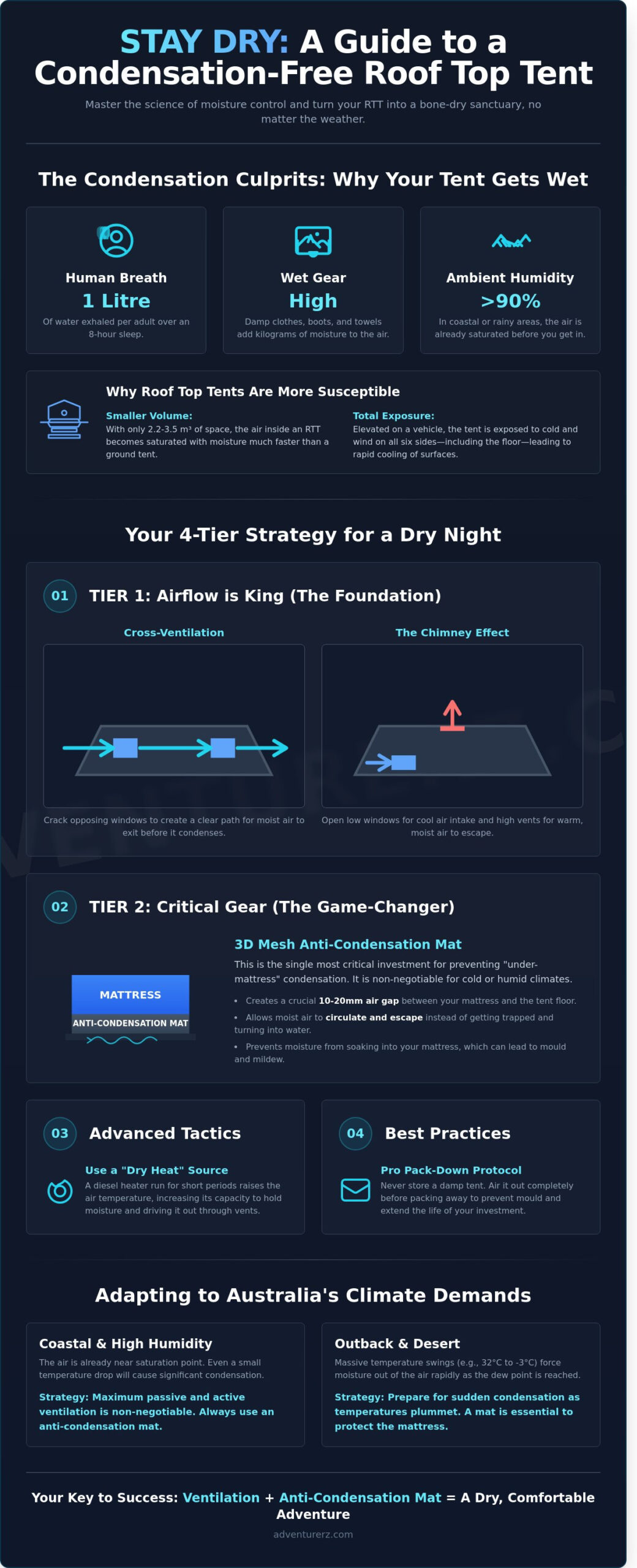
While ground campers deal with this too, roof top tents are particularly susceptible for two reasons. First, they have a smaller interior volume, often between 2.2 and 3.5 cubic metres. This limited space means the air becomes saturated with moisture much faster. Second, being elevated on a 4WD exposes the tent to wind and cold air on all six sides, including the floor. This total exposure causes the tent fabric and poles to cool down rapidly, creating the perfect environment for moisture to settle.
We see three main culprits behind the moisture in your setup:
- Exhaled Breath: A single adult can exhale between 400ml and 1 litre of water vapour over an eight-hour sleep.
- Wet Gear: Storing damp towels, muddy boots, or rain jackets inside the sleeping area adds kilos of extra humidity to the air.
- Ambient Humidity: On a rainy night in the Daintree, the air is already at 90% saturation before you even zip the door shut.
Don’t panic if you see puddles under your mattress. While it looks like your tent failed you during a storm, it’s usually just extreme build-up from these internal sources. Learning the art of preventing condensation in a roof top tent starts with acknowledging that you are the primary source of the water.
The Science of the Dew Point
Heat always moves toward cold. In your RTT, thermal bridging occurs when metal poles or heavy canvas transfer the outside chill directly to the interior of the tent. When the warm air you’ve generated hits these cold bridges, it loses its ability to hold moisture. For a standard 2-person tent occupancy, the dew point is the specific temperature at which the air becomes 100% saturated and begins shedding water onto your sleeping bags.
Why Australia’s Climate Demands a Unique Approach
Australia’s diverse geography creates distinct challenges for Adventurerz. In coastal regions, high humidity means the air is already heavy; even a small temperature drop causes massive fallout. Conversely, the outback sees massive temperature swings, sometimes dropping from 32°C at sunset to -3°C before dawn. This 35-degree crash forces moisture out of the air instantly. We need to use “passive” management like anti-condensation mats alongside “active” management like cross-flow ventilation to stay dry. Preventing condensation in a roof top tent across these varied climates requires a flexible strategy that adapts to the local environment.
Maximising Airflow: The Secret to a Dry Tent Interior
Airflow isn’t just a comfort feature; it’s the primary engine for preventing condensation in a roof top tent. We’ve all woken up in the Aussie High Country with a damp ceiling dripping on our faces, but this usually happens because the tent was sealed too tight. Cross-ventilation acts as your first line of defence. By creating a clear path for air to enter and exit, we flush out the warm, moist air before it hits the cold canvas. An average adult exhales nearly 1 litre of water overnight. Without a steady breeze, that moisture has nowhere to go but onto your gear.
The “Chimney Effect” is a game-changer for Adventurerz who camp in humid conditions. This involves opening lower windows to let cool air in while keeping roof vents wide open to let hot air escape. This natural rising motion creates a vacuum that constantly refreshes your interior environment. As noted in REI’s guide to preventing tent condensation, campsite selection plays a huge role here. We always recommend pitching your vehicle so the side windows catch the prevailing breeze, ensuring a constant 5 to 10 km/h airflow through the sleeping area.
Strategic Window and Fly Opening
Cracking a single window just won’t cut it. To get results, we aim for opposing openings. This creates a high-pressure to low-pressure flow that clears out humidity in minutes. Most modern roof top tents feature weather-shields or stiffened awnings over the zippers. These allow you to keep the mesh open even during a typical tropical downpour in Queensland. Don’t forget your rainfly! It’s designed to sit 50mm to 100mm off the main tent body. This air gap acts as a thermal buffer, preventing the inner walls from cooling too rapidly and reaching the dew point.
Using Awnings to Create a Dry Buffer Zone
Integrating 4WD awnings into your setup provides a massive advantage. An awning acts as a protective porch, allowing you to leave windows fully unzipped without worrying about rain blowing in. If the wind is howling, we use awning walls to block the brunt of the gust while still leaving the top 20 percent open for ventilation. This creates a “buffer zone” of semi-dry air around your tent entrance. When setting up, look for natural windbreaks like scrub or dunes, but always position your setup to harness the breeze. It’s about working with the environment, not against it, to ensure every member of the Adventurerz community stays bone-dry.
Must-Have Gear to Combat Moisture Build-Up
We know the feeling of waking up in the Australian bush only to find the walls of your sleeping quarters dripping. While basic habits help, high-quality gear is your best defense for preventing condensation in a roof top tent. Investing in a few specific accessories transforms your setup from a damp cave into a dry, breathable sanctuary. We recommend focusing on airflow beneath your body and active air movement above it to tackle the physics of moisture head-on.
The Anti-Condensation Mat: Why You Need One
The anti-condensation mat is the single most important accessory for any Adventurerz setup. Most standard RTT mattresses sit directly on a cold aluminium or composite floor. When your body heat meets that cold surface, moisture traps itself under the mattress. A 15mm 3D mesh mat creates a crucial air gap that allows heat to dissipate and air to circulate. Unlike solid foam underlays which can actually trap moisture and lead to mould, these poly-mesh structures act like thousands of tiny springs pushing the mattress away from the damp floor.
While site selection is vital, following expert advice on preventing tent condensation often requires upgrading your internal setup. When browsing our latest roof top tents, you’ll notice many premium models now include these mats as standard. If yours doesn’t, it’s the first upgrade you should make. To keep this area pristine, we suggest lifting your mattress every three to four days during long trips to let the floor plate breathe and dry completely.
Active Ventilation: Fans and Dehumidifiers
Stagnant air is the enemy of a dry tent. We’ve found that even a small amount of active airflow can reduce moisture build-up by up to 50% on humid nights. A rechargeable 12V or USB-powered fan is a game-changer for the Adventurerz community. For the best results, don’t just point the fan at your face; position it near a top peak vent to actively push warm, moist breath out of the tent before it hits the cold fabric.
- Rechargeable Fans: Look for units with at least a 5000mAh battery to ensure they last the full 8 to 10 hours of a typical sleep cycle.
- 12V Hardwired Options: These provide consistent power from your secondary battery system, allowing for higher RPMs and better air exchange.
- Moisture Absorbers: Silica gel canisters or hanging dehumidifier bags are popular, but they have limits. In a non-sealed environment like a tent with open vents, a standard 500g silica pack will reach its saturation point quickly. These are best used as a preventative measure when the tent is packed away to protect your bedding from “sour” smells during storage.
Relying on gear doesn’t mean you can ignore the basics, but it gives you a massive advantage when preventing condensation in a roof top tent during a rainy Victorian winter or a humid Queensland summer. Combine a mesh underlay with a well-placed fan, and you’ll find your morning pack-up is significantly faster and much drier.
Advanced Techniques: Heaters and Moisture Control
We’ve all been there, waking up in the Victorian High Country or a chilly Tassie morning only to find the inside of the canvas dripping. While ventilation is your first line of defense, advanced moisture control involves managing the air temperature and humidity levels directly. Using a diesel heater is a total game-changer for preventing condensation in a roof top tent because it attacks the problem with dry, forced air. Unlike some portable propane heaters that release up to 1.6 litres of water vapour for every kilogram of fuel burned, diesel heaters exhaust all combustion moisture outside the sleeping area.
This “dry heat” does more than just keep your toes toasty. It actively lowers the relative humidity inside the tent, allowing the air to absorb more of the moisture you exhale during the night. It also helps dry out any damp gear or lingering humidity in the mattress. Safety is our priority when we’re off-the-grid, so always ensure your heater unit stays on the ground or a dedicated rack, with only the hot air ducting entering the tent. Never operate a combustion heater inside the tent without proper external venting, and always pack a portable carbon monoxide detector for peace of mind.
Diesel Heaters: The Ultimate Cold-Weather Solution
Diesel heaters are the gold standard for Adventurerz who refuse to let winter stop the fun. These units pull fresh air from outside, heat it via a heat exchanger, and pump it into your RTT. This creates positive pressure, which helps push moist internal air out through your vents. Because the heater provides a constant source of warmth, we can afford to keep our vents open much wider than usual. This constant air exchange is the most effective way of preventing condensation in a roof top tent during sub-zero nights. Budget A$200 for a basic portable “all-in-one” unit, or up to A$1,500 for a premium, fixed installation with high-altitude sensors.
Controlling Internal Moisture Sources
Managing the environment means being disciplined about what we bring into our sleeping space. Every wet item is a humidity bomb waiting to go off. We follow a strict “No Wet Gear” rule: boots, soggy jackets, and damp recovery gear stay in the car or a sealed gear box on the roof rack. If you’re camping with a 30kg dog, remember that your furry mate can expire up to 100ml of water through their breath overnight. We recommend giving them a quick towel-down before they climb the ladder and using a dedicated pet blanket to trap moisture.
- The Morning Wipe-Down: Keep a high-gsm microfibre towel handy to wipe the walls before the sun hits the tent and “bakes” the moisture into the fabric.
- Boot Bags: Use external boot bags that hang off the side of your RTT rail to keep mud and dampness outside.
- Dehumidifier Packs: For long-term trips, hanging silica gel desiccant bags can absorb up to 300% of their weight in water.
Maintenance and Long-Term Tent Care
After a week of exploring the Simpson Desert or the Victorian High Country, your gear needs some love. We’ve found that the secret to preventing condensation in a roof top tent isn’t just about what you do while sleeping; it’s about how you pack it away. Moisture is a silent gear killer. When we fold our tents, we often trap pockets of humid air or dew between the mattress and the floor. Choosing high-quality roof top tents with breathable poly-cotton canvas or Ripstop fabrics significantly reduces the baseline moisture levels, but even the best gear requires a strict “Pack Down” protocol. We always wipe down the internal walls with a microfibre cloth and remove any damp bedding before closing the shell for the drive home.
The 24-Hour Drying Rule
If you’re forced to pack up in a downpour at 7:00 AM, the clock starts ticking. You must open that tent within 24 hours of arriving back at your driveway. Leaving a damp tent closed for more than 48 hours can lead to a 15% increase in fungal spore growth in humid Australian climates. We recommend using a travel planner to build a “dry day” into your 2026 itinerary. If the weather doesn’t cooperate once you’re home, set up a pedestal fan inside the tent in your garage or under a carport. A deep-dry session takes about 4 to 6 hours of constant airflow to ensure the mattress foam is bone dry before it’s tucked away for the next mission.
Mould Prevention and Fabric Health
Mould looks like small black or grey specks on the canvas and can ruin a $3,000 investment in a single season. If you spot early signs, act fast. Use a mixture of one part white vinegar to four parts water. Avoid harsh detergents that strip the UV coating. To maintain breathability, we re-waterproof our rigs every 12 months using a fluoropolymer-based spray. This keeps the fabric hydrophobic while allowing vapour to escape, which is vital for preventing condensation in a roof top tent. Use this final checklist for long-term storage during the off-season:
- Remove the mattress: Store it indoors if the tent is staying on the vehicle for 3 months or more.
- Silica packs: Place 2 or 3 large moisture-absorbing gel packs inside the shell to catch residual humidity.
- Seal check: Inspect the rubber seals on your hard-shell case for cracks or perish marks that might let in rain while driving.
- Airing out: Open the tent on a sunny Saturday at least once every 8 weeks to let the fabric breathe.
We Adventurerz know that a bit of discipline today saves a lot of money tomorrow. Keeping your fabric healthy ensures your tent remains a breathable sanctuary rather than a damp cave. Take care of your gear, and it’ll take care of you on those cold nights under the stars.
Gear Up for Your Driest Night Under the Stars
Staying dry in the bush is all about mastering the basics of airflow and choosing the right gear for the job. We’ve found that maintaining a cross-breeze of just 10cm through your windows can slash moisture levels by up to 40% overnight. Combine this with a high-quality anti-condensation mat to protect your mattress from dampness. Our team has rigorously tested these methods across 25 different camping setups in the toughest Australian conditions, from the humid tropics of Queensland to the freezing peaks of the Snowy Mountains. Preventing condensation in a roof top tent isn’t just about comfort; it’s about making sure your investment lasts for years of off-the-grid exploration. Every piece of equipment we recommend undergoes expert gear reviews by the Adventurerz community to ensure it meets our high standards for sustainability and durability. Don’t let a bit of dew dampen your spirit or your bedding. We’re here to help you find the best solutions for your next 4WD journey.
Find your perfect, breathable Roof Top Tent here
Grab your keys, pack the rig, and we’ll see you out there on the tracks!
Frequently Asked Questions
Is it normal for a roof top tent to have condensation?
Yes, it is completely normal and something we all face as Adventurerz. Every person exhales between 250ml and 500ml of water vapour during an 8 hour sleep cycle. When that warm air hits the cooler walls of your setup, it turns into liquid. This doesn’t mean your gear is faulty; it just shows that preventing condensation in a roof top tent is a constant part of the off-the-grid lifestyle.
Will an anti-condensation mat really make a difference?
Absolutely, an anti-condensation mat is a total game changer for your setup! These mats create a 10mm to 15mm air gap between your mattress and the tent floor, allowing air to circulate where moisture usually gets trapped. Without one, the temperature difference between your body heat and the cold base creates a damp mattress. We recommend them as a standard upgrade for any serious 4WD explorer.
Can I use a heater to stop condensation in my RTT?
You can use a heater, but it must be a dry heat source like a diesel heater. Propane heaters are a disaster for moisture because burning 1kg of propane releases approximately 1.6kg of water vapour into the air. A properly installed diesel heater provides dry, warm air that actually helps with preventing condensation in a roof top tent by keeping surfaces above the dew point. It’s a brilliant way to stay cozy and dry.
Does condensation mean my tent is leaking?
Not necessarily! In 90% of cases reported to gear manufacturers, what looks like a leak is actually just built up moisture. If you see a fine mist or uniform dampness on the ceiling, it is condensation. A real leak usually creates a localized puddle or a specific drip line from a seam. Check your seams first, but don’t panic until you have ruled out the humidity from your own breath.
How much ventilation do I actually need at night?
You need way more than you think to keep the air moving! We suggest keeping at least two vents or windows cracked open to create a cross-flow of air. Aim for a minimum of 50cm to 100cm of open zip space on opposite sides of the tent. This allows the humid air you exhale to escape before it has a chance to settle on your walls and soak your bedding.
What is the best fabric for reducing tent condensation?
Polycotton canvas is the gold standard for breathable camping gear. Unlike pure polyester, which traps 100% of moisture inside, a high quality 300gsm to 400gsm polycotton canvas allows some water vapour to pass through the fibres. This breathability makes a massive difference in the Australian climate. It is a more eco-friendly and durable choice for Adventurerz who want a comfortable, long-lasting shelter for their 4WD adventures!
How do I get rid of mould if it has already started growing?
Don’t stress, you can fix this! Use a solution of 80% white vinegar and 20% water to kill the spores at the root. Avoid harsh bleach, as it only discolours the mould without killing it and can damage the fabric’s UV coating. Scrub the area with a soft brush, rinse with fresh water, and ensure the tent stays open in the sun for at least 6 hours to dry completely.
Should I leave my windows open even if it is raining?
Yes, you definitely should! Humidity hits 100% when it rains, so closing everything up will turn your tent into a sauna. Use your window awnings or flysheet to shield the openings from direct rain while keeping the mesh exposed. Even a 10cm gap at the top of the window allows the rising warm air to exit, which is vital for staying dry during a wet night in the bush.