There’s nothing that kills the vibe of a perfect Aussie campsite faster than an awning that won’t cooperate. We’ve all felt that frustration-wrestling with a complex setup as the sun beats down, or worse, watching your shelter get hammered by a wild coastal wind. A flimsy or poorly chosen awning can turn a dream stopover into a total headache. That’s why knowing exactly what to look for in a 4WD awning isn’t just about buying gear; it’s about investing in hassle-free adventures and reliable protection from the elements.
Get ready, fellow Adventurerz! In this ultimate 2026 buyer’s guide, we’re cutting through the jargon and getting straight to what matters. We’ll help you master the technical specs, from wind ratings and fabric durability to finding a setup that integrates seamlessly with your existing roof top tent. By the end, you’ll have the confidence to choose a rock-solid shelter that sets up in minutes and stands strong against anything the Aussie bush throws at it. Let’s find the perfect awning for your rig!
Key Takeaways
- Match your awning type-straight, 180, or 270-degree-to your adventure style, whether you’re a solo tourer or setting up a family basecamp.
- Decode the specs that truly matter for the harsh Aussie sun, like why a UPF 50+ rating and the right canvas weight (gsm) are non-negotiable.
- Go beyond the basics of what to look for in a 4wd awning by understanding how its weight impacts your vehicle’s static and dynamic roof load limits.
- Discover how to choose a truly sustainable awning by checking for modular, repairable parts, ensuring you buy once and buy right for a lifetime of adventures.
Understanding 4WD Awning Types: Which Configuration Fits Your Journey?
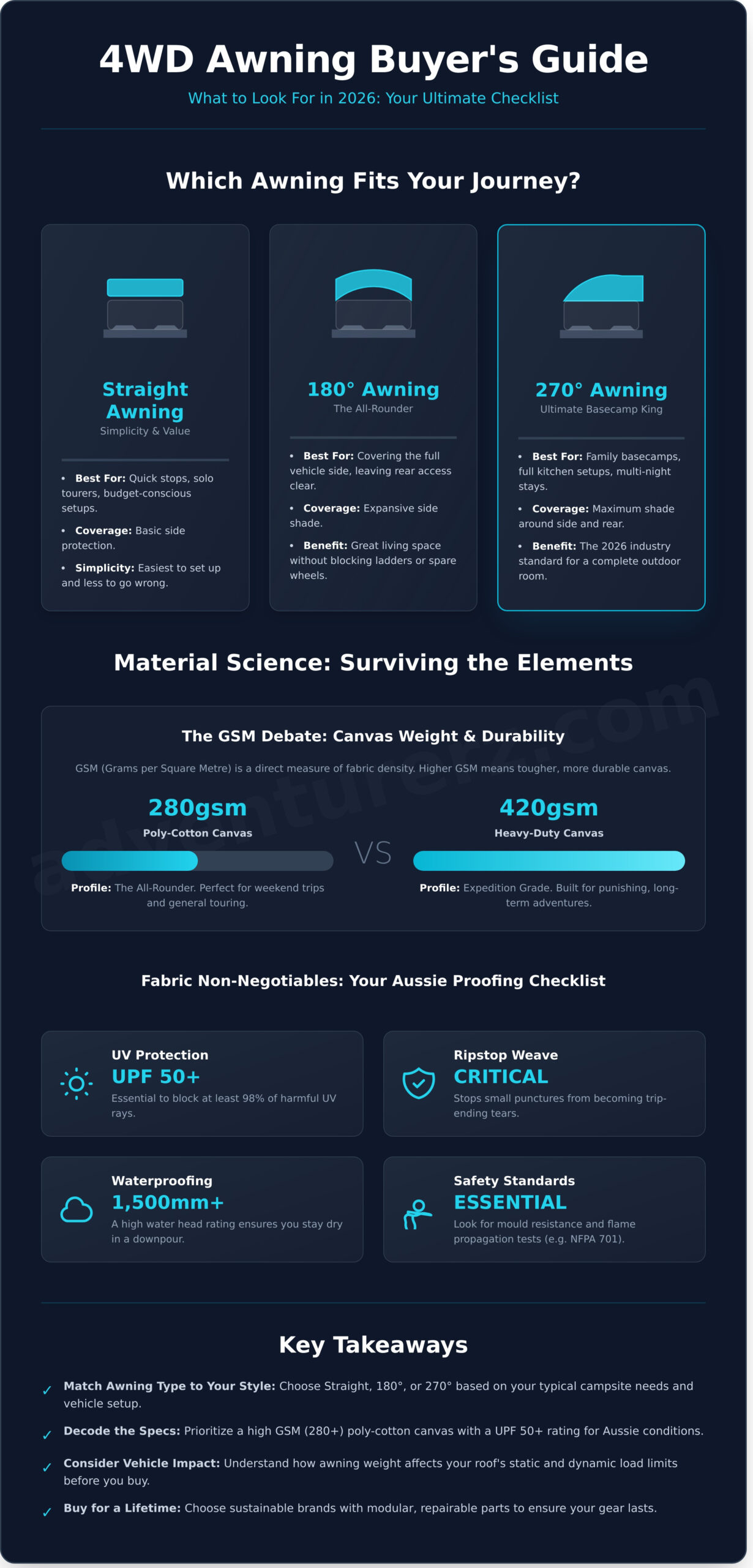
Alright Adventurerz, let’s get straight to it! Choosing your 4WD awning is one of the most exciting gear decisions you’ll make. It’s your instant shelter from the scorching Aussie sun or a sudden downpour, creating a comfortable living space wherever you park up. But before we dive into fabrics and brackets, the first question is always about shape and coverage. Fundamentally, awnings fall into three main categories, and understanding the basics of different Vehicle and Camping Awnings is the first step. Deciding between a straight, 180-degree, or 270-degree model is the cornerstone of figuring out what to look for in a 4wd awning that perfectly matches your adventure style.
The Classic Straight Awning: Simplicity and Value
The trusty straight awning is the go-to for so many of us, and for good reason! It’s the epitome of simplicity and value, making it a fantastic first awning. Perfect for quick lunch stops on the track or for budget-conscious weekenders, its no-fuss rectangular design gets the job done efficiently. While it can act like a sail in heavy winds if not pegged down properly, its simple mechanics mean there’s less to go wrong on a remote trip. For pure reliability, you can’t beat it!
180 vs. 270 Degree Awnings: The Wraparound Revolution
This is where the game truly changes! Wraparound awnings have transformed how we set up camp, offering incredible coverage that turns the side of your rig into a genuine outdoor room. They are the ultimate upgrade for those who spend multiple nights in one spot.
- The 180-Degree Advantage: This model is a fantastic middle-ground, swinging out to cover the entire side of your vehicle from front to back. It’s ideal for those who want massive shade without interfering with a rear-mounted spare wheel, bike rack, or ladder. It gives you a huge, protected living space right next to your passenger doors.
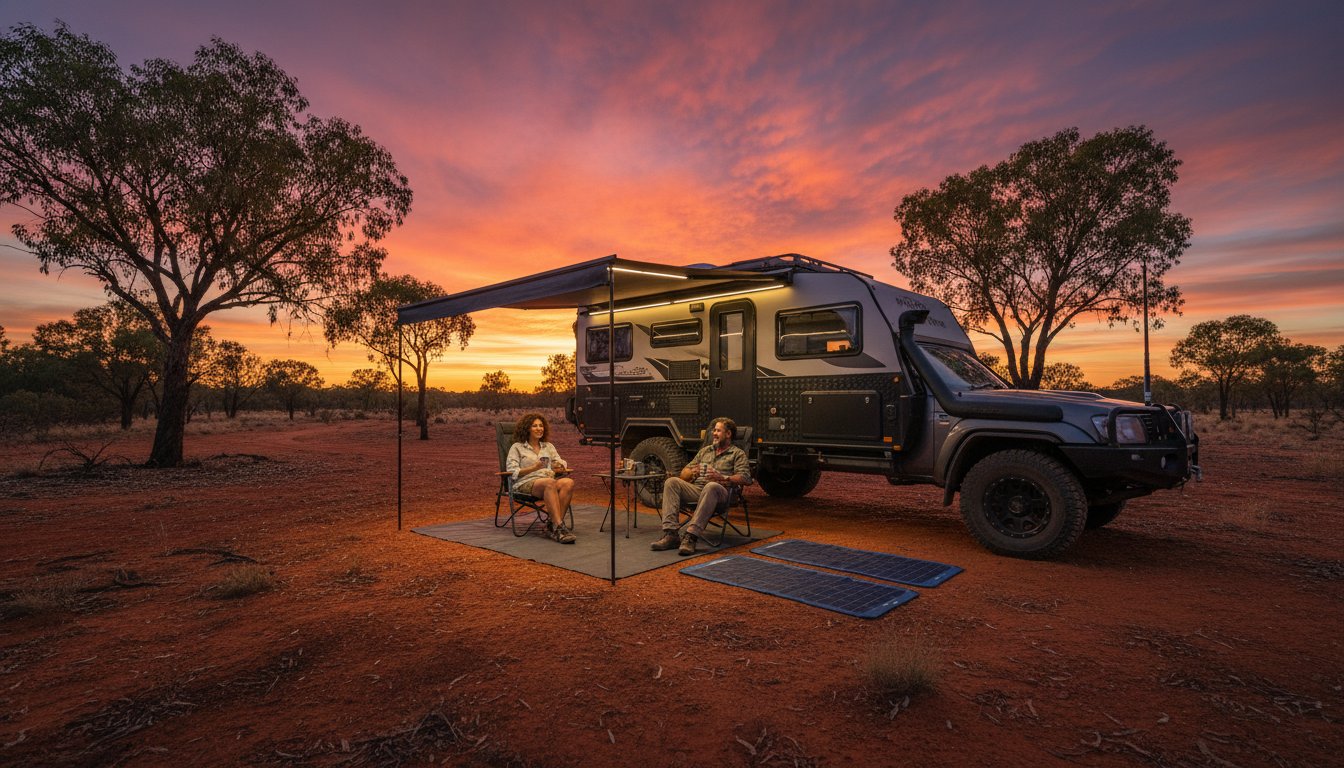
- The 270-Degree ‘King’: This is the undisputed champion for basecamp living! By wrapping all the way around to the rear, it protects your kitchen setup and your rear door access simultaneously. It’s no surprise this has become the 2026 industry standard we’re all moving towards. Just remember its ‘swing radius’-you’ll need a bit more space to deploy it in a tight campsite.
Ultimately, the right choice comes down to your footprint. How much shade do you really need? If you’re a solo tourer living out of a swag, a straight awning might be all the cover you need. But if you’re setting up a family basecamp with a full kitchen, the sprawling protection of a 270-degree awning is an absolute game-changer. Thinking about your typical setup is key to knowing what to look for in a 4wd awning.
Material Science & Durability: Surviving the Australian Elements
Your awning is your first line of defence against the relentless Aussie elements. From scorching sun to sudden downpours, the right materials make all the difference. Understanding the science behind the fabric and frame is fundamental when you’re figuring out what to look for in a 4wd awning that won’t let you down on a remote track.
Canvas vs. Synthetic: The GSM Debate
For us Adventurerz, nothing beats the performance of a high-quality poly-cotton canvas. It breathes beautifully in the heat, insulates when the temperature drops, and has that rugged, reliable feel we love. When you see weights like 280gsm vs. 420gsm, you’re looking at a trade-off. A 280gsm is a fantastic all-rounder, perfect for weekend trips and general touring. A heavy-duty 420gsm is built for punishing, long-term expeditions where maximum durability is key. While lighter synthetic options save kilos, they rarely match the long-term ruggedness of canvas. Put simply, GSM (Grams per Square Metre) is a direct measure of fabric density and longevity-the higher the number, the tougher the material.
Beyond weight, here are the non-negotiables for your awning’s fabric:
- UV Protection: A UPF 50+ rating is essential to block out at least 98% of harmful UV rays. Don’t settle for less!
- Ripstop Weave: This grid-like reinforcement woven into the fabric stops small punctures from becoming massive, trip-ending tears. It’s your insurance policy in the bush.
- Waterproofing: Look for a high water head rating (we recommend 1,500mm or more) to ensure you stay bone-dry when the sky opens up.
- Safety Standards: Premium canvases are also treated for mould resistance and often tested against benchmarks like the NFPA 701 flame propagation standards, giving you peace of mind around the campfire.
Frame Strength and Pivot Points
The fabric is only half the story; a robust frame is its backbone! Most frames use anodised aluminium for its fantastic balance of strength and low weight. The real weak point on many budget awnings, however, is the pivot joints. Look for models with heavily reinforced, cast-metal or thick nylon pivots-this is the #1 point of failure we see out on the tracks. And if you’re a coastal explorer hitting spots like Moreton Island, ensure all hardware has excellent salt-spray resistance to prevent corrosion from seizing up your setup. Awesome!
This emphasis on high-quality, genuine components to prevent failure is a principle that extends beyond camping gear; it’s critical in industrial settings where specialists like InstroDirect supply automation equipment designed for maximum reliability.
The Freestanding Debate: Convenience vs. Structural Integrity
Let’s get straight to it, Adventurerz. The allure of the “freestanding” awning is massive. We’re talking about a 30-second setup versus a 5-minute wrestle with poles and ropes. For a quick lunch on the Gibb River Road or a fast shelter from a passing shower, that speed is pure gold. But in 2026, “freestanding” doesn’t mean “invincible.” It means it can support its own weight in calm conditions-a crucial distinction.
The hidden danger is the unpredictable Australian gust. A sudden southerly buster can turn an expensive freestanding awning into a twisted wreck, potentially damaging your vehicle in the process. This is why understanding the frame is a critical part of what to look for in a 4wd awning. A truly “pole-less” capable frame features beefy, oversized aluminium box-section arms and reinforced hinges designed to resist twisting forces. Cheaper designs will bend and fail where it counts.
When to Go Freestanding
So, when is the convenience worth the risk and the extra weight? Freestanding models shine in specific scenarios. They are significantly heavier than their poled counterparts, so always factor that into your GVM and roof load limits. Consider one if you are:
- A Rapid Mover: Constantly on the go, stopping for short periods where a full setup is overkill.
- A Beach Explorer: Perfect for pulling up on the sand for a few hours without wanting to hammer in pegs.
- A Solo Traveller: The ease of a one-person deployment is a massive psychological and practical win.
The Role of Integrated Poles and Guy Ropes
Here’s our non-negotiable advice: even with the toughest freestanding awning, if you’re setting up for the night or the wind hits 15-20km/h, use the poles! Think of them not as a hassle, but as essential insurance. For winds over 40km/h, you’ll need advanced techniques like running two guy ropes from each corner pole at opposing 45-degree angles for maximum stability. And while integrated LED lighting is a fantastic feature for 2026 setups, remember it’s a luxury. A strong, reliable frame that you know how to secure properly is the true necessity.
Mounting, Weight, and Vehicle Dynamics: What No One Tells You
Alright, fellow Adventurerz, let’s get into the nitty-gritty. You’ve picked the fabric and size, but how you bolt that new slice of shade to your rig is just as crucial. This is a key part of what to look for in a 4wd awning that often gets overlooked until it’s too late. Your vehicle has two roof load limits: static (when parked) and dynamic (when bouncing down a track). That 15-30kg awning adds to your dynamic load, which also includes your roof rack, jerry cans, and anything else up top. This extra weight, sitting high, will raise your vehicle’s centre of gravity, impacting handling on and off-road, and will slightly affect your fuel economy. Get it wrong, and you risk serious vehicle damage or worse.
Roof Rack Compatibility and Brackets
Not all mounting kits are created equal! While many awnings come with “universal” L-brackets, be wary. Cheaper, thinner brackets can suffer from metal fatigue on corrugated Aussie roads and fail when you least expect it. We recommend heavy-duty steel brackets (at least 3-4mm thick) or, even better, a brand-specific system designed to integrate perfectly with your roof rack. Planning a full touring setup? Getting your mounting right is the first step, especially if you’re pairing it with a tent. For more on that, check out our complete Rooftop Tent Buying Guide.
The RTT Integration Challenge
Combining a 4WD awning with a Roof Top Tent (RTT) is the ultimate setup, but it requires some clever thinking. The biggest challenge? Clearance. You need to mount your awning so it doesn’t block your tent’s ladder or foul the opening mechanism. Specialised “awning extender” brackets can lift the awning up and out, providing the clearance needed for hard-shell RTTs. Also, consider rain. Positioning your awning slightly lower than the edge of your RTT can create a brilliant channel for runoff, keeping your tent entrance dry during a downpour. It’s these little details that make a good setup a great one!
Making the Sustainable Choice: Awnings That Last a Lifetime
Here at Adventurerz, our philosophy is simple: buy once, buy right. The best way we can protect the stunning Aussie landscapes we love is by reducing our footprint, and that starts with gear that doesn’t end up in a landfill after two seasons. A quality 4WD awning isn’t just an expense; it’s an investment in countless future adventures. It’s about choosing a system that grows with you, from quick weekenders at the Glass House Mountains to epic treks across the Simpson.
Modularity and Repairability
We champion brands that offer a full catalogue of spare parts. Why? Because a freak gust of wind that snaps a single pole shouldn’t mean replacing your entire A$900 setup. When deciding what to look for in a 4wd awning, check if you can easily buy a replacement canvas, arm, or even a hinge. A robust repair culture beats a “replace-only” warranty every single time. Always pack a simple field repair kit-gaffer tape, heavy-duty zip ties, and a multi-tool can save a trip!
Building a brand that adventurers trust involves more than just great products; it requires a smart online strategy to make those parts and that support easily accessible. For those interested in how specialized gear companies grow their online presence, you can discover Ecom Expedition – Your Growth Partners.
The Adventurerz Verified 5-Point Checklist
Before you tap your card, run your potential purchase through our final test. This is the checklist that separates the long-haul legends from the campsite disappointments.
- Parts Availability: Can you easily source a replacement part online or from an Australian stockist?
- Build Quality: Are the fittings stainless steel and the brackets solid alloy? Plastic components are a major red flag for longevity.
- Fabric Strength: Is the canvas a heavy-duty, mould-resistant poly-cotton (at least 280GSM) with a solid waterproof rating?
- Ecosystem Potential: Does the brand offer compatible walls, annex rooms, or organisers? This allows your setup to evolve with your needs.
- Proven Performance: Has it survived real-world Aussie conditions? Don’t just trust the marketing copy.
The Adventurerz Community Verdict
This is where the rubber really hits the road. Generic global reviews can’t tell you how an awning holds up to the salty air at Scarborough or a sudden summer storm over the Redcliffe Peninsula. Our community of Adventurerz provides honest, on-the-ground feedback about what truly works in our unique QLD conditions. Their experience is the ultimate tie-breaker when choosing your gear. Ready to get the inside scoop? Join the Adventurerz community for more gear deep-dives!
Your Next Great Escape Starts with the Right Shelter
We’ve covered a lot of ground, from decoding material science for our harsh Aussie elements to weighing up the convenience of a freestanding setup against the rugged stability needed for a coastal southerly. Ultimately, understanding what to look for in a 4wd awning comes down to matching the gear to your unique style of adventure and committing to a sustainable choice that will last for years of exploration.
But the journey doesn’t end here! The absolute best gear is tried and tested by fellow Adventurerz. That’s why we’ve teamed up with the Scarborough 4WD community to bring you expert reviews you can trust. We focus on sustainable, long-lasting gear built tough for Australian coastal and remote conditions. Ready to see what the pros are running? Explore our community-recommended 4WD gear reviews and join the conversation!
Get out there and make some memories. Your perfect patch of shade is waiting!
Frequently Asked Questions
Can I install a 4WD awning by myself, or do I need a professional?
Absolutely! Most 4WD awnings are designed for a straightforward DIY installation, and it’s a great way to get familiar with your gear. We always recommend grabbing a mate to help, as lifting the awning onto your roof rack can be tricky solo. Just make sure your roof rack is compatible and follow the manufacturer’s instructions carefully. You’ll have it sorted in an afternoon, ready for your next adventure. No need for a professional unless you’re not confident with the tools!
How do I stop my awning from flapping and making noise in the wind?
A noisy, flapping awning can be a real mood-killer! The key is to get it drum-tight. Always use your guy ropes and peg them out at a good angle to create solid tension. For extra windy conditions, consider investing in anti-flap kits or de-flappers. These handy devices clamp onto the edges of the fabric, securing it to the horizontal poles and stopping that annoying flapping noise in its tracks. A quiet setup is a happy setup!
What is the best way to clean and store my awning to prevent mold?
Great question, as proper care is crucial! The golden rule is to never store your awning while it’s wet. If you have to pack up in the rain, make sure you roll it out to dry completely within 24-48 hours. To clean, use a soft brush and a gentle, pH-neutral soap with water. Avoid harsh chemicals that can damage the waterproof coating. A well-maintained awning is a long-lasting one, ready for countless trips into the Aussie bush.
Are 270-degree awnings legal to have overhanging on the side of my vehicle?
This is a big one for us Adventurerz! In Australia, vehicle dimension regulations are strict. Generally, any load can’t overhang more than 150mm from the side of your vehicle. Most 270-degree awnings are designed to sit within this limit when packed away. However, it’s always your responsibility to measure your specific setup and check with your state’s road authority, as rules can vary slightly. Stay safe and stay legal on the tracks!
Do I need to upgrade my suspension if I add a heavy 270-degree awning?
That’s a smart thing to consider. A heavy 270-degree awning (some are 25kg+) adds significant weight, especially when combined with a steel roof rack. While the awning alone might not require a suspension upgrade, it contributes to your Gross Vehicle Mass (GVM). If you’re also carrying bull bars, winches, and drawers, you could be pushing your limits. We recommend getting your rig weighed at a public weighbridge to be sure. Safety first, always!
Can I use a 4WD awning on a small SUV or canopy, or are they only for large 4x4s?
You bet! Awnings aren’t just for big 4x4s. Many smaller, lighter pull-out awnings are perfect for small SUVs, wagons, or utes with canopies. The most important factor when considering what to look for in a 4wd awning for a smaller vehicle is weight. Check your vehicle’s roof load limit and choose a lightweight model that won’t overload it. It’s all about matching the gear to your specific rig for the best and safest adventures.
What happens if my awning gets wet? Can I pack it away immediately?
We’ve all been there – a sudden downpour just as you’re packing up! You can pack a wet awning away for the short trip home, but it’s critical that you open it up to dry completely as soon as you can, ideally within a day. Leaving it rolled up wet is a one-way ticket to mold and mildew, which can permanently damage the fabric and its waterproofing. A little effort back home ensures your gear is ready for the next trip.
Is there a difference between a “caravan awning” and a “4WD awning”?
Yes, there’s a big difference! The main distinction in what to look for in a 4wd awning versus a caravan one is the mounting system. Caravan awnings typically slide into a ‘sail track’ or ‘rope track’ fitted to the side of the van. 4WD awnings are self-contained in a bag or case and are designed to bolt directly onto a roof rack or roof bars. They are built to be more rugged and handle the vibrations of off-road travel.