If your gear cannot survive a week strapped to a dusty 4WD in forty-degree heat, it simply does not belong on your remote adventure packing list. We have all felt that nagging worry while heading off the grid; will a bargain board actually hold its air, or will the harsh Australian sun turn those glued seams into a sticky mess by lunchtime? You deserve equipment that matches your spirit for exploration without the constant fear of punctures or UV degradation ruining your time on the water.
Our community of explorers has spent months testing the best inflatable paddle boards Australia has to offer for 2026. We have pushed these iSUPs to their limits in rugged conditions to ensure they provide the rigidity of a traditional hardboard while remaining compact enough for van life. Whether you are looking for the latest thermal-welded rail technology or a lightweight hybrid for your next coastal trek, we are here to guide you toward a reliable choice. In this review, we will dive into the newest 2026 standards for durability, compare the top-performing models for stability, and explain the critical safety regulations you need to know before hitting the water.
Key Takeaways
- Learn how to maximize your 4WD storage by swapping bulky hardboards for high-performance inflatables that fit perfectly alongside your roof top tent.
- Discover why heat-welded seams are essential for the best inflatable paddle boards australia to ensure your gear survives extreme 40°C+ temperatures without failing.
- Identify the right board category for your mission, whether you’re seeking a stable family all-rounder or a streamlined touring board for multi-day treks.
- Check your technical requirements for remote travel, including weight capacities for heavy gear and tool-less fin systems for easy setup at the water’s edge.
- Explore the logistics of integrating your iSUP into a remote camping setup using 12V electric pumps powered by your vehicle’s dual-battery system.
Table of Contents
- Why Inflatable Paddle Boards (iSUPs) are Essential for Australian Road Trips
- Decoding iSUP Construction: What Survives the Australian Elements?
- Choosing Your Ride: Top iSUP Categories for Australian Conditions
- The Australian iSUP Buying Checklist: Performance and Durability
- Integrating Your iSUP into the Ultimate 4WD Camping Setup
Why Inflatable Paddle Boards (iSUPs) are Essential for Australian Road Trips
Exploring the red dirt tracks and turquoise coastlines of Australia requires gear that can keep up. For many of us, the roof rack is already a crowded piece of real estate. Between recovery tracks, fuel cans, and your roof top tents, there is rarely room left for a 10-foot fiberglass board. This is where the best inflatable paddle boards australia has to offer change the game. They pack down into a bag no larger than a hiking pack, sliding easily into your drawer system or behind the driver’s seat.
While the history of stand-up paddleboarding shows a sport rooted in solid timber and foam, modern technology has moved toward high-pressure inflatables. We aren’t talking about the flimsy ‘toy’ boards you see in department stores that bend like a banana. Professional-grade iSUPs are built with thousands of internal threads and welded seams, making them feel as rigid as a plank of wood underfoot. For the self-reliant explorer, this means you can access remote billabongs or hidden bays that are completely unreachable with a trailer or a bulky hardboard.
To better understand why we prioritize certain designs for our rugged landscape, watch this breakdown of top-performing models:
ISUP vs. Hardboard: The Verdict for Remote Travel
When you’re miles from the nearest town, gear failure isn’t just an inconvenience; it’s a trip-ender. We prefer inflatables for remote travel for several practical reasons:
- Impact Resistance: Unlike fiberglass, which cracks if it hits a rock at a river launch, an iSUP bounces off obstacles.
- Weight: Most high-end boards weigh between 7kg and 11kg, making them easy for a solo traveler to carry down a steep track.
- Storage: You don’t need a massive garage or a custom rack. You can store your board in a van, a compact SUV, or even under a 4WD awning during a rain shower.
The Environmental Edge of Quality Gear
We believe in buying gear once and using it for a decade. Cheap, disposable boards often end up in landfills after a single season because their glue fails in the Aussie heat. By choosing the best inflatable paddle boards australia provides, featuring welded seams and UV-resistant materials, you reduce your environmental footprint. High-quality construction prevents microplastic shedding and ensures that your exploration of sensitive aquatic ecosystems remains responsible and sustainable. We want our community to leave nothing but ripples behind.
Decoding iSUP Construction: What Survives the Australian Elements?
Australia’s climate is a brutal testing ground for outdoor equipment. A board that performs perfectly in a cool European lake can quickly delaminate when strapped to the roof of a 4WD in the Kimberley. To find the best inflatable paddle boards australia offers, we have to look past the bright graphics and interrogate the engineering. We prioritize military-grade PVC with high denier ratings, usually 1000D or higher, to handle the abrasive sand and rocky launches typical of our remote waterways. Without a robust outer skin and UV-resistant coatings, the harsh Southern Hemisphere sun will degrade the material long before you’ve finished your first season of exploration.
The core of any quality board is its drop-stitch density. This internal architecture consists of thousands of polyester threads connecting the top and bottom layers. Cheaper “big box” boards often cut corners here, using fewer threads per square inch. This results in the “taco” effect, where the board bows under your weight, killing your glide and stability. If you’re still mapping out your summer route, check our latest adventure ideas in Australia to find the perfect launch spot where a rigid, high-density board truly shines.
Thermal Welding: The Heat-Proof Standard for 2026
Traditional boards rely on chemical glues to hold their seams together. On a forty-degree day, that glue can become viscous, causing the high-pressure air inside to force the seams apart. This is why we advocate for thermal welding. This process uses heat to fuse the layers of PVC together into a single piece. Welded Seam Technology is the industry gold standard for 2026, creating a permanent mechanical bond that effectively turns two pieces of PVC into a single, indestructible layer. It’s a “forever bond” that won’t creep or fail, even if your board is sitting in the sun while you set up camp.
Stiffness and PSI: Achieving Hardboard Performance
Rigidity is the direct result of internal pressure. While many boards claim to be stiff, the best inflatable paddle boards australia has tested are those that maintain their shape at 15-18 PSI. This is the “sweet spot” for most Australian paddlers, providing enough tension to mimic a hardboard without putting unnecessary stress on the valves. Modern dual-layer fusion technology has made this easier to achieve. By laminating the second layer of PVC directly onto the drop-stitch core during manufacturing, brands have stripped away the weight of manual gluing while increasing overall structural strength. You get a board that is lighter to carry but feels like a solid platform once you’re on the water.
Choosing Your Ride: Top iSUP Categories for Australian Conditions
Selecting the best inflatable paddle boards australia has available requires an honest assessment of your mission. We don’t all need a high-speed racing machine, just as we don’t all need a massive board built for three people. Whether you are navigating the intricate mangrove systems of the Top End or paddling through the crystal-clear waters of a southern bay, your board’s shape dictates your experience. In our community of explorers, we categorize gear by its utility in the field, ensuring you don’t end up with a board that’s too unstable for the family or too slow for a long-distance trek.
The All-Rounder: Stability Meets Versatility
For most adventurers, the all-rounder is the ultimate quiver-of-one. These boards typically measure around 10’6″ in length and 32″ in width, providing a stable platform for beginners while remaining maneuverable for those with more experience. We recommend a rounded nose for these boards because it handles the unpredictable coastal chop of our beaches far better than a narrow, pointed tip. It’s the “go-anywhere” choice that fits perfectly under your 4WD awning at the end of a long day on the tracks. If you want a board that can handle a light surf session in the morning and a calm river cruise in the afternoon, this is your category.
Expedition and Touring: Covering Distance Responsibly
When the goal is to disappear into a remote waterway for a few days, you need a touring board. These are longer, usually 12′ or more, and feature a pointed nose designed to pierce through wind-chop rather than riding over it. The increased length provides better “tracking,” which means the board stays straight with fewer stroke corrections. This efficiency is vital when you are carrying a full load of gear. We prioritize touring boards with ample D-rings and bungee systems to secure “Leave No Trace” camping kits. Being able to carry your own water and waste out of sensitive ecosystems is a hallmark of a responsible explorer.
Beyond these two staples, the best inflatable paddle boards australia provides also include specialized categories for specific hobbies. Fishing-specific iSUPs offer extra width (often 34″ or more) and mounting points for rod holders, making them a silent and stable way to chase barra in remote estuaries. Conversely, compact or travel boards use split deck pads and thinner materials to fold down into half the size of a standard iSUP. These are the “secret weapons” for hikers or those with small vehicle setups who still want to access the water without compromising on their roof top tents or other essential equipment.
The Australian iSUP Buying Checklist: Performance and Durability
Self-reliance in the outback starts with a rigorous checklist. When we evaluate the best inflatable paddle boards australia provides, we look beyond the board itself to the ecosystem of gear that supports it. You need to ensure your board’s weight capacity accounts for more than just your body weight; factor in another 15kg to 20kg for camping dry-bags and water supplies. We also prioritize tool-less fin systems for remote convenience. Losing a tiny fin screw in the sand at a remote campsite can end your session before it begins, so look for “click-in” or “smart-lock” designs that require no extra hardware.
Safety is non-negotiable on our open waterways. As of 2025, the Australian Standard AS 4758 is the required standard for all new personal flotation devices (PFDs). Whether you are paddling 400m from shore in Victoria or exploring the Western Australian coast, carrying a compliant lifejacket is often a legal requirement. We recommend choosing a low-profile, Level 50S PFD that allows for a full range of motion while you paddle. To ensure you’re fully prepared for your next trip, check out our latest camping equipment reviews and recommendations for more expert-tested gear.
Essential Accessories for the Remote Adventurer
A high-performance board is only as good as the tools you use to power it. We’ve found that investing in a carbon fiber paddle is the single best upgrade you can make. On a 5km trek to a hidden billabong, every gram counts, and carbon is significantly lighter than fiberglass. This reduction in weight saves your shoulders from fatigue during long expeditions. Your carry bag also needs to be up to the task. Look for heavy-duty bags with thick backpack straps and oversized wheels that can handle gravel, dirt, and sand without seizing up. Finally, never head off-grid without a field repair kit containing PVC patches, a valve wrench, and high-grade waterproof adhesive.
The ‘Aussie Sun’ Maintenance Routine
Our sun is relentless. Even the highest quality PVC can suffer if mistreated. You should never leave a fully inflated board in direct sunlight on your roof rack next to your roof top tents. The air inside expands as it heats up, which can stress even the strongest seams. We suggest dropping the pressure by 2 to 3 PSI if the board is sitting out of the water for an extended period. Always rinse your board with fresh water after a salt-water session to preserve the deck pad and prevent salt crystals from jamming the valves. For long-term storage, keep the board loosely rolled in a cool, dry place at around 5 PSI to maintain its shape without overstretching the material.
Integrating Your iSUP into the Ultimate 4WD Camping Setup
Building the ultimate touring rig is a game of millimeters. We know how it feels to try and squeeze one last piece of gear into a packed canopy or a crowded tray. By choosing the best inflatable paddle boards australia provides, you reclaim that precious roof space usually reserved for rigid boards. This allows you to prioritize high-profile essentials like roof top tents without sacrificing your ability to explore the water once you reach camp. We’ve tested these setups across the Nullarbor and through the Kimberley to ensure they survive the vibration of corrugated roads.
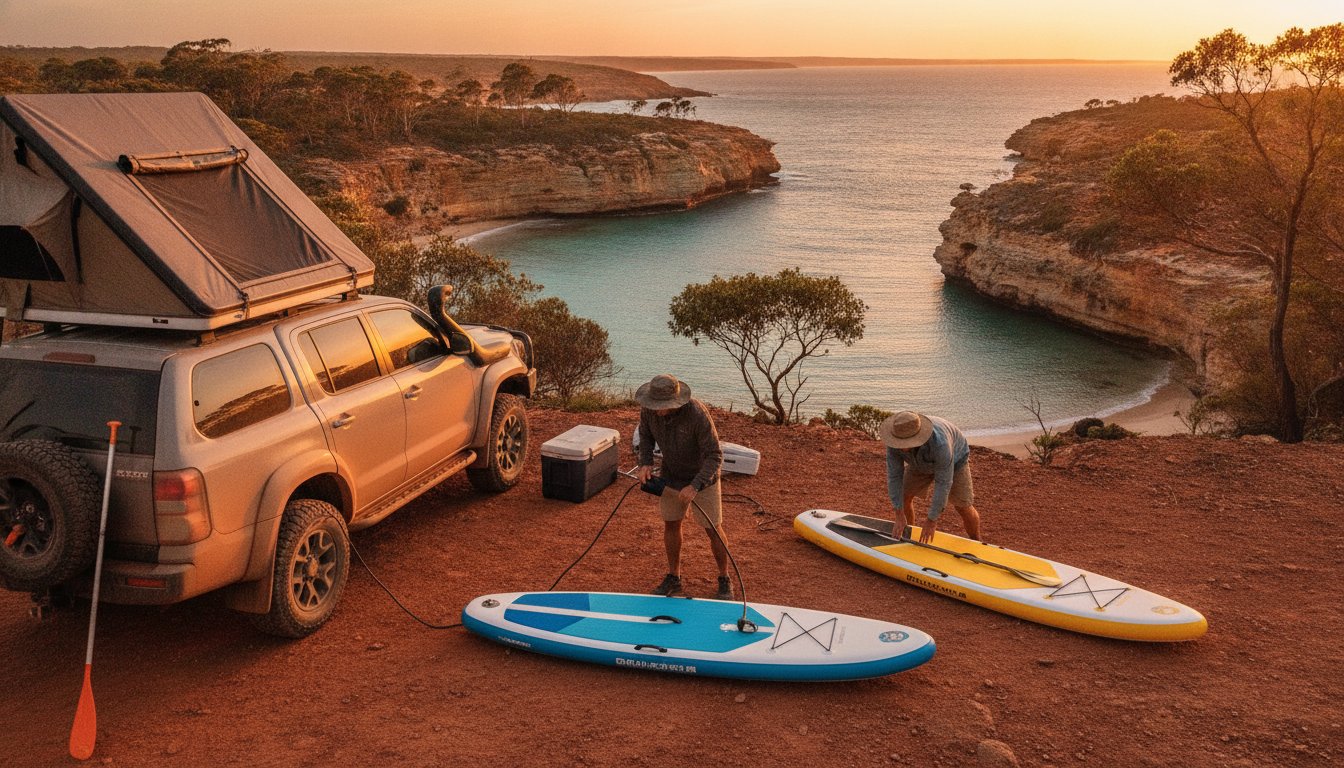
Efficiency in the field is everything. Instead of wasting energy with a manual pump in the midday heat, we recommend utilizing a high-pressure 12V electric pump. Most modern dual-battery systems can easily handle the current draw required to reach 15-18 PSI in under ten minutes. This hands-free approach lets you focus on organizing your dry bags or checking local conditions while the pump prepares the best inflatable paddle boards australia has to offer for 2026. It’s about working smarter so you have more time for the actual exploration.
The 4WD Connection: Gear Synergy
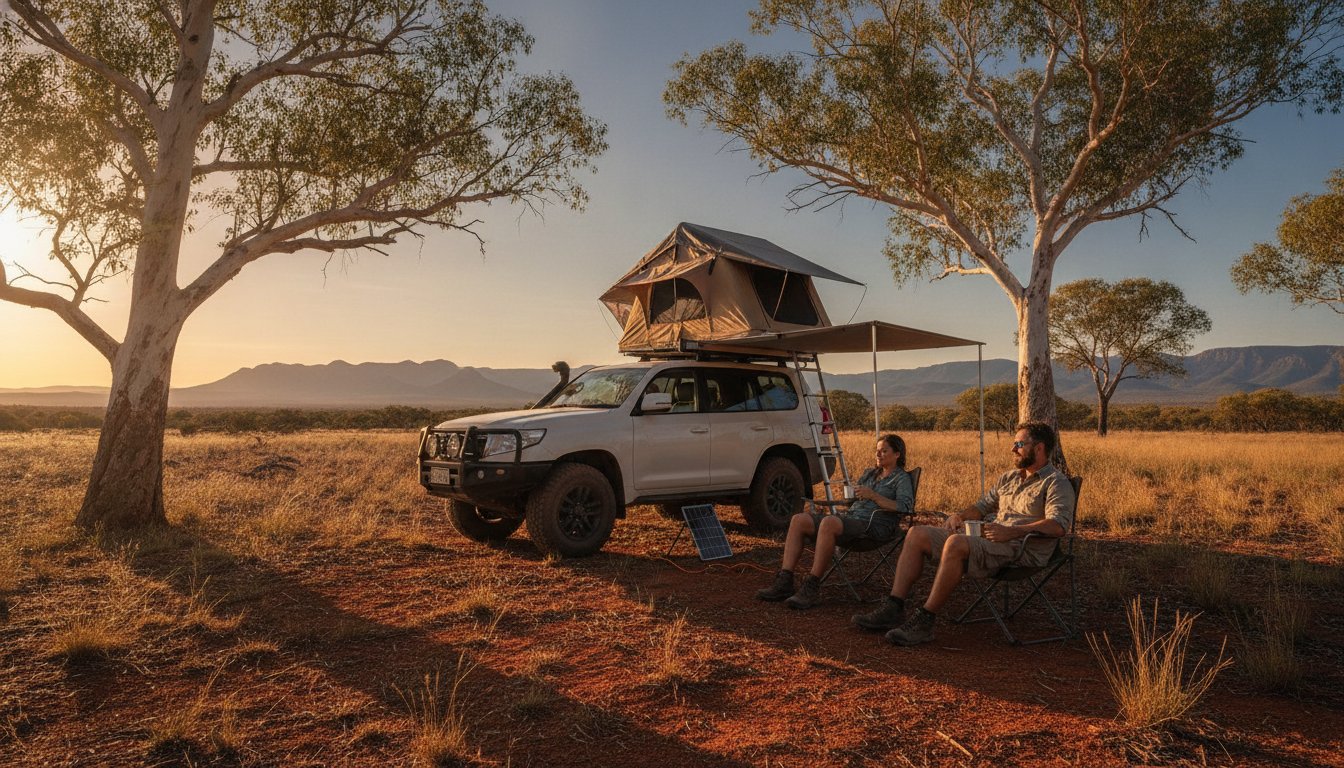
Your vehicle is more than just transport; it is your basecamp. We love using a 4wd awning as a dedicated staging area for board preparation. It provides essential shade to prevent the PVC from overheating during inflation and gives you a clean, sand-free surface to work on. If you are moving between nearby campsites, you can securely strap an inflated board to your roof rack for short distances, provided you use wide cam-lock straps to avoid crushing the rails. Don’t overlook the versatility of an iSUP around camp either. We have seen plenty of clever community members use their boards as an insulated camp bed or a comfortable lounge for afternoon reading. It is a fantastic multi-use gear hack that adds extra value to your setup.
Planning Your Next Water-Based Escape
Remote exploration requires methodical preparation. We suggest using The Ultimate Adventure Travel Planner to identify inland waterways and hidden coastal entries that are off the beaten track. When you are paddling in regions with no mobile reception, always carry a PLB (Personal Locator Beacon) or a satellite communication device. Tell someone your expected return time and stick to your plan. Safety protocols are the foundation of self-reliance.
Sustainable exploration is at the heart of what we do. We must respect the delicate balance of Australian aquatic life, from nesting shorebirds to the apex predators that call our northern estuaries home. Always practice ‘Leave No Trace’ principles by packing out all waste and avoiding contact with sensitive vegetation. We are a community of responsible explorers, and our impact on these environments should be non-existent. Ready to show off your latest discovery? Share your 2026 paddling photos with our network and help us inspire the next generation of adventurers.
Ready to Launch Your 2026 Coastal Expedition?
Choosing the right gear is the difference between a failed seam in the outback and a decade of flawless, sun-drenched adventures. We have explored why thermal-welded construction is non-negotiable for our climate and how the right board category can transform your 4WD setup into a truly mobile basecamp. Finding the best inflatable paddle boards australia offers is ultimately about securing a rugged piece of equipment that facilitates self-reliance in our most isolated locations.
Our community relies on expert gear reviews by Australian adventurers to navigate the confusion of price versus quality. We remain committed to a sustainability-first approach to travel, ensuring our presence on the water preserves these pristine environments for the future. With community-vetted recommendations at your back, you are ready to push further into the wild. It is time to leave the crowded beaches behind and find your own path.
Are you prepared to map out your next mission? Plan your next remote escape with our Ultimate Adventure Travel Planner and join our network of explorers. We can’t wait to see where your new board takes you.
Frequently Asked Questions
Are inflatable paddle boards as good as hardboards for Australian conditions?
Modern iSUPs with thermal-welded seams and high-density drop-stitch are arguably better for our rugged terrain. They offer superior impact resistance against rocks and logs in remote waterways where fiberglass would easily crack. While hardboards have a slight edge in pure speed, the portability and durability of the best inflatable paddle boards australia has available make them the superior choice for 4WD touring and remote coastal exploration.
How long do inflatable paddle boards actually last in the sun?
A high-quality board with UV-resistant coatings and welded seams can last over ten years with proper care. Cheap, glued boards often fail within two seasons due to UV degradation and heat-induced seam creep. We recommend choosing gear built with military-grade PVC and keeping it shaded whenever you aren’t on the water. This longevity is better for your wallet and significantly more sustainable for our planet.
Can I leave my iSUP inflated on top of my 4WD?
You can for short trips, but you must take precautions. Never leave a board at maximum PSI on your roof in the midday heat, as the air inside expands rapidly. We suggest dropping the pressure by 2 or 3 PSI to allow for this expansion. Always secure it with wide cam-lock straps rather than thin ratchets to avoid crushing the rails or damaging the internal drop-stitch structure during transport.
What is the best PSI for an inflatable paddle board in hot weather?
We find that 15 to 18 PSI is the ideal range for performance and safety. In extreme Australian heat, aim for the lower end of that scale if the board will be sitting out of the water for an extended period. High-quality boards are rated for higher pressures, but staying around 15 PSI provides plenty of rigidity while giving the seams a safety margin as temperatures climb throughout the afternoon.
Do I need a special permit to paddle in Australian National Parks?
Generally, you don’t need a specific permit for the board itself, but park entry fees and vessel registration rules still apply. If you attach a motor, you must register it according to state laws. Always check local regulations, as some sensitive catchments or remote alpine lakes may have seasonal closures to protect local birdlife or water quality. We advocate for a “Leave No Trace” approach every time you launch.
Are cheap inflatable paddle boards worth it for beginners?
We generally advise against “big box” budget boards. While the low price is tempting, these boards often lack the rigidity needed for a stable learning experience, leading to frustration. They also tend to use toxic glues that fail in the heat, resulting in premature landfill waste. Investing in a mid-range board with welded seams ensures you actually enjoy the sport and own a piece of gear that lasts for years.
How do I repair a puncture on a remote trip?
Every explorer should carry a field repair kit containing PVC patches and waterproof adhesive. Start by cleaning and drying the area around the leak. Apply the adhesive to both the patch and the board, let it get tacky for a few minutes, then press them together firmly. It’s a simple process that we’ve used many times to save a trip. Always allow 24 hours for the bond to cure before re-inflating.
What is the difference between a single-layer and double-layer iSUP?
Single-layer boards are lighter and cheaper but much more prone to flexing and punctures. Double-layer boards use a second skin of PVC for vastly improved stiffness and durability. Modern “fusion” technology is the gold standard, as it laminates these layers together during manufacturing. This creates a board that is nearly as light as a single-layer but as tough and rigid as a traditional double-layer setup for your 2026 adventures.