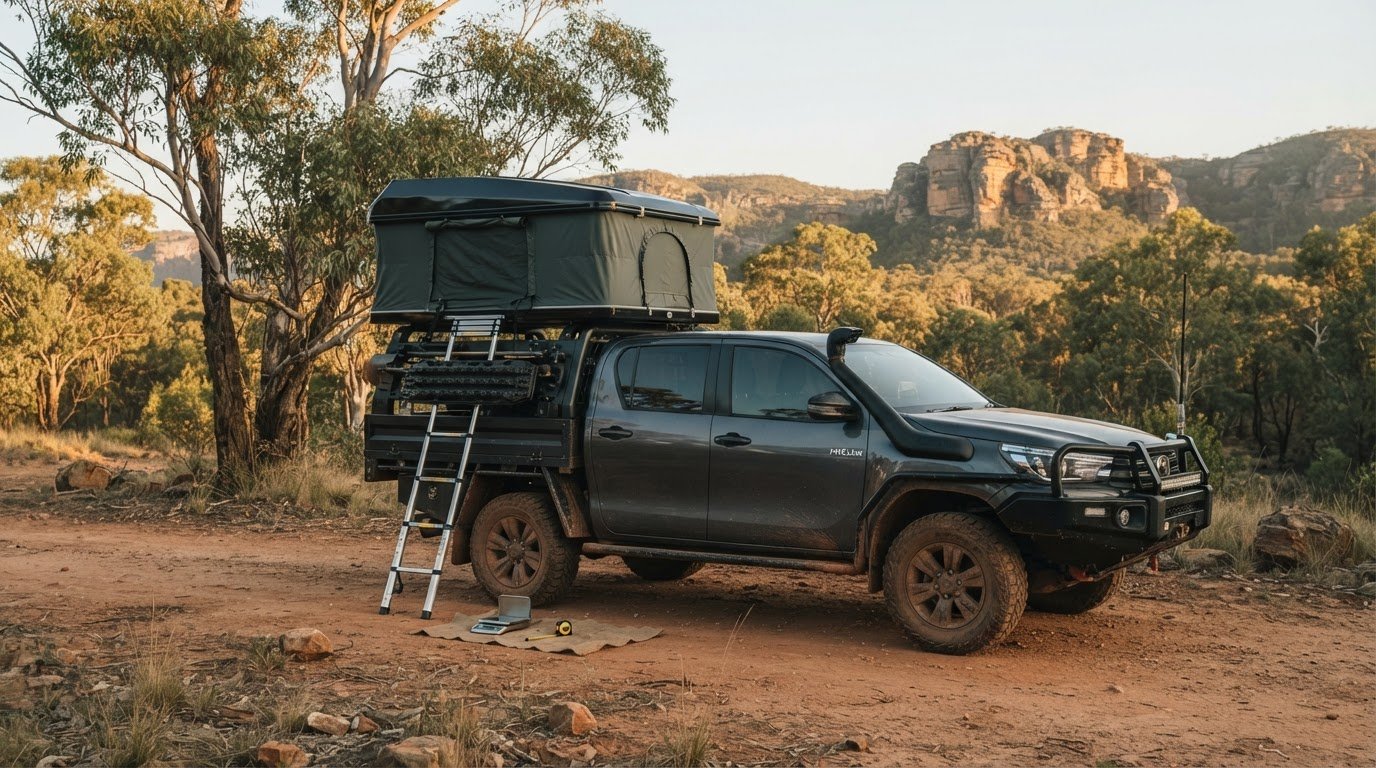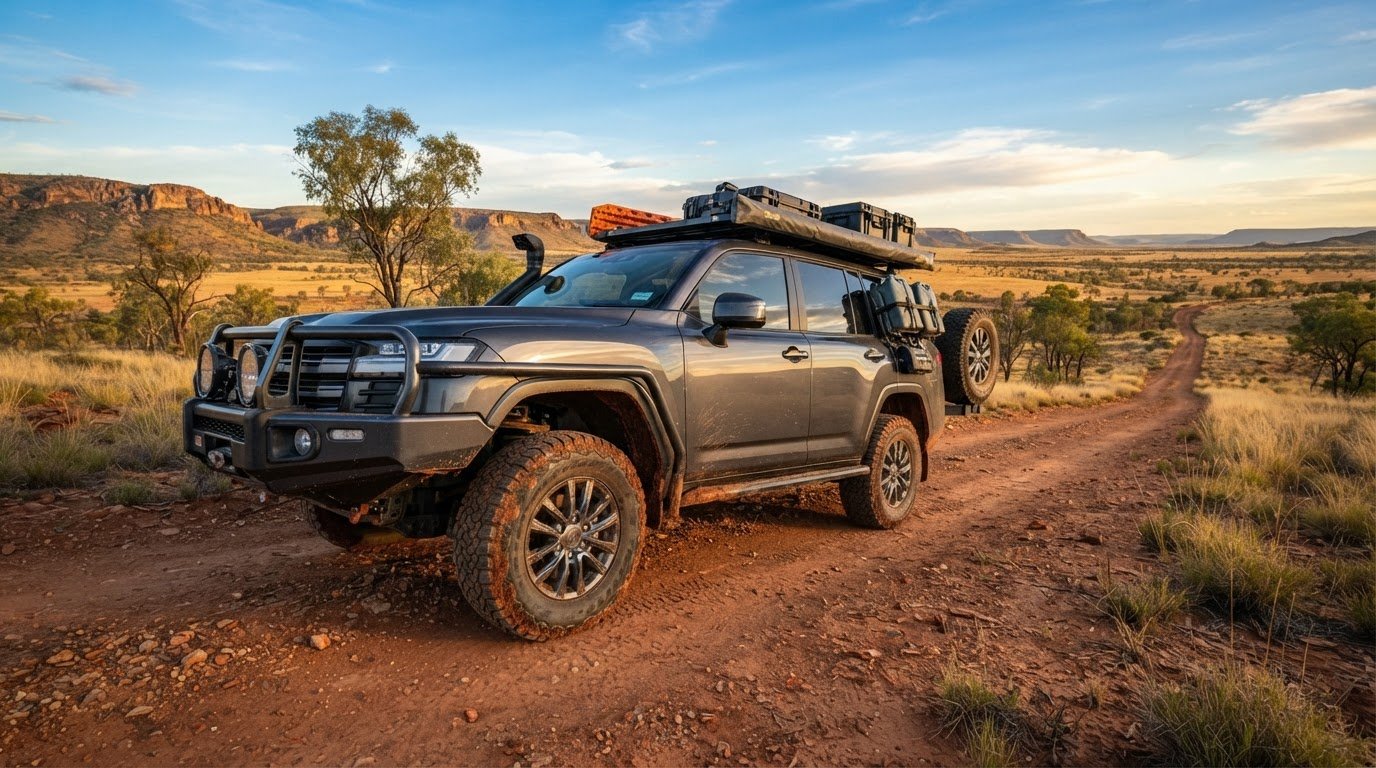
The red dust settles, the engine finally cools, and the vast outback sky begins to fill with stars. You’re exhausted after a long day on the tracks, but your camp for the night is just a few minutes away… or is it? This is where the ultimate Aussie touring debate ignites. The decision in the roof top tent vs swag for touring showdown is more critical than ever in 2026, with soaring fuel costs and strict vehicle GVM limits weighing on every adventurer’s mind. The wrong choice can mean wasted fuel, a strained vehicle, and a frustrating setup when all you want is a comfortable night’s sleep.
But don’t worry, we’re here to settle the score! In this guide, we’re diving deep to discover which iconic camping setup wins for your specific touring style. We’ll compare lightning-fast setup times for those crucial “fast-camp” transitions, analyse the impact on your fuel economy for long-range desert crossings, and determine which offers the best protection from our slithering and crawling local wildlife. Let’s get you geared up for a smarter, more efficient, and unforgettable adventure!
That view of the stars is often the highlight of any trip, offering a truly immersive connection to the cosmos. For those who want to share that sense of wonder with a larger group for an event or educational outreach, mobile planetariums can bring the universe to you. If you’re curious about how this is done, you can learn more.
Key Takeaways
- Understand how each setup impacts your GVM and your 4WD’s centre of gravity, ensuring you stay legal and safe on technical High Country tracks.
- Nail your daily touring rhythm by discovering which setup offers the fastest pack-down for those quick overnight stops versus a longer base camp stay.
- The roof top tent vs swag for touring debate isn’t just about gear; we help you match your choice to your specific adventure style, from solo explorer to family nomad.
- Find out which shelter truly excels in iconic Aussie conditions, from handling salty winds on the coast to conquering rocky ground in the mountains.
Understanding the Icons: What Defines RTTs and Swags in 2026?
Welcome, fellow Adventurerz! When we gear up for an epic journey across the red dirt and rugged coastlines of Australia, the first big question always sparks a massive debate: roof top tent vs swag for touring. This isn’t just about where you sleep; it’s a choice that defines your entire setup, your pace, and your connection to the wild. In 2026, these two touring icons represent distinct philosophies: the elevated, all-in-one luxury of a Rooftop Tent (RTT) versus the rugged, ground-level minimalism of the classic Australian Swag. Let’s break down what these shelters look like today.
The Anatomy of a Modern Rooftop Tent
The RTT has exploded in popularity, evolving far beyond a simple box on a roof rack. The core choice now lies between sleek hard-shell models, which pop up in under a minute and offer superior aerodynamics, and versatile soft-shell tents that often provide more internal space. But the real game-changer is what’s inside. We’re talking integrated features that were once pure luxury:
- Internal, dimmable LED light strips.
- Built-in USB ports for charging devices off-the-grid.
- Solar-ready roofs designed to mount flexible panels.
Thanks to advanced composites and lighter alloys, the average RTT weight in 2026 has dropped by an incredible 15%, making them a viable option for a wider range of 4WDs and even some SUVs. While the basic concept of sleeping atop your vehicle is well-established-if you’re curious about the history, you can explore the fundamentals of What is a Roof Top Tent?-today’s models are high-tech, comfortable, and incredibly fast to deploy.
The Evolution of the Australian Swag
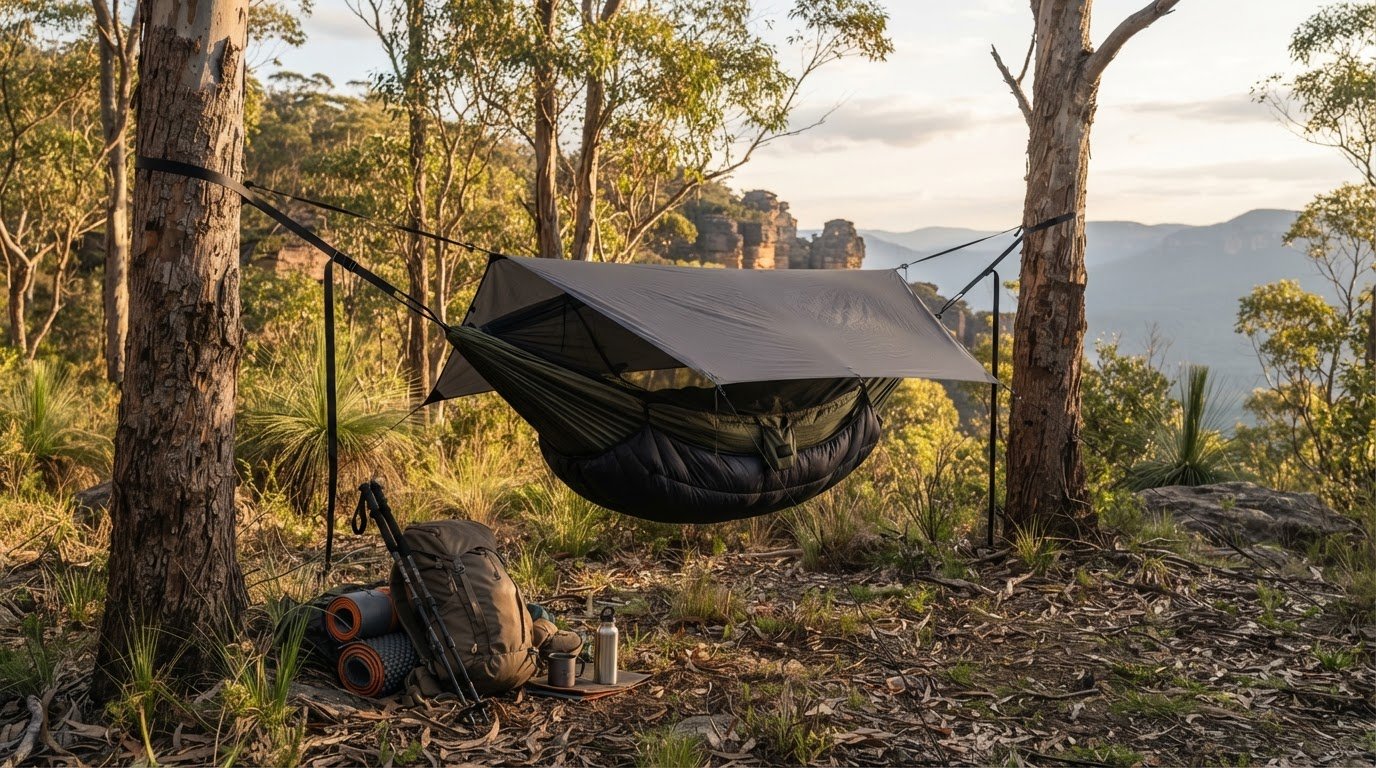
Don’t you dare think the swag has been left in the dust! This Aussie legend has evolved from a simple canvas bedroll into a high-tech micro-shelter. While traditional, heavy-duty canvas is still cherished for its unmatched durability, modern synthetic blends now offer fantastic breathability and a much lighter packed weight. They’re also quicker to dry after a morning dew. Structure is key now, with different types for different trips: Apex swags offer great headroom, Dome designs provide excellent stability in windy conditions, and classic Flat swags remain the ultimate minimalist choice.
For solo Adventurerz, the unbeatable “Swag + Awning” combination remains a firm favourite. It’s a fast, flexible, and deeply personal way to connect with the landscape, giving you a reliable shelter that can be thrown down anywhere, from a sandy riverbed to a high-country campsite.
The Technical Showdown: Weight, Aerodynamics, and Fuel Economy
Alright Adventurerz, let’s get down to the brass tacks. Beyond the campfire comfort, your choice of shelter has a massive impact on your vehicle’s performance, safety, and your wallet. This is where the real roof top tent vs swag for touring debate gets technical, and where we separate a good setup from a great one.
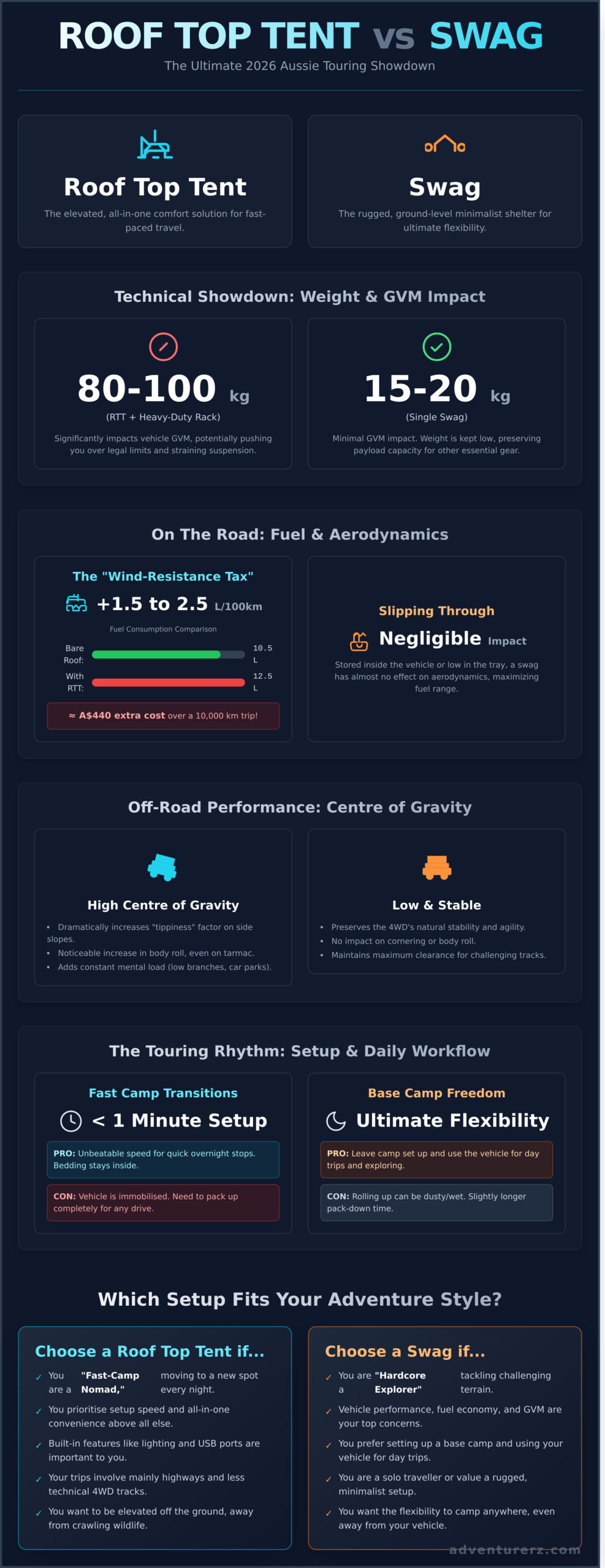
Every kilogram we add to our rigs matters, especially when it’s up high. The GVM (Gross Vehicle Mass) challenge is real! A typical hard-shell RTT, plus a heavy-duty roof rack, can easily add 80-100kg to the highest point of your vehicle. For many dual-cab utes already pushing their payload limits with bull bars, canopies, and drawers, this can be the final straw that pushes you over the legal-and safe-limit.
Vehicle Handling and Off-Road Safety
Bolting that much weight to your roof fundamentally changes your vehicle’s centre of gravity. You’ll feel it immediately as increased body roll when cornering on the tarmac. On a technical 4WD track with a steep side-angle, that higher centre of gravity dramatically increases the “tippiness” factor. It also puts extra strain on your suspension components. Plus, there’s the constant mental load of your new height-dodging low-hanging branches in the High Country or nervously eyeing the 2.1m clearance sign at the local shopping centre becomes second nature. A swag, in contrast, keeps its 15-20kg bulk low down in the tray or boot, preserving your 4WD’s natural stability and off-road agility.
Fuel Consumption and Long-Range Economics
Think of an RTT as a permanent air brake. On the open highway, this aerodynamic drag translates directly into higher fuel consumption. We’ve seen it time and again: adding a quality hard-shell RTT can increase fuel use by 1.5-2.5L/100km. We call this the “Wind-Resistance Tax,” and it adds up fast on a big lap!
- Bare Roof (e.g., Prado): 10.5L / 100km
- With Hard-Shell RTT: 12.5L / 100km
- The Cost: Over a 10,000km trip, that’s an extra 200 litres of diesel. At A$2.20/litre, you’re looking at an extra A$440 just for your sleeping quarters!
Looking ahead, with Australia’s New Vehicle Efficiency Standard starting to bite in 2026, the long-term fuel efficiency gap between a streamlined swag setup and a roof-mounted RTT will become an even more critical financial and environmental consideration for every tourer.
Terrain-Specific Performance: Where Each Setup Shines
Australia throws everything at us, Adventurerz! From the salt spray of Fraser Island to the rocky tracks of the Victorian High Country, your shelter needs to be up for the challenge. The great roof top tent vs swag for touring debate often boils down to one simple question: where are you heading next? Let’s dive into how each setup performs when the terrain gets tough.
On the beach or deep in the desert, a roof top tent (RTT) is a game-changer. It elevates you above the endless sand and dust, keeping your sleeping space clean and comfortable. That extra height is also a blessing for catching a breeze on a sweltering night in the Gibson. In the High Country, an RTT shines on uneven, rock-strewn campsites where finding a flat spot for a swag is nearly impossible-just remember to level your vehicle!
A swag, however, offers unmatched flexibility. You can unroll it in a small, sheltered nook away from the 4WD, a feat impossible for a vehicle-mounted setup. This is perfect for finding that ideal spot protected from the wind or tucked under a shady tree.
The “Croc-Factor” and Ground Safety
Up in the Tropical North, an RTT offers incredible peace of mind. Being off the ground in croc country is a non-negotiable for many, and that elevation also improves airflow, which is a huge win in the humid tropics. For our dedicated swag campers, campsite selection is absolutely critical. Always set up in a cleared area well away from the water’s edge and give those boots a good shake-out in the morning!
Wind and Weather Resilience
When a coastal gale is blowing, a low-profile swag is king. It hugs the ground, offering superb stability. An RTT can catch the wind, leading to flapping canvas and a noisy night’s sleep. During a downpour, an RTT keeps you and your bedding bone-dry inside. While a well-seasoned swag is wonderfully waterproof, packing it up wet is a classic touring challenge that can introduce moisture and condensation inside if you’re not careful.
Sustainable Tip: When re-waterproofing your canvas, we recommend choosing a modern, eco-friendly treatment. Look for PFC-free formulas that protect both your gear and the incredible environments we love to explore.
The Touring Rhythm: Setup Speed and Daily Workflow
Your touring style dictates everything. Are you constantly on the move, chasing the sunset to a new camp each night? Or do you prefer to set up a solid basecamp and explore an area for days? This daily rhythm is the ultimate test in the roof top tent vs swag for touring showdown, directly impacting your morning coffee and your evening wind-down.
Setup and Pack-Down Times
Hard-shell RTTs are the undisputed champions of speed. While the “30-second setup” is a tad optimistic once you factor in ladders and windows, you can genuinely be ready for bed in under five minutes. But their secret weapon is bedding management. Leaving your pillows and doona perfectly in place, ready to go, is a luxury you’ll appreciate every single morning. A swag is also brilliantly simple-unroll and you’re home. The challenge? The dreaded “wet swag” dilemma. After a dewy morning or a downpour, rolling up a damp, muddy canvas and storing it inside your vehicle is a ritual no one enjoys.
Mobility and Vehicle Use
Here’s where the choice becomes crystal clear for many Adventurerz. If you’re setting up a basecamp, the RTT can feel like a trap. Need to drive to a trailhead, grab some firewood, or do a quick supply run? Your entire shelter has to be packed down. It completely anchors your vehicle to your campsite.
The swag, in contrast, offers total freedom. Set it up once and your 4WD is ready for action. This is where a swag setup truly shines, especially when paired with versatile 4wd awnings to create a sprawling, comfortable living space. Your camp stays put while you explore. This liberating workflow is often the deciding factor for those choosing a swag for extended, multi-day stays in one spot.
Your workflow efficiency really boils down to this:
- RTT Workflow: Arrive, unlatch, pop up. Morning: fold down, latch, drive away. Best for transit-style touring where the camp moves daily.
- Swag Workflow: Arrive, unroll, set up camp. Morning: leave swag, go exploring. Best for basecamp-style touring where your vehicle is needed for day trips.
The 2026 Verdict: Which Setup Fits Your Adventurerz Spirit?
Alright team, we’ve broken down the nuts and bolts. After all the specs and scenarios, the great roof top tent vs swag for touring debate comes down to one thing: you. Your mission, your crew, and your connection to the Aussie bush. There’s no single right answer, but there’s definitely a right answer for your next adventure.
For the Solo Specialist, the lone wolf charting their own course, the swag remains the undisputed champion. It’s the epitome of freedom-unroll it by the fire, throw it on a riverbank, or tuck it beside your 4WD on a tight track. Its simplicity is its strength, offering a rugged, ground-level experience that’s fast, flexible, and deeply connected to the landscape.
Conversely, for the Luxury Nomad-couples and young families seeking comfort and convenience-the Roof Top Tent (RTT) is a game-changer. It’s your elevated sanctuary, a clean, spacious, and secure basecamp away from the creepy crawlies and uneven ground. It transforms your rig into a true home on wheels, making multi-week trips more comfortable and organised.
Sustainable Innovations in 2026 Gear
As Adventurerz, we have a responsibility to tread lightly. Thankfully, modern gear helps us do just that. Look for RTT shells and swag linings made from recycled PET fabrics, turning plastic bottles into durable shelters. Consider repairability, too; a classic canvas swag with replaceable poles might outlast a complex RTT with proprietary parts. Lighter materials, like aluminium frames, also reduce your vehicle’s fuel consumption, shrinking your carbon footprint one kilometre at a time.
Making the Purchase: Cost vs. Value
Your budget is a huge factor. A top-tier swag might set you back A$800, while a quality RTT starts around A$2,500 and can climb past A$6,000. However, think long-term value. An RTT often holds its resale value remarkably well, acting as a genuine asset for your vehicle. Whichever you choose, regular maintenance-seasoning canvas and checking mechanisms-is key to ensuring your gear is trail-ready for years of exploration. Ready to kit out your rig? Explore our latest Roof Top Tent reviews.
Before you swipe your card, ask yourself these five questions:
- Who’s in my crew? Am I rolling solo or bringing the family?
- What’s my touring style? Am I setting up a long-term basecamp or moving every single day?
- Where am I headed? Will I face tight, tree-lined tracks or open station country?
- What’s my vehicle’s roof load capacity? Can my rig safely handle the weight of an RTT, racks, and people?
- What does my gut say? Which setup genuinely gets me more excited to hit the road?
Ultimately, the best choice is the one that gets you out there, creating memories and exploring our incredible backyard with confidence and respect. Happy travels!
Your 2026 Touring Shelter: Which Camp Are You In?
So, what’s the final call? We’ve seen that the modern Roof Top Tent delivers unparalleled elevated comfort and a streamlined workflow, perfect for long-haul tourers who value a consistent basecamp. On the other hand, the iconic Aussie swag remains the undisputed king of rugged simplicity and versatility, ideal for solo adventurers tackling tight tracks. Ultimately, the debate over a roof top tent vs swag for touring boils down to your personal rhythm and the landscapes you chase.
But the journey to the perfect setup doesn’t end here! Our recommendations are born from real-world testing, with expert 4WD reviews from our home on the Redcliffe Peninsula and countless community-tested gear reports. We’re a tribe dedicated to sustainable Australian exploration. Join the Adventurerz community for more expert gear guides and share your own touring setup!
Whichever shelter you choose, the adventure is what matters most. Get out there, explore responsibly, and we’ll see you on the tracks!
Frequently Asked Questions
Is a roof top tent warmer than a swag in winter?
Generally, yes! Being elevated off the cold, frozen ground makes a massive difference in retaining warmth. A roof top tent’s insulated floor and enclosed space are fantastic at trapping heat. While a high-quality swag paired with a winter-rated sleeping bag is a seriously rugged setup, the RTT has a natural advantage against the seeping cold from the earth. We love that feeling of being snug and secure up high on a frosty night!
Can I put a roof top tent on any 4WD or SUV?
Not quite, but most are up to the task! The crucial factors are your vehicle’s roof load ratings-both dynamic (while driving) and static (while parked). You also need a roof rack system rated to handle the tent’s weight. Most popular Aussie 4WDs and SUVs are built for it, but always check your owner’s manual for specific limits before you buy. Safety is paramount on every adventure, fellow Adventurerz!
Do swags get moldy if packed away wet?
They absolutely can, and it’s something every swag owner needs to watch out for. Canvas is a brilliant, breathable material, but it must be completely dry before you roll it up for storage. Packing a damp swag is a surefire way to invite mildew and that awful musty smell, which can ruin the fabric. If you have to pack up in the rain, make sure you unroll it to air out as soon as you get home. It’s a vital part of responsible gear care!
How much does an average roof top tent affect fuel economy?
You’ll definitely notice it at the bowser. The added weight and wind resistance can increase your fuel consumption by 10-15%, sometimes more depending on the tent’s profile and your highway speed. On a big trip, this can add up to a few hundred dollars (A$). Hard-shell tents are typically more aerodynamic than soft-shell models, which can help lessen the hit to your fuel budget. It’s a small price for that incredible elevated view!
Are roof top tents safe in high winds?
They are surprisingly resilient! Reputable brands design and test their RTTs for tough Australian conditions. However, common sense is your best friend here. We always recommend parking your vehicle facing into the wind to create a more streamlined shape. In extreme, gale-force winds, it’s always safer to find a more sheltered campsite or even consider sleeping inside your vehicle for the night. Your safety is always priority number one.
What is the best way to prevent condensation in a swag?
Great question! Condensation can really spoil a comfy night’s sleep. The number one defence is promoting airflow. Even on a chilly night, it’s essential to crack open the canvas flaps at the head and foot of your swag to create ventilation. This allows the moisture from your breath to escape instead of settling on the inner canvas. Using a swag stretcher also helps by allowing air to circulate underneath, further reducing moisture buildup.
Can I leave my pillow and sleeping bag inside my roof top tent?
This is one of the absolute best perks of an RTT! With most models, especially hard-shell and many soft-shell fold-out designs, you can leave all your bedding inside when you pack it away. This makes your camp setup and pack-down incredibly fast-we’re talking minutes! It saves a huge amount of time and frees up valuable space inside your 4WD for other essential gear. It’s a total game-changer for touring!
This frees up valuable space inside your 4WD for other essential gear—like a good book for quiet evenings under the stars. For those looking to explore new worlds from the comfort of their campsite, publishers like Wydawnictwo AORA offer a diverse range of stories perfect for any adventure.
Which setup is better for a solo traveler in the Outback?
This is the heart of the great roof top tent vs swag for touring debate! For a solo Adventurerz, a swag often wins on pure simplicity and speed. You can throw it down anywhere, it has a minimal footprint, and it’s incredibly quick to roll up and hit the road. However, an RTT offers superior comfort and a greater sense of security from critters. If you value a fast, rugged, and traditional setup, go for the swag. If elevated comfort is your top priority, the RTT is a fantastic choice.