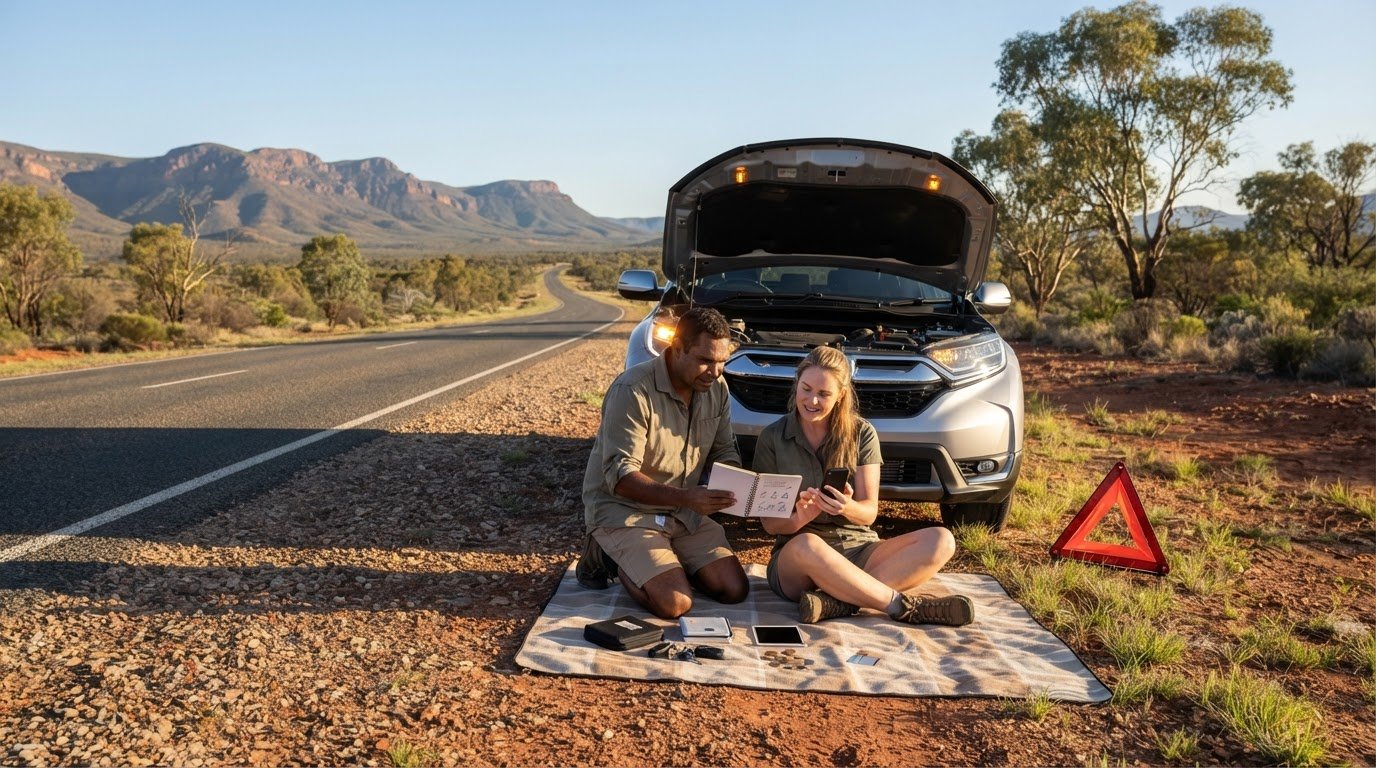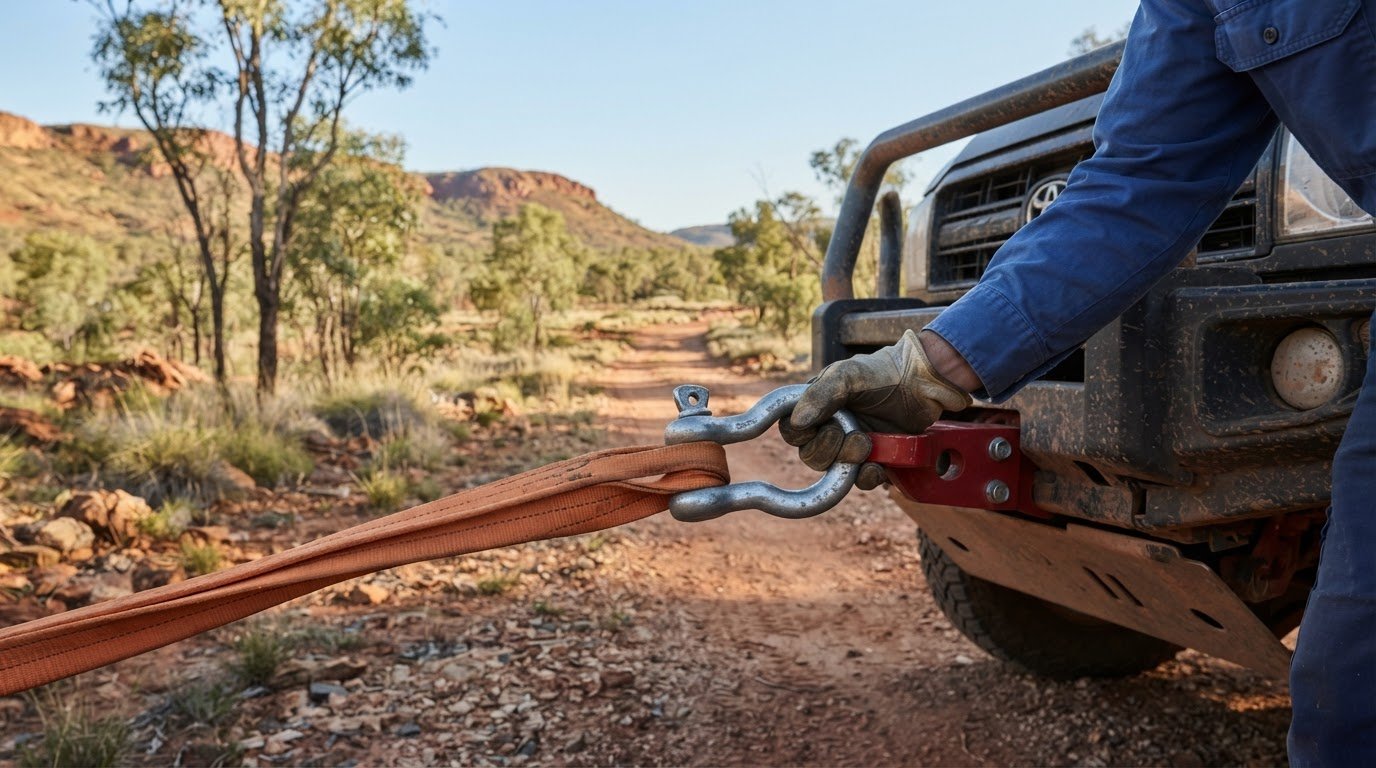
The most expensive accessory on your 4WD might be the very thing that leaves you stranded 500 kilometres from the nearest mechanic. Mastering overland vehicle builds australia isn’t about how much gear you can fit; it’s about how much reliability you can maintain. As Adventurerz, we know you’re caught between the desire for ultimate comfort and the fear of snapping an axle on a remote track. You want a rig that’s tough enough for the Canning Stock Route but light enough to stay within legal limits.
We’re going to help you master the art of building a vehicle by focusing on the perfect balance of capability, weight management, and environmental responsibility. Our goal is to give you a clear roadmap to build a sustainable rig that’s ready for any 2026 expedition. We’ll dive into expert gear selection, GVM strategies, and how to create an off-grid setup that respects the rugged Australian interior while keeping you safe and self-sufficient.
Key Takeaways
- Discover how to select the perfect platform for your overland vehicle builds australia, from the trusty Hilux to heavy-duty expedition trucks built for the long haul.
- Learn why prioritising your living space with integrated rooftop tents and 4WD awnings is the secret to maintaining mental longevity during months of off-grid exploration.
- Master the transition to sustainable power with advanced LiFePO4 setups and solar blankets, ensuring your rig remains eco-friendly while providing total self-sufficiency.
- Define your unique “mission profile” and structure a realistic budget in A$ that includes a vital 15% contingency for those unexpected outback challenges.
- Join the Adventurerz tribe in shifting from simple car camping to a disciplined, self-reliant lifestyle where the journey through the rugged Australian interior is the ultimate goal!
What defines a true Australian overland vehicle build?
We believe that overlanding is more than just a hobby; it’s a commitment to the horizon. At its heart, overlanding is self-reliant travel to remote destinations where the journey itself is the primary goal. While traditional 4WDing often focuses on conquering a specific technical obstacle and car camping usually involves a short drive to a managed site, overland vehicle builds australia are designed for the long haul. We aren’t just out for a weekend. We are out to explore the soul of the continent.
If you look at the history of What is Overlanding?, you will see it is deeply rooted in the Australian outback with pioneers like Len Beadell. This heritage shapes how we build today. Our landscape presents brutal challenges that demand respect. On the 1,850 kilometre Canning Stock Route, temperatures frequently exceed 40 degrees Celsius and fine bulldust can penetrate every seal on your rig. We build our vehicles to withstand these extremes while adhering to the Adventurerz philosophy: where rugged capability meets modern sustainability. We want to see the wild, but we also want to protect it for the next generation of explorers.
The core pillars of a remote-ready build
- Mechanical reliability: In the middle of the Simpson Desert, the simplest fix is often the only fix. We prioritise proven components over unverified tech because a broken electronic sensor can strand you, while a mechanical workaround gets you home.
- Self-sufficiency: A true build must manage resources for at least 14 days off the grid. This means calculating precise water usage, carrying spare fuel, and managing food supplies without relying on a corner store that is 500 kilometres away.
- Environmental ethics: We are guests in the wilderness. Building a vehicle that leaves no trace involves everything from eco-friendly waste management to choosing gear that doesn’t leak fluids into pristine soil.
Capability vs. Comfort: Finding your balance
It’s easy to get carried away with the latest accessories, but over-building a vehicle is a common trap. Many modern dual-cab utes have a Gross Vehicle Mass (GVM) limit of around 3,200kg to 3,500kg. Adding heavy steel bars, oversized tyres, and massive drawer systems can quickly push you over the legal limit, which leads to poor handling and potential insurance denials. We advocate for a “less is more” approach to modern Australian touring. By selecting lightweight solutions like high-quality roof top tents, we keep the centre of gravity low and the vehicle agile. The overlander mindset prioritises the richness of the experience over the accumulation of complex gadgets. When we strip away the unnecessary, we find more room for the adventure itself.
Selecting the right platform for your overland project
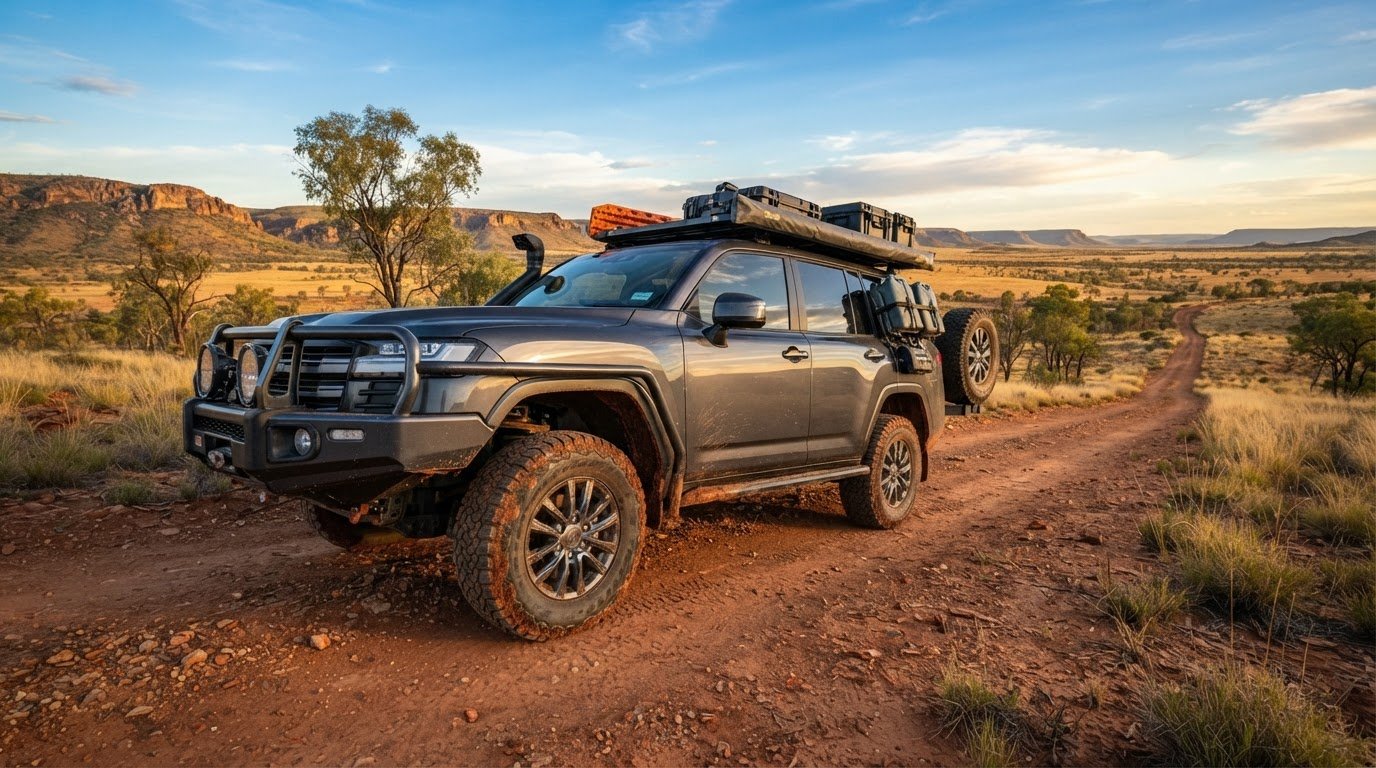
Choosing your base is the most critical decision you’ll make for your overland vehicle builds australia. We see a lot of debate in our community, but it usually comes down to your specific travel style and payload requirements. For most Adventurerz, the choice sits between the iconic 300 Series or 79 Series LandCruisers, the ever-reliable Hilux and Ranger, or the massive American pickups like the RAM 2500 that are flooding Australian tracks in 2026. If you’re planning a five year lap of the continent, you might even look at an expedition truck like an Iveco Daily 4×4 or a Mercedes Unimog for ultimate off-the-grid living.
Wagons like the Y62 Patrol provide incredible comfort and security for your electronics; however, they lack the separation of a dedicated dirty tray area. Dual-cab utes win on versatility because you can keep your fuel, recovery tracks, and muddy gear away from your sleeping quarters. If you’re towing a heavy off-road caravan, those big American trucks offer 4,500kg braked towing capacities that leave standard Japanese utes in the dust. Every choice involves a trade-off between comfort, size, and where you can actually fit on a tight bush track.
Weight is the enemy of every build. You must ensure your vehicle stays legal and safe by adhering to the National Code of Practice for Light Vehicle Construction and Modification. A Gross Vehicle Mass (GVM) upgrade is often mandatory for overland vehicle builds australia once you add bull bars, winches, and long-range tanks. In 2024, industry data showed that 65% of touring vehicles were over their legal weight limit before even adding passengers. Don’t be that person; build it right from the start to protect your insurance and your safety.
The 79 Series and Troopy: Australian icons
The 70 Series remains the undisputed king for remote reliability. Its simple engine and global parts network make it the gold standard for desert crossings. Many Adventurerz opt for chassis extensions to improve stability or coil conversions to fix the notoriously harsh leaf-spring ride. For solo travelers or couples, the “Troopy” (78 Series) offers an incredible internal living space that keeps you protected from the elements during a midnight storm in the High Country.
Modern Dual-Cabs: The versatile choice
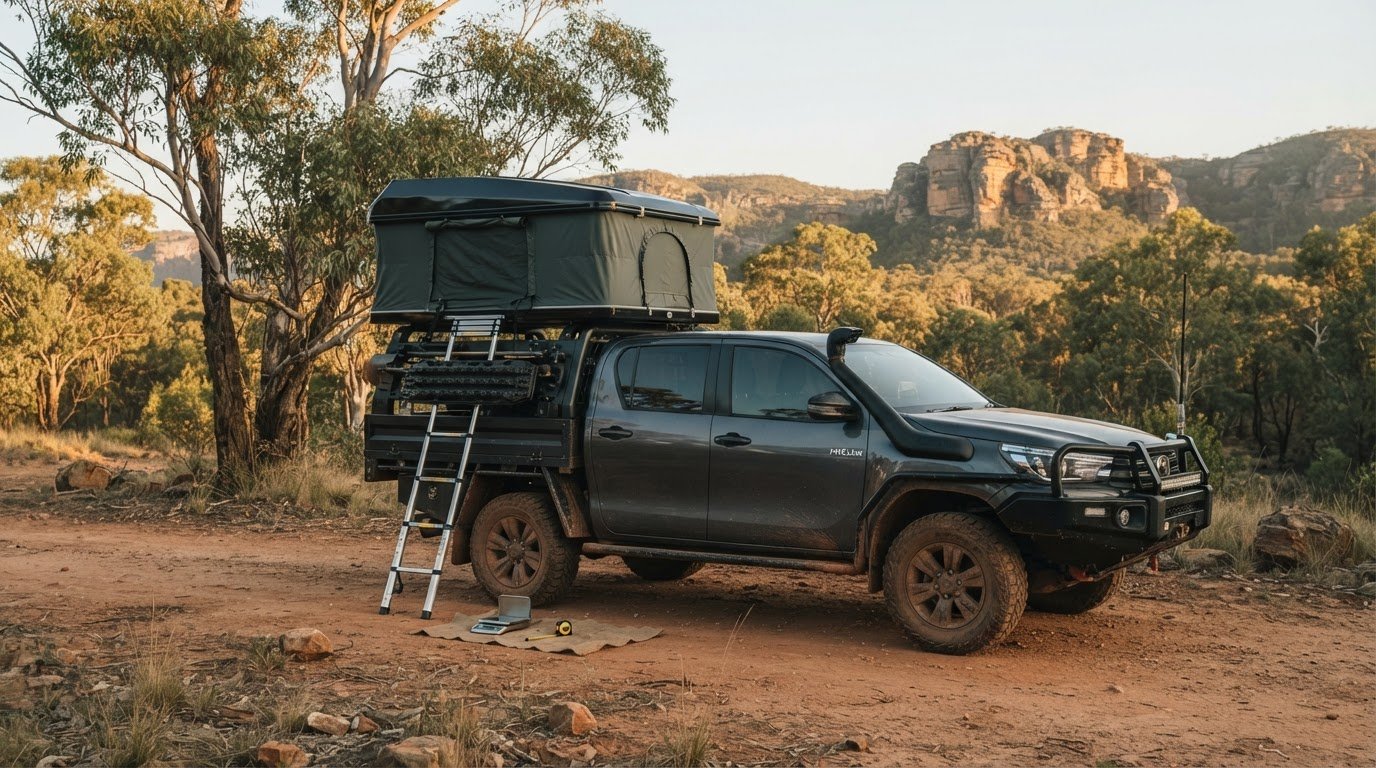
The Ford Ranger and Toyota Hilux are the most accessible entry points for new explorers. These platforms thrive when paired with a high-quality canopy system to organize your gear and keep the red dust out of your kitchen. Modern 2.0L or 3.0L turbo diesels typically achieve 9 to 11 liters per 100km, which is a massive 30% improvement over the 14 to 16 liters often seen in older, heavy-duty 4.5L V8 platforms. While you’re setting up your canopy, consider how one of the best 4WD awnings can transform your campsite into a functional outdoor living room.
Creating your living space: Rooftop tents and awnings
When we plan overland vehicle builds australia, we focus heavily on the living area. It’s the most critical part of your setup for mental longevity. If your camp takes two hours to set up every afternoon, you’ll eventually lose the desire to explore. We’ve moved away from traditional ground tents because integrated, vehicle-mounted solutions offer better protection from the red dust and local wildlife. Your rig is your sanctuary, and a well-designed living space keeps the stoke high during a six-month trek across the Top End.
Modern Adventurerz prioritize speed and comfort. Discover our top-rated roof top tents to find a model that fits your specific travel style and vehicle capacity.
Rooftop Tents: Hard shell vs. Soft shell
Hard-shell tents have become the gold standard for daily pack-downs in 2026. They offer superior durability against low-hanging branches on tight tracks and can be ready for bed in under 60 seconds. However, weight is a major factor. A premium hard-shell can weigh between 75kg and 100kg. This mass sits at the highest point of your vehicle, which significantly impacts your centre of gravity and handling on off-camber sections of the Canning Stock Route.
- Soft shell: These are usually lighter and provide a larger internal footprint, though the pack-down process takes longer and involves wrestling with a PVC cover.
- Hard shell: These offer faster setup and better fuel aerodynamics, but they require a high-capacity roof rack system.
- Climate control: Look for models with massive side openings. Proper ventilation is vital for humid nights in North QLD to prevent condensation from soaking your bedding by morning.
Shade and Shelter: 270-degree awnings
The Australian sun is relentless, making high-quality shade a non-negotiable part of overland vehicle builds australia. We’ve seen a massive evolution from basic side awnings to 270-degree systems that wrap around the rear of the vehicle. This creates a massive 10 to 15 square metres of protected space for your kitchen and lounge area. Choose the best 4WD awnings to ensure you’re protected when the UV index hits extreme levels.
When choosing your shade, consider the wind. Free-standing awnings are convenient for quick lunch stops, but they can act like a sail in the Outback. Always choose a model with integrated pole supports for when those 50km/h desert gusts arrive. We also encourage our tribe to look for sustainable materials. Many 2026 models now use recycled poly-cotton canvases that offer the same rugged durability as traditional fabrics while reducing the environmental footprint of your gear.
Off-grid power and sustainable technology
We’ve moved past the days of heavy lead-acid batteries and flickering gas lanterns. In 2026, modern overland vehicle builds australia rely on sophisticated energy ecosystems that prioritize efficiency and environmental impact. We’re seeing a massive shift toward total self-sufficiency, allowing Adventurerz to stay deeper in the bush for longer without leaving a trace. This evolution isn’t just about luxury; it’s about building a reliable life-support system for the most demanding environments on Earth.
The Lithium revolution in 4WD builds
The transition to Lithium Iron Phosphate (LiFePO4) is the single biggest game-changer for our community. A standard 100Ah Lithium battery weighs roughly 12kg, compared to a bulky 30kg AGM equivalent, yet it offers double the usable capacity. You can safely discharge a Lithium cell to 90% without damage, whereas old-school batteries suffer after 50%. This power density is vital for running high-draw gear. For instance, a standard 50L 12V fridge typically requires between 40Ah and 60Ah of capacity per 24-hour period in typical Australian summer conditions. To keep these systems humming, we pair them with high-efficiency DCDC chargers and MPPT solar controllers from brands like Redarc or Victron. These smart chargers ensure your alternator and solar panels work in harmony to top up your cells while you drive or camp.
Harvesting energy has never been easier. We recommend a hybrid approach: fixed 200W rooftop panels for constant “trickle” charging and portable 250W solar blankets to chase the sun while parked in the shade. This setup provides enough juice to ditch the gas bottle entirely. Induction cooktops are now standard in premium overland vehicle builds australia, offering a safer, wind-proof, and carbon-neutral way to prep meals. Since power is the heartbeat of your rig, you should use The Ultimate Adventure Travel Planner to map your routes based on your expected energy harvest and consumption.
Eco-friendly overlanding tech
Sustainability isn’t just a buzzword; it’s how we protect the tracks we love. Integrating multi-stage water filtration systems, like UV-C or 0.1-micron hollow fiber filters, eliminates the need for single-use plastic bottles. We’ve also seen a shift toward low-draw LED lighting that provides 100 lumens per watt, ensuring your camp stays bright without draining the bank. Smart monitoring systems are the final piece of the puzzle. Using a Bluetooth-enabled hub allows you to track every milliamp on your phone, preventing total system failure before it happens. This data-driven approach keeps us safe and responsible in the most remote corners of the outback.
Planning your build: DIY vs. turn-key solutions
We’ve reached the final stage of your journey. Creating the ultimate rig is a rite of passage for every member of our community. Whether you’re starting with a blank canvas or a pre-loved wagon, the way you approach overland vehicle builds australia wide determines if you’ll be sipping a cold drink at sunset or spinning a spanner on a dusty shoulder. We believe in a methodical approach to ensure your setup is safe, legal, and ready for the red dirt.
- Step 1: Define your mission profile. We often see rigs overbuilt for tasks they never perform. Ask yourself if you’re tackling the technical madness of the Anne Beadell Highway or stickling to coastal caravan parks. Your suspension and tyre choice should reflect your actual 80/20 usage.
- Step 2: Set a realistic budget with a 15% contingency. Overland projects always reveal surprises. Whether it’s a worn bush found during a lift kit install or a hidden electrical gremlin, that 15% buffer keeps your stress levels low when the invoice arrives.
- Step 3: Source quality components. Support the local industry by choosing reputable Australian suppliers. From heavy-duty 4WD awnings for the tropical north to robust roof top tents for elevated sleeping, quality gear pays for itself in reliability.
- Step 4: Know when to call the pros. We love a weekend project, but some tasks require a licensed hand. Auto-electrics and GVM upgrades fall into this category. If it impacts the safety or legality of your vehicle, get a certificate.
- Step 5: The 48-hour shakedown. Never head to the Simpson Desert without a local test run. Spend two nights at a nearby campsite to test every switch, pump, and bolt.
The benefits of a professional build
Opting for a turn-key solution from a professional workshop offers peace of mind that’s hard to beat. When a certified shop handles your GVM upgrade, you receive official engineering compliance paperwork. This is vital for insurance and roadside inspections. These experts ensure your suspension, tyres, and weight distribution work in perfect harmony. Plus, documented professional overland vehicle builds australia wide typically command a higher resale price. Buyers pay a premium for a rig with a verified paper trail and a national warranty.
The DIY path: Learning your vehicle
There’s a special kind of empowerment that comes from building your own rig. When you’re 400 kilometres down the Canning Stock Route and a secondary battery stops charging, you’ll know exactly which wire to check because you’re the one who crimped the terminal. DIY builds offer massive cost savings and the freedom to customise every millimetre of your storage drawers or kitchen slide. It’s about self-sufficiency and the pride of craftsmanship. Are you ready to start your project? Join the Adventurerz community today to share your build progress and get advice from fellow travelers who’ve been exactly where you are, or find verified partners for your next expedition through Travel Companion Hub.
Gear Up for Your 2026 Australian Expedition
Your journey into the red heart of the continent starts with a solid foundation. We’ve explored how selecting the right 4WD platform and integrating high-efficiency lithium power systems defines the gold standard for overland vehicle builds australia in 2026. Whether you’re bolting on a lightweight rooftop tent or engineering a full off-grid electrical setup, every choice impacts your self-sufficiency in the bush. Our community of Adventurerz provides expert gear reviews based on thousands of kilometres logged on remote tracks like the Gunbarrel Highway. We bridge the gap between rugged utility and environmental responsibility by offering community-driven advice on sustainable travel. This specialized knowledge of remote Australian conditions ensures your rig isn’t just tough, but also respectful of the landscapes we love. It’s time to turn those blueprints into reality and prepare for the dust. We’re here to help you navigate every technical hurdle and eco-friendly upgrade along the way.
Start planning your next remote escape with our Adventure Travel Planner
The horizon is calling, and we can’t wait to see where your new build takes you!
Frequently Asked Questions
What is the best vehicle for overlanding in Australia?
The Toyota LandCruiser 300 Series and the Ford Ranger are the top choices for overland vehicle builds australia because of their extensive aftermarket support and proven reliability. We love the 300 Series for its 3,500kg braked towing capacity and 700Nm of torque. These specs make it a powerhouse for hauling heavy off-grid setups through the Simpson Desert. Choosing a vehicle with a wide service network ensures you’ll find parts even in remote towns like Birdsville.
How much does a full overland vehicle build cost in 2026?
A comprehensive build in 2026 typically ranges from A$45,000 to A$95,000 depending on your choice of canopy and lithium power systems. High-end electrical setups with 400Ah of lithium now cost approximately A$12,000 including professional installation. We’ve seen prices for premium aluminium canopies stabilize at A$15,000. Budgeting an extra 10% for specialized engineering certifications is a smart move for any serious Adventurerz planning a long-term trek.
Do I really need a GVM upgrade for my 4WD?
You definitely need a GVM upgrade if your total weight, including passengers and gear, exceeds the manufacturer’s plate limit. Most stock dual-cab utes offer a payload under 1,000kg. Once you install a bull bar, winch, and 100L water tank, you’ve already used 35% of that capacity. Getting a GVM upgrade before registration saves you A$1,500 in engineering fees and keeps your insurance valid while exploring the high country.
Is a rooftop tent better than a swag for Australian conditions?
Rooftop tents are superior for comfort and safety in Northern Australia, but a traditional swag offers better fuel economy and lower clearance. Statistics from 2025 show that 72% of Adventurerz choose hardshell rooftop tents for their 30-second setup times. Swags remain the go-to for solo travelers who want to sleep under the stars without the A$4,000 price tag of a premium tent. It really depends on your specific travel style and height restrictions.
How do I manage water and fuel for remote desert crossings?
We recommend carrying 6 litres of water per person per day and installing a long-range fuel tank to reach a 1,200km minimum range. Crossing the 1,850km Canning Stock Route requires meticulous planning and often a secondary 70L auxiliary tank. Use a dedicated water filtration system to safely tap into station bores. This sustainable approach reduces your reliance on single-use plastic bottles while you’re out exploring our beautiful, rugged backyard.
Can I build an overland vehicle on a budget?
You can certainly start your overland vehicle builds australia journey on a budget by prioritizing second-hand recovery gear and basic 12V systems. A reliable used build can be functional for under A$8,000 if you source pre-owned steel rims and manual awnings. We suggest investing your limited funds into a high-quality air compressor and a basic recovery kit first. Safety should always come before expensive aesthetic mods like custom wraps or luxury interior lighting.
What are the most essential 4WD accessories for the Outback?
A quality 12V fridge, a 5-watt UHF radio, and a set of rated recovery points are the most critical items for any Outback expedition. Reliable communication is vital; 94% of remote track incidents require a UHF radio to coordinate with nearby travelers. Don’t forget a sturdy shovel and a tyre pressure monitoring system. These tools empower every Adventurerz to handle the harsh corrugations of the Oodnadatta Track with confidence and responsibility.
Is it better to buy a new or used vehicle for an overland build?
Buying a new vehicle provides a full factory warranty for remote travel, whereas a used 4WD can save you upwards of A$35,000 in initial costs. A 3-year-old Toyota Hilux often retains 80% of its value, making it a stable investment for a custom build. If you choose used, ensure the previous owner hasn’t performed low-quality electrical work. New vehicles allow you to integrate modern eco-friendly technologies like smart alternators more efficiently.