You absolutely do not need a massive 4WD to explore the best of remote Australia. That’s not just a nice idea; it’s a fact we Adventurerz live by, and it’s about to become your reality, too!
We get it, though. The thought of strapping gear to your sedan brings up visions of exceeding that tricky 75kg dynamic load limit, not to mention the hit to your fuel budget. It’s easy to believe the dream of overlanding is reserved for big rigs. But what if we told you that your hatchback could be the key to unlocking the outback? The secret isn’t a bigger car; it’s a smarter setup, starting with the perfect lightweight roof top tent for a small car.
This is your ultimate 2026 guide to making it happen. We promise to demystify your car’s actual roof capacity and show you how to transform it into a rugged, reliable basecamp. Inside, you’ll find our expert-tested list of the best RTTs under 50kg and the practical know-how to travel with total confidence. Let’s get you packed!
Key Takeaways
- Learn the critical difference between dynamic and static roof load limits to confidently choose a tent your small car can safely support.
- Discover how cutting-edge materials and smart design choices determine if a hard shell or soft shell tent wins the weight war for your vehicle.
- Find the perfect lightweight roof top tent for small car models, from zippy hatchbacks to compact SUVs, by matching the tent’s weight to your vehicle’s class.
- Get our pro tips on positioning your tent to minimise wind resistance, improve fuel economy, and enhance driving stability on the open road.
Cracking the Code: Roof Load Limits and Your Small Car
Let’s get straight to it, fellow Adventurerz! The dream of rooftop camping isn’t just for massive 4WDs anymore. The game has completely changed, and seeing a compact SUV or even a hatchback with a tent on top is becoming a common sight at campsites from the Kimberley to Tasmania. But before we get carried away with the epic freedom this offers, we need to talk about the single most important factor: weight. Understanding your car’s roof load limit is the first, non-negotiable step. Before we dive into the nitty-gritty of load limits, it helps to be on the same page about what a roof-top tent is and why its specific weight is the number one factor for small car owners.
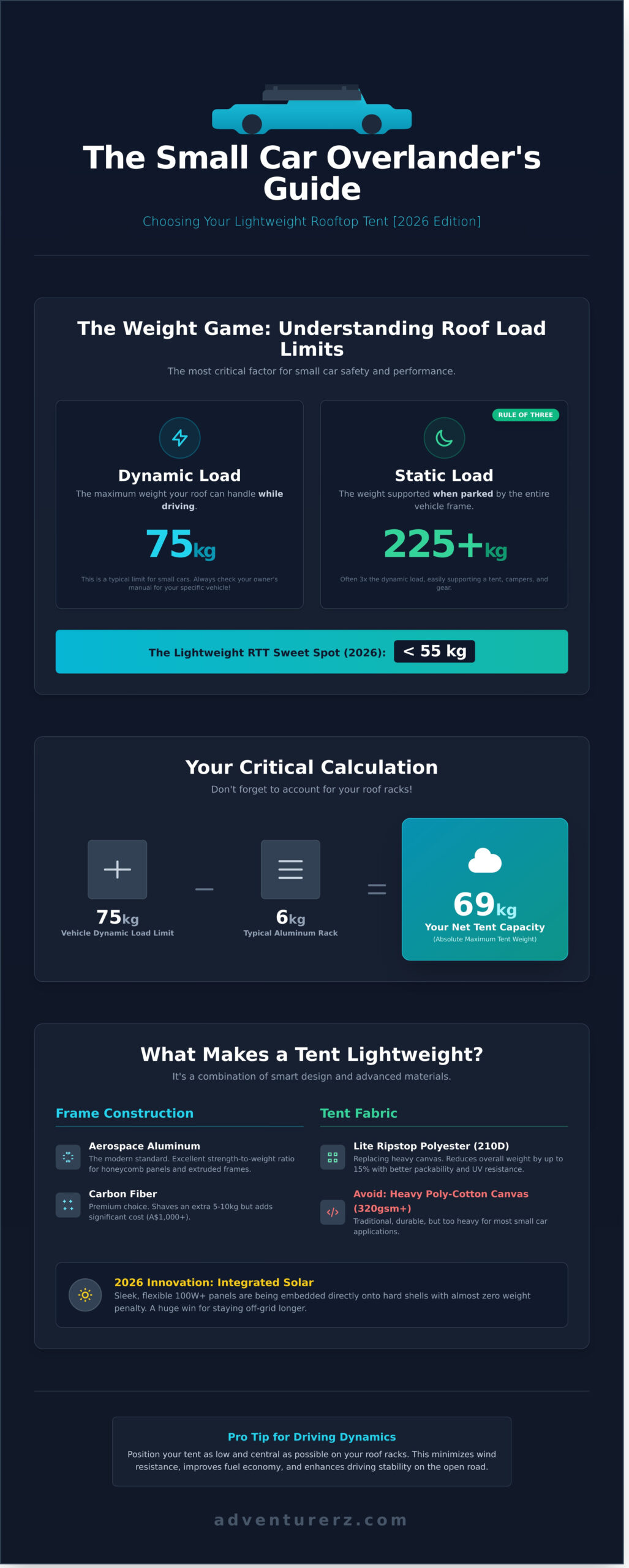
For 2026, we define the “lightweight” RTT category as any tent weighing under 55 kilograms. This is the magic number that opens up a world of possibilities for smaller vehicles. Anything heavier, and you’re pushing the limits of most sedans and hatchbacks. So, how do you know what your car can handle? It all comes down to two critical numbers: dynamic and static load.
The reason small cars, like a Mazda 3 or Hyundai i30, have stricter limits than a Toyota LandCruiser is pure engineering. Your hatchback is built on a unibody frame, designed for passenger safety and fuel efficiency. A big 4WD is often built on a rugged ladder-frame chassis designed to haul serious weight. But don’t worry, your car is stronger than you think, especially when it’s not moving. The key is to find your vehicle’s official rating. Grab your owner’s manual right now and look in the index for “Roof Load,” “Roof Rack,” or “Vehicle Specifications.” This is your source of truth!
Dynamic vs. Static Loads: Why It Matters
This is where most people get confused, but it’s actually simple. Your Dynamic Load is the maximum weight your roof can safely handle while you’re driving, braking, and cornering at up to 100km/h. Your Static Load is the weight it can support when parked. The static capacity is always much, much higher because the vehicle’s entire frame, not just the roof, supports the weight. A great rule of thumb is the “Rule of Three”: your static load capacity is often at least three times your dynamic rating. That’s how a roof with a 75kg dynamic limit can easily support a 50kg tent plus two adults (around 150kg) and gear overnight!
The Weight of the Rack: Don’t Forget the Foundation
Here’s a detail that can trip up even experienced campers. Your car’s dynamic load limit (let’s say it’s 75kg) includes the weight of everything on the roof. That means your roof rack system plus your tent. This is why choosing lightweight aluminum bars from brands like Thule or Rhino-Rack, which typically weigh only 5-7kg combined, is essential. Heavy steel racks can eat up too much of your precious capacity. Always calculate your “Net Cargo Capacity” before you shop for a lightweight roof top tent for small car setups. The formula is simple:
- Vehicle Dynamic Load Limit – Roof Rack Weight = Net Tent Capacity
- Example: 75kg (Your Car’s Limit) – 6kg (Rhino-Rack Bars) = 69kg (Your Max Tent Weight)
This 69kg number is your absolute ceiling. Stick to it, and you’ll be setting up camp safely and responsibly for years to come.
Materials and Design: What Makes a Tent Truly Lightweight?
Let’s get one thing straight, fellow Adventurerz: a “lightweight” RTT isn’t just about a number on a spec sheet. It’s the result of some seriously clever engineering and a revolution in materials. Every gram saved on your roof means better fuel efficiency, easier handling on the tracks, and, most importantly, staying well within your vehicle’s legal load limits. Before you even think about mounting a tent, it’s critical to understand your car’s dynamic and static load limits, as outlined by transport authorities. The best tent manufacturers know this, and they’re in a constant race to shed weight without sacrificing an ounce of durability.
The game has changed completely from the days of heavy steel frames. Today, the magic lies in materials like aerospace-grade honeycomb aluminum panels and extruded alloy frames. They provide the structural integrity we need to handle corrugated roads, but at a fraction of the weight. For those pushing the limits, carbon fiber is the new frontier. While it carries a premium price tag, often adding A$1,000 or more to the cost, it can shave an extra 5-10kg off a hard shell design. It’s the ultimate choice for the dedicated overlander.
The tent’s fabric is another key player. We’re seeing a massive shift away from traditional heavy-duty 320gsm poly-cotton canvas to advanced 210D lite-ripstop polyester with UV50+ ratings. This single change can reduce the overall weight by up to 15% while improving pack-down bulk. And for 2026, the big innovation is integrated, low-profile solar. Designers are now building sleek mounting channels and even embedding flexible 100W panels directly onto hard shells with almost zero weight penalty. This is a massive win for staying off-grid longer without lugging around heavy, separate panels.
Soft Shell Tents: The Lightweight Champions
For most small car owners, the soft shell is king. Its folding ‘taco’ design creates a massive sleeping area from a compact, small-footprint base that fits perfectly on a hatchback or small SUV. Modern 2-person soft shells now consistently weigh between 38kg and 45kg. The trade-off? Aerodynamics. They sit higher and catch more wind, which can affect fuel economy on long highway stretches, but for pure weight savings, they’re tough to beat.
Ultra-Slim Hard Shells: The Premium Alternative
Don’t count out the hard shells! The rise of ultra-slim ‘clamshell’ and ‘pop-top’ designs has been incredible. We’re now seeing premium models constructed from ABS plastic or carbon fiber dip below the 50kg mark, a milestone that makes finding the right lightweight roof top tent for a small car easier than ever. The biggest win here is the lightning-fast, 30-second setup. For Adventurerz who move camp every day, that convenience can easily justify the extra 5-10kg and higher cost over a soft shell.
Ultimately, the perfect tent balances these factors against your specific needs. Are you a weekend warrior or a full-time nomad? We dive deep into specific models in our ultimate RTT gear reviews to help you make the right call. The innovation is happening fast, and it’s making rooftop camping more accessible than ever!
Matching Your Vehicle: The Best Tent-to-Car Pairings
Alright team, let’s get into the nitty-gritty. Finding the right tent isn’t just about the specs on a website; it’s about creating a perfect partnership between your gear and your ride. A brilliant tent on the wrong car can compromise safety, handling, and fuel economy. We see our community of Adventurerz getting amazing results by matching their tent to one of three main small car categories: the zippy hatchback, the versatile compact SUV, and the classic sedan.
The secret is finding the weight-to-class “sweet spot.” Every car has a dynamic roof load capacity-the maximum weight it can safely carry while in motion. This number is your golden rule. Your car’s manual is your bible here, but for a deep dive into the crucial difference between static and dynamic loads, understanding your vehicle’s roof load capacity is absolutely essential reading. Pushing this limit is a massive no-go. We recommend keeping your total setup (tent plus roof racks) at least 10-15% below this dynamic limit for a safe buffer on rough Aussie roads.
Another major factor for shorter vehicles is “overhang.” A tent that extends too far over the windscreen or rear window can catch wind, create unnerving noise at 100 km/h, and negatively affect your car’s aerodynamics. It’s a rookie mistake that can make your trip far less enjoyable, so always measure your roof’s usable length!
The Hatchback Hero Setup
Got a Toyota Corolla, Hyundai i30, or Mazda 3? You’re in luck! These cars are incredibly capable adventure machines with the right setup. The key challenge is the rear hatch; you need a tent with a compact footprint that won’t block it from opening fully. Look for tents with a length under 2.1 metres. Our community of Adventurerz has found that a 42kg soft-shell tent on a Corolla with a 50kg dynamic roof limit is a perfect, real-world example. It leaves 8kg for the roof racks, keeping the whole system balanced, safe, and ready for action!
Compact SUVs and Crossovers
If you’re piloting a Mazda CX-5, Subaru XV, or Toyota RAV4, you’ve got a bit more to work with. These vehicles often boast a higher dynamic roof load limit, typically around 75kg, and a longer roofline. This opens up possibilities! The extra height makes them brilliant platforms for integrating a 180-degree or even a 270-degree awning, turning your campsite into a palace. However, it’s vital to remember the centre of gravity. A taller car means you’ll feel that rooftop weight more on winding coastal roads. Choosing a truly lightweight roof top tent for a small car, even if it’s a crossover, is critical to maintaining that car-like handling and avoiding excessive body roll.
Those winding coastal roads often lead to some of Australia’s most stunning destinations, like the NSW South Coast, which is as popular for camping getaways as it is for major celebrations. For inspiration on what makes a venue in that region special, you can check out Figbird Cottage.
Driving Dynamics and Sustainability on the Road
Alright Adventurerz, you’ve found the perfect lightweight roof top tent for your small car. Epic! Now, let’s talk about the drive. Bolting an extra 40-60kg to your roof changes things, but don’t sweat it. With a few adjustments, you’ll be carving up the highways and backroads with confidence, all while keeping your footprint light. This isn’t just about getting from A to B; it’s about making the journey itself a masterclass in efficient and responsible exploration.
First up, fuel. Yes, your consumption will increase. On a small car like a Suzuki Jimny or a Subaru XV, you can expect a 10-15% increase in fuel use, which often translates to an extra 1-3 litres per 100km. It’s a simple matter of physics: more weight and more wind resistance mean your engine works harder. But we can absolutely minimise that impact!
The Aerodynamics of Adventure
Think of your car and tent as a single unit moving through the air. A boxy, high-profile tent acts like a parachute, creating drag that hammers your fuel economy. This is why choosing a sleek, low-profile hardshell tent can save you up to 2 litres per 100km compared to a bulkier softshell. Over a 2,000km trip, that’s a saving of over A$70! We also recommend fitting a wind deflector or fairing to your roof rack. These simple additions can smooth airflow over the tent, cutting wind noise and reducing drag by a solid 15-20%. Finally, ease off the accelerator. Wind resistance increases exponentially with speed. We’ve found 90km/h is the “green zone” for RTT travel. Pushing it to 110km/h on the freeway can increase your fuel consumption by a staggering 25%.
The added top-weight also affects your car’s handling. That higher centre of gravity means you’ll feel more body roll in corners. The key is to drive smoothly. Think ahead and adjust your style:
- Braking: Your stopping distance will be longer. On the tarmac, increase your following distance from a 2-second gap to a 4-second gap. This gives you the reaction time you need for a safe, gradual stop.
- Cornering: Take corners wider and slower than you normally would. Avoid sudden, sharp turns that can unsettle the vehicle. Smooth inputs are the name of the game.
Sustainable Exploration Practices
Here’s one of the best parts about RTT life: you’re already being kinder to the environment. Unlike ground tents, which can compact soil and damage fragile vegetation, a roof top tent leaves no trace on the ground below. You camp on your car, not on the delicate ecosystem. To take it a step further, always practice pack-in, pack-out principles. In a small car, space is precious, so use collapsible containers for waste and water. Always dispose of greywater (from washing up) at least 60 metres away from any rivers or creeks. We’re also seeing incredible innovation from gear brands. Look for companies that use recycled polyester fabrics and PFC-free durable water repellent (DWR) coatings. Every conscious choice adds up!
Driving smart and camping responsibly transforms a simple road trip into a statement of respect for the wild places we love. Ready to fine-tune your setup? Explore our range of eco-friendly roof rack accessories and wind deflectors to make your next trip smoother and greener.
The Adventurerz Way: Final Tips for Your First Trip
You’ve done the research and chosen the perfect lightweight roof top tent for your small car. Congratulations! The hardest part is over, and the real adventure is about to begin. But before you point your bonnet toward the bush, we believe that great trips are born from solid preparation. It’s not just about having the gear; it’s about knowing it inside and out. This is how we turn a weekend getaway into a seamless, self-sufficient expedition.
Your first mission is what we call the “First Night” trial. Set it all up in your driveway or backyard. Yes, really! This isn’t just a practice run; it’s your chance to build muscle memory. Open it, close it, climb the ladder, and check every single strap and zipper. This is also your moment for a critical pre-trip check. Get your socket set out and tighten every bolt connecting the tent to your roof rack. Check the rack’s tension on your vehicle’s roof. Doing this now means you won’t be fumbling with a head torch in the dark, miles from anywhere.
Choosing a lightweight setup isn’t just about suiting your vehicle; it’s a statement about how you travel. Lighter rigs mean less fuel burned, less strain on tracks, and a smaller footprint on the pristine Aussie wilderness we all love. Being a true Adventurer means being a better steward of the land, and it all starts with making smart, considerate gear choices.
Safety and Maintenance
Your responsibility doesn’t end once the tent is bolted on. Think of it as a crucial part of your vehicle. We live by a few simple rules to keep our setups safe and ready for anything the Aussie climate throws at us.
- The 50km Check: This is non-negotiable. After your first 50 kilometres of driving, road vibrations will have settled everything into place. Pull over safely and re-torque all mounting brackets to the manufacturer’s specified nM. This simple 5-minute check prevents catastrophic failures.
- Off-Season Storage: Leaving a tent on year-round can cause unnecessary roof fatigue on smaller cars. During the wet season or long breaks, remove it. Storing it upright against a garage wall or on a simple hoist system preserves both your tent’s fabric and your car’s structural integrity.
- QLD Climate-Proofing: That unpredictable tropical weather demands respect. Once a year, before storm season, inspect your seam seals. A quick application of a product like Gear Aid Seam Grip can be the difference between a dry night and a disaster. Always air your tent out for at least 24 hours after a trip to beat the mould and mildew that thrives in humidity.
Start Your Journey with Adventurerz
You’re not in this alone! The single best piece of gear you can have is a community of people who have been there and done that. That’s what we’re building here at Adventurerz. We are a tribe of explorers dedicated to helping each other get out there safely and sustainably.
Our forums have dedicated threads where members share their favourite remote spots accessible to smaller vehicles like Foresters and RAV4s, not just heavily modified Patrols. Leverage thousands of real-world reviews from fellow Adventurerz to avoid “buyer’s remorse.” Our community has saved people an average of $A250 per trip just by recommending the right, field-tested gear over expensive, heavy alternatives. When you need honest feedback on a lightweight roof top tent for a small car, you’ll find it with us. Ready to stop scrolling and start exploring? Join the Adventurerz community and find your perfect gear!
Gear Up and Go: Your Small Car Adventure Starts Now!
You’re now equipped to turn your small car into the ultimate adventure rig! Remember the most critical steps: always confirm your vehicle’s dynamic roof load limit, typically between 50-75kg for compact models, and understand how advanced materials like honeycomb aluminium panels can get tent weights under 45kg. Finding the perfect lightweight roof top tent for small car is about matching these specs to your travel style, allowing you to move with greater fuel efficiency and a lighter environmental footprint.
The next step is choosing your gear with total confidence. That’s where our community comes in. At Adventurerz, our gear guides are powered by thousands of real Australian Adventurerz, offering community-vetted reviews that hold up to our unique and rugged conditions. We provide expert guidance on sustainable, remote travel that’s tailored specifically for Australian vehicle standards. Ready to find the one? Explore our Expert Gear Reviews for Your Next Adventure and get properly sorted.
The open road is calling your name. We’ll see you out there!
Frequently Asked Questions About Lightweight Roof Tents
Can I put a roof top tent on a car with a 50kg roof limit?
No, it’s not a great idea to mount a roof top tent on a vehicle with a 50kg dynamic roof limit. This limit refers to the weight the roof can handle while driving. Even the lightest tents weigh around 40kg, and when you add a quality roof rack system (another 8-10kg), you’ve already exceeded the limit. Always ensure the combined weight of your tent and racks is under your car’s specified dynamic load rating for safe travels.
Will a roof top tent void my car’s warranty?
No, fitting a roof top tent won’t automatically void your entire vehicle warranty in Australia. Under Australian Consumer Law, a manufacturer can only deny a claim if they prove the aftermarket part caused the specific failure. For instance, damage to your roof panel from an incorrectly installed rack might not be covered, but it won’t affect the warranty on your engine. We always recommend using professionally installed, compliant roof racks to be safe!
How much does a lightweight roof top tent actually weigh in 2026?
In 2026, the weight of a lightweight roof top tent for a small car has dropped significantly thanks to new materials! The lightest soft-shell models now come in between 38kg and 50kg. Even advanced hard-shell tents, which offer better aerodynamics, have options starting around 48kg. Brands are using advanced composite bases and lighter fabrics, so you get all the adventure without overloading your vehicle. It’s a game-changer for small car owners!
Do I need special roof racks for a roof top tent on a small car?
Yes, you absolutely need a robust aftermarket roof rack system; the factory rails on most small cars aren’t up to the task. Look for a crossbar system from a reputable brand like Rhino-Rack or Thule with a dynamic weight rating that is higher than your tent’s weight. These systems are designed to distribute the load correctly across your vehicle’s structural points, which is crucial for both on-road and off-road safety. Don’t skimp here, fellow Adventurerz!
How does a roof top tent affect the fuel economy of a small car?
You can expect a fuel consumption increase of 8% to 15% on a small car. The impact depends on the tent’s design. A lower-profile, aerodynamic hard-shell tent might only add 8-10% to your fuel bill. A bulkier soft-shell model creates more drag and could push that figure closer to 15%. For a car averaging 7.0L/100km, that’s a jump to about 7.9L/100km. It’s a small price for the freedom of the open road!
Is it safe to sleep in a roof top tent on a small car during high winds?
Yes, it’s safe to sleep in a quality roof top tent during high winds, as long as you take smart precautions. Most tents are rated to handle winds up to 60 km/h. We recommend parking your car facing into the wind to create a more stable, aerodynamic profile. Always use all your guy ropes and pegs, and check the Bureau of Meteorology forecast before setting up camp in an exposed area. A little prep goes a long way!
Can one person install a lightweight roof top tent alone?
While it might be physically possible with some of the lightest models under 45kg, we strongly advise against a solo installation. These tents are bulky and awkward, and lifting one onto a car roof alone risks damaging your vehicle, the tent, or yourself. Our advice? Grab a mate and make it a team effort! With two people, you can have it safely mounted and ready for adventure in less than an hour. It’s just safer that way.
What is the best lightweight roof top tent for a Subaru Crosstrek?
The best lightweight roof top tent for a Subaru Crosstrek is one weighing under 65kg. The Crosstrek typically has a dynamic roof load limit of 75kg, and after you subtract about 10kg for a solid roof rack system, you’re left with a 65kg payload. Models like the Front Runner Feather-Lite (43kg) or the Darche Intrepidor 1400 (57kg) are fantastic options that leave plenty of capacity to spare. Always double-check your specific model year’s manual before buying!