The most expensive recovery board on the shelf might actually be the wrong choice for your specific 4WD setup. It’s a bold claim, but as we move through 2026, the heated debate of maxtrax vs tred recovery boards has shifted from simple brand loyalty to a technical science of vehicle GVM and material flexibility. We’ve all felt that gut-sinking feeling when the chassis drops in soft sand, and no one wants to watch their investment melt under tire friction in the mid-day heat.
For the full-time nomad traversing the Canning Stock Route, we recommend the Maxtrax Xtreme or the TRED Pro. The ability to replace worn teeth in the field is a game-changer when you’re thousands of kilometers from the nearest shop; this is a scenario common for Adventurerz on MINT Adventures self-drive 4×4 expeditions in Namibia or Kyrgyzstan. If you only hit the beach twice a year for a quick surf or a family fish, the TRED GT or the Maxtrax MKII provides exceptional value without over-capitalizing. Remember, having any reputable board from these two brands is far better than relying on a cheap imitation that might snap and cause injury when you’re most vulnerable.
We’ve put these Australian-made icons through the wringer to help you choose with confidence. You’ll discover which brand truly dominates the outback through our field-tested comparison of durability, stacking height, and traction. We’re breaking down everything from the Maxtrax Xtreme’s 88 replaceable alloy teeth to TRED’s patented EXOTRED dual composite construction. We’ll show you how to match board flex to your vehicle’s weight so you can keep exploring our beautiful country responsibly and safely. It’s time to gear up and ensure every Adventurerz in your convoy stays unstuck and on the move.
Key Takeaways
- Compare the material science behind maxtrax vs tred recovery boards to understand why specific polymers are essential for handling the extreme 2026 Australian heat.
- Learn how to match your vehicle’s weight and GVM to the right board flexibility to avoid the dreaded “melted tooth” syndrome during high-friction sand recoveries.
- Discover our field-tested “Adventurerz Choice” recommendations that balance upfront cost against long-term durability for both weekend explorers and full-time nomads.
- Master the technical differences between nylon and polypropylene to ensure your recovery kit remains a reliable safety net when traveling off-the-grid without a winch.
- Find out how to maintain and stack your gear efficiently after a messy mud-season expedition to keep your setup organized for the next leg of your journey.
Why Recovery Boards are Non-Negotiable for Remote Australian Travel
We’ve all seen the dusty 4WDs lined up at the fuel bowser in Birdsville, but in 2026, one piece of kit has officially moved from the optional wishlist to the essential safety list. We’re talking about the maxtrax vs tred recovery boards debate. These aren’t just colorful plastic planks bolted to a roof rack; they’re a three-in-one insurance policy. A quality board acts as a portable bridge over washouts, a ramp to climb out of ruts, and a high-traction surface when the ground turns to soup. For us, they represent the ultimate tool for self-reliance.
Australia’s environment is notoriously harsh on gear. While boards designed for North American or European markets might survive a muddy weekend, they often crumble under our relentless UV levels, which frequently hit index ratings of 11 or higher. We need equipment that won’t turn brittle after a single summer in the Simpson Desert. Beyond the technical specs, there’s a massive psychological benefit. Knowing you can perform a self-recovery when you’re 200km from the nearest station changes your entire approach to off-roading. It turns a potential disaster into a minor speed bump, allowing every Adventurerz to explore with a sense of calm and confidence.
The Physics of Getting Un-Stuck
The magic of a recovery board lies in weight distribution. A standard kitted-out 4WD can easily place over 700kg of pressure on a single tire’s contact patch. When you’re bogged, that pressure drives you deeper. By placing a board underneath, you instantly spread that weight across a surface area roughly four times larger than the tire’s footprint. This allows the vehicle to “float” on top of soft sand or silt. We always focus on static friction, which is the grip between the tire and the board before movement happens. Once your wheels start spinning, you enter the realm of kinetic friction. This creates immense heat, and it’s the number one reason people melt the teeth off their expensive boards. Patience is your best friend here.
2026 Standards for Remote Safety
Current safety recommendations for 2026 emphasize visibility and kit integration. Choosing high-visibility colors like safety orange isn’t just about aesthetics; it’s about finding your boards after they’ve been buried a foot deep in grey mud or red sand. We recommend integrating your boards into a holistic setup. This means ensuring they are easily accessible alongside your shovel and other essentials. Many in our community mount their boards on the side of their roof top tents or racks for quick access. Being prepared means having your recovery gear ready before you actually need it, ensuring we all leave the bush exactly as we found it, without tearing up the tracks in a desperate struggle for grip.
Technical Deep Dive: Nylon vs Polypropylene and the ‘Teeth’ Problem
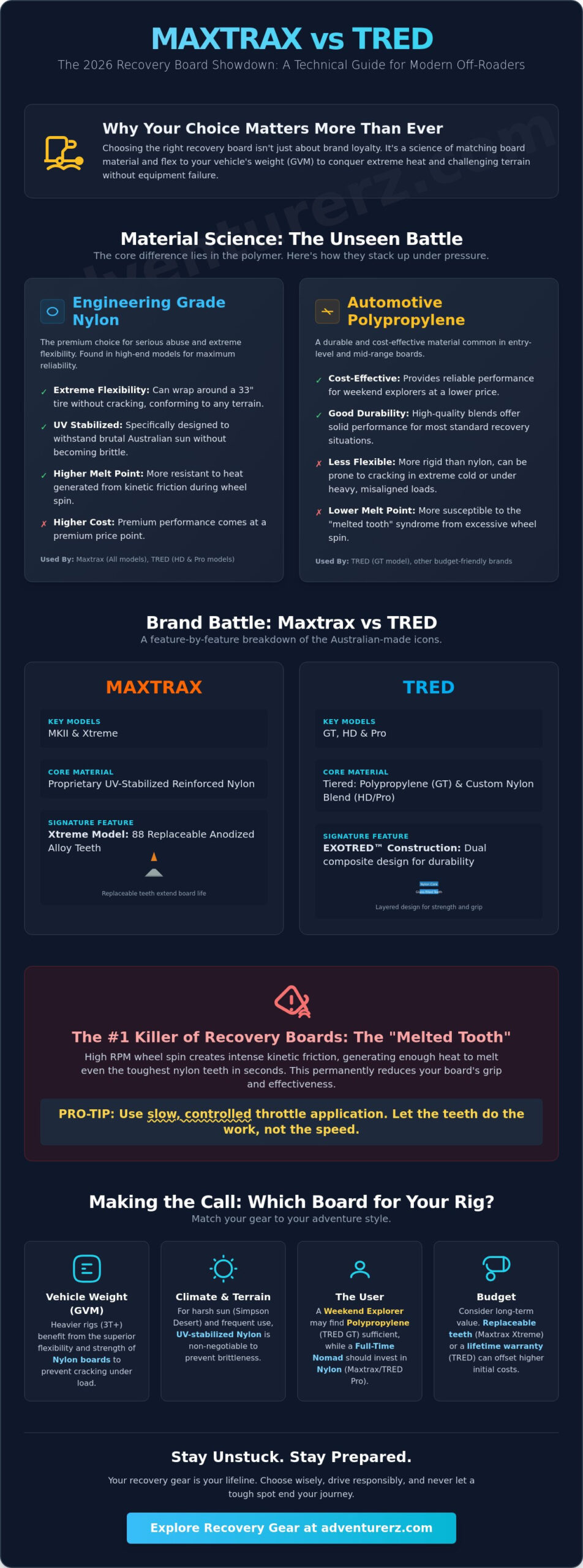
When we look at the chemistry of maxtrax vs tred recovery boards, we’re really talking about how high-tech polymers handle stress and solar radiation. In 2026, the standard for ‘Engineering Grade’ has reached a peak. Maxtrax uses a proprietary UV-stabilized, reinforced nylon designed to withstand the brutal Australian sun without turning brittle. TRED takes a tiered approach. Their GT model uses high-quality automotive-grade polypropylene, while the HD and Pro versions utilize a custom blend of engineered nylon. This distinction is vital for Adventurerz to understand because the material determines how your boards react when the temperature hits 45°C in the shade.
The ‘Melt Point’ is the silent killer of recovery gear. Even the best engineering-grade nylon has a physical limit. When wheels spin at high RPM, the friction generates heat that can reach hundreds of degrees in seconds. This is why we always advocate for responsible off-highway vehicle use through controlled throttle application. If you spin your tires, you aren’t just digging a deeper hole; you’re effectively machining the traction teeth off your boards. Understanding these material limits helps us keep our gear in top shape for years of exploration.
Material Flexibility vs. Rigidity
A board that bends is a board that lives. On March 19, 2026, tests at the University of Queensland demonstrated that a Maxtrax MKII could wrap entirely around a 33-inch tire without cracking. This flexibility allows the board to contour to the terrain and distribute the vehicle’s GVM more effectively. TRED’s HD and Pro models are rated for a massive 4,000kg to 4,500kg and operate safely from -15°C up to 70°C. This wide temperature range ensures the plastic maintains its “memory,” returning to its original flat shape even after being crushed into a deep rut under a heavy 4WD. Check out our latest reviews and adventure ideas to see how these materials hold up in the field.
The Evolution of Traction Teeth
The 2026 landscape has seen a massive shift toward repairability. The Maxtrax Xtreme remains a heavy-duty favorite because it features 88 hard-anodised alloy teeth that are entirely field-repairable. If you do happen to have a “moment” with the accelerator, you don’t have to replace the whole board. TRED Pro boards counter this with their patented EXOTRED™ construction and replaceable teeth design. You can identify tooth wear by looking for “rounding” or “mushrooming” at the tips. Once the sharp edges are gone, your traction drops by roughly 40 percent. We recommend inspecting your boards after every trip to ensure they’re ready for the next recovery.
Brand Battle: Maxtrax MKII & Xtreme vs TRED GT, HD & Pro
Choosing between the giants of the recovery world often feels like picking a favorite campsite; both have their unique charm. The Maxtrax MKII remains the enduring legacy of the industry. At just 3.4kg per board, it’s the lightweight champion that revolutionized how we handle bogs. However, for those who push their rigs to the absolute limit, the Maxtrax Xtreme offers a significant upgrade. While it carries a weight penalty of 9kg per pair, the inclusion of 88 hard-anodised alloy teeth means you’re investing in a board that can handle accidental wheel spin far better than any plastic-only alternative.
TRED has cleverly tiered their 2026 lineup to suit different budgets and needs. The TRED GT is an excellent entry point for weekend warriors, utilizing automotive-grade polypropylene. Stepping up to the TRED HD gets you into engineered nylon territory with a wider operating temperature range of -15°C to 70°C. The crown jewel is the TRED Pro, featuring patented EXOTRED technology. This dual-composite construction provides a rigid base to prevent the board from bowing too much under pressure while maintaining a flexible top layer for maximum grip. When debating maxtrax vs tred recovery boards, the TRED Pro’s 4,500kg load capacity makes it a formidable opponent for the Xtreme.
Stackability and Mounting Solutions
Every millimeter of space on your roof rack is precious, especially when you’re already carrying roof top tents and fuel. Maxtrax boards are famous for their incredibly tight nesting, which keeps your profile low and wind noise to a minimum. TRED boards have improved their stack height significantly in recent years, but they generally sit slightly higher than a Maxtrax pair. It’s also vital to check mounting pin compatibility. While some aftermarket brackets claim to be universal, we always recommend sticking to brand-specific pins to ensure your boards don’t become high-speed projectiles on the corrugated roads of the Oodnadatta Track. A pair of Maxtrax MKIIs weighs in at 6.8kg, while TRED Pros are slightly heavier, so keep your total roof load in mind.
Warranty and Australian Manufacturing
There’s a deep sense of pride in knowing both these brands are Australian-owned and manufactured. This isn’t just about patriotism; it’s about gear designed by people who actually drive in our conditions. Both companies offer robust warranties, but the lifetime warranty often comes with caveats regarding user error, specifically wheel spin damage. Adventurerz community feedback consistently highlights that while both brands have excellent customer service, Maxtrax’s long-standing presence in the market has built a massive trust bank. Supporting local manufacturing ensures that these companies can continue innovating for the specific challenges of our rugged landscape. We’ve seen both brands stand by their products when manufacturing defects appear, giving us the confidence to head off-the-grid.
Real-World Performance: Sand, Mud, and the 2026 Heat Factor
Nothing tests your patience like a soft dune in the Simpson Desert. When the sand is as fine as talcum powder, the choice in maxtrax vs tred recovery boards becomes a matter of immediate “bite.” Maxtrax MKII boards generally grab the tire tread slightly faster in dry, shifting sand due to their 88-tooth layout. However, TRED Pro boards often perform better in the “slop.” The larger channels in the TRED design allow mud and debris to clear more efficiently, preventing the board from becoming a slippery slide. We’ve found that both brands offer excellent shovel-shaped ends, which are vital for clearing the build-up under your diff before you even attempt to drive out.
Cleaning your gear is the part of the journey no one puts on Instagram, but it’s essential for longevity. After a wet-season expedition, mud can bake into the crevices of your boards like concrete. We recommend a high-pressure hose and a stiff brush to clear the traction nodes. This isn’t just about looks; dried mud acts as an abrasive that can wear down your tires and the boards themselves during the next recovery. If you’re looking for more ways to optimize your setup, read our latest adventure guides to see how we manage gear on long-haul trips.
Heavy Vehicle Recovery (3.5t – 4.5t)
The 2026 trend toward GVM-upgraded 300 Series LandCruisers and heavy electric 4WDs has changed the recovery game. A standard 4WD might weigh 2.5 tonnes, but a fully laden touring rig or a modern EV can easily push 3.5 to 4.5 tonnes. When a vehicle of this mass settles into a bog, the pressure on the recovery board is immense. We often see standard boards bow or “banana” under these loads if the ground underneath isn’t perfectly flat. For these heavy hitters, we strongly recommend using four boards instead of two. This distributes the massive weight across a larger surface area and reduces the risk of snapping a board. A standard engineering-grade nylon recovery board is typically rated to support a maximum vehicle weight of 4,500kg when used correctly on a flat surface.
Operating in Extreme 45°C+ Heat
Australia’s 45°C summer days are the ultimate stress test for polymers. High ambient temperatures naturally soften plastic, which significantly lowers the melting point of the traction teeth. If you’re recovering a vehicle in the midday sun, you have almost zero margin for wheel spin. We’ve seen “knock-off” boards from budget retailers turn white and snap like crackers after just one summer of UV exposure. Genuine Maxtrax and TRED boards use high-level UV stabilizers to prevent this degradation. To protect your investment, we suggest mounting your boards in a way that provides some shade, perhaps tucked under the edge of your roof top tents, or using a dedicated protective cover when you’re not on the tracks. Keeping them out of the direct sun when parked at home will add years to their service life.
Ready to upgrade your recovery kit for your next big trip? Check out our full gear guides to find the perfect match for your 4WD setup.
Making the Call: Which Recovery Board Should You Pack?
We’ve broken down the polymers, analyzed the teeth, and weighed the impact of a 4.5-tonne GVM on Australian sand. Now comes the moment of truth in the maxtrax vs tred recovery boards debate. The choice isn’t just about which brand has the flashiest marketing; it’s about matching the tool to your specific mission. Whether you’re a full-time nomad living out of a canopy or a weekend warrior hitting the local tracks, your recovery gear needs to be as reliable as your sense of adventure. We’ve seen that while both brands offer incredible performance, their strengths cater to different styles of exploration.
As Adventurerz, we also have a responsibility to the landscapes we love. In 2026, sustainable exploration means considering the lifecycle of our gear. While these boards are built from high-grade, UV-stabilized plastics to last a decade or more, they aren’t immortal. We encourage our community to look for recycling programs or repurposing ideas once a board finally reaches its limit. Choosing a durable, Australian-made product from the start is the best way to reduce your environmental footprint, as it prevents cheap, “single-use” knock-offs from ending up in landfill after one failed recovery. Investing in quality is a win for both your rig and the bush.
Your recovery kit shouldn’t exist in a vacuum. A seamless setup involves how these boards integrate with your other essentials. Many of us find that mounting boards on the side of a roof rack or tucked behind our best 4wd awnings keeps them accessible without cluttering the interior. This layout ensures that when you’re bogged in a rising tide or a muddy creek bed, you aren’t digging through a mountain of camping gear to find your traction aid. Speed and accessibility are the keys to a stress-free recovery.
The Verdict for Different Travelers
For the full-time nomad traversing the Canning Stock Route, we recommend the Maxtrax Xtreme or the TRED Pro. The ability to replace worn teeth in the field is a game-changer when you’re thousands of kilometers from the nearest shop. If you only hit the beach twice a year for a quick surf or a family fish, the TRED GT or the Maxtrax MKII provides exceptional value without over-capitalizing. Remember, having any reputable board from these two brands is far better than relying on a cheap imitation that might snap and cause injury when you’re most vulnerable.
Next Steps for Your 2026 Adventure
Don’t wait until you’re axle-deep in a salt lake to learn how your boards behave. We suggest heading to a safe, local patch of sand to practice your technique. Familiarize yourself with how the boards flex and how your vehicle responds to low-range crawling on the nylon surface. Once you’re confident in your recovery skills, it’s time to start dreaming big. Check out our latest travel planner to map your next escape into the wild. We’d love for you to join the Adventurerz community and share your own recovery stories, because every lesson learned on the tracks helps the whole tribe stay safe and keep exploring!
Gear Up for Your Next Great Outback Escape
Deciding on maxtrax vs tred recovery boards comes down to matching your vehicle’s specific needs with your travel style. We’ve highlighted how the March 19, 2026, University of Queensland tests proved nylon’s incredible ability to flex without cracking. We also know that modern, heavy-duty 4WDs reaching a 4,500kg GVM require the structural integrity found in TRED’s EXOTRED technology. Whether you prioritize the lightweight 3.4kg MKII or the repairable alloy teeth of the Xtreme, your investment ensures you can explore our beautiful country while minimizing damage to the tracks.
Our mission remains focused on sustainable and responsible exploration, ensuring every Adventurerz leaves the wilderness exactly as they found it. By choosing Australian-made gear expertly tested for our unique conditions, you’re joining a movement of travelers who value quality and environmental stewardship. Don’t let the fear of a bog hold you back from the Simpson Desert or the High Country. Join the Adventurerz community for more expert 4WD gear reviews and remote travel tips! We’re here to help you move forward with confidence and camaraderie. See you on the tracks!
Frequently Asked Questions
Can I use TRED mounting pins with Maxtrax boards?
No, TRED mounting pins are not directly interchangeable with Maxtrax boards. Each brand utilizes a unique hole pattern and pin diameter designed specifically for their own stacking geometry. While some aftermarket universal brackets exist, we always recommend using brand-specific pins to ensure your gear stays securely attached when you’re bouncing along corrugated outback tracks.
How many recovery boards do I actually need for a 4WD?
Two boards are the bare minimum for most sand recoveries, but carrying four is the gold standard for heavy touring rigs. Having a board for every wheel allows you to maintain momentum across a soft patch rather than just getting one axle out and sinking the next. This is a vital consideration for modern 4WDs with a GVM exceeding 3,000kg.
Do recovery boards work in deep snow as well as sand?
Yes, recovery boards are highly effective in snow by providing a stable platform that prevents tires from digging into icy ruts. The technique is very similar to sand recovery, though you must be mindful of extreme cold. Boards like the TRED HD are specifically rated to operate in temperatures as low as -15°C without becoming brittle or snapping.
What is the best way to clean my boards after a mud recovery?
Use a high-pressure hose and a stiff-bristled brush to clear all debris from the traction nodes and mounting holes. It’s important to avoid harsh chemical degreasers that could potentially leach into the soil or degrade the UV-stabilized polymers over time. Keeping them clean ensures they nest together perfectly and don’t rattle on your roof rack during the drive home.
Will spinning my tyres really melt the teeth on a Maxtrax?
Yes, excessive wheel spin will instantly melt or “mushroom” the traction teeth on any plastic board. The friction between a spinning tire and the board generates heat that exceeds the nylon’s melting point in less than five seconds. When comparing maxtrax vs tred recovery boards, keep in mind that Maxtrax Xtreme models use alloy teeth to solve this exact problem.
Are the cheaper recovery boards from big-box retailers worth buying?
Generally, no, because budget boards often lack the high-level UV stabilizers required for the Australian sun. Field observations show that these cheaper alternatives often turn white and snap after less than 12 months of exposure. Investing in reputable maxtrax vs tred recovery boards ensures your safety kit won’t fail when you’re 100km from the nearest sealed road.
How do I secure my recovery boards to prevent theft while traveling?
The most effective method is using dedicated locking mounting pins or a high-quality cable lock looped through the handles and around your roof rack. Many Adventurerz find that a simple weather-proof padlock through the hole in the mounting pin provides a sufficient deterrent. It’s a small step that protects your investment while you’re away from the vehicle exploring.
Can recovery boards be used as a bridge over small washouts?
Yes, but only if the manufacturer explicitly states they are rated for bridging and the gap is within their specified limits. Bridging puts immense stress on the internal structure of the plastic, so you must ensure the ground on either side is firm. Always double-check your board’s maximum weight capacity before attempting to bridge a heavy, fully laden 4WD.