In 2026, the era of simply pulling over anywhere is officially dead, replaced by a high-tech game of strategy and stewardship. As councils from the Gold Coast to Tasmania ramp up enforcement, with some fines reaching as high as $834 for a single night, the stakes for our community have never been higher. We understand the thrill of the open road and the desire to wake up to a remote sunrise without a price tag. That’s why learning how to find free campsites in Australia isn’t just about saving your hard-earned cash anymore; it’s about protecting our collective access to the wild while staying on the right side of the law.
We’ve all felt that sinking feeling when arriving at a supposed free spot after a long drive, only to find a “No Camping” sign or a line of rangers. You deserve to explore with total confidence, knowing your rig is legally self-contained and your destination is legitimate. This guide will teach you exactly how to master the latest 2026 regulations and digital tools. We’ll dive into the best systems for finding secluded spots, explain the new permit requirements in regions like Tasmania’s Central Coast, and show you how to use tools like WikiCamps to ensure your off-grid adventure remains both safe and sustainable.
Key Takeaways
- Leverage the latest digital scouting tools and satellite tech to find secluded spots that aren’t on the radar of the weekend crowds.
- Understand the technical requirements for 2026 self-containment certifications so your vehicle is welcomed in restricted free-camping zones.
- Master the art of how to find free campsites in Australia by deciphering local council signage and stay limits before you even shift into park.
- Implement a robust power and waste management strategy that allows you to stay off-grid longer without leaving a trace on our fragile environments.
- Plan a balanced itinerary that combines remote freedom with strategic commercial stops to keep your gear maintained and your supplies stocked.
Table of Contents
Understanding Free Camping in Australia for 2026
We’ve seen the map of our great sunburnt country change rapidly over the last decade. Finding a spot to park up for the night isn’t just about luck anymore; it’s about strategy. If you’re wondering how to find free campsites in Australia without getting a knock on the window at 2 AM, you need to understand the new hierarchy of sites. In 2026, the ‘free’ in free camping often comes with a caveat of high-level preparation. You won’t find manicured lawns or hot showers at most of these spots. Instead, expect a dusty patch of dirt, a stunning view, and the absolute silence of the outback. Most sites now strictly require you to be ‘Certified Self-Contained,’ meaning you carry your own water, power, and waste management systems. We believe this shift is actually a win for our community because it keeps these pristine locations open for those who truly respect the land.
The Three Pillars of Legal Free Camping
Legal free camping generally falls into three categories. First, we have council-designated free zones, often found on the outskirts of rural towns to encourage local spending. These usually have strict 24 or 48 hour stay limits. Second are the showgrounds and donation camps. While technically ‘free’ or low-cost, we always encourage leaving a contribution to help the small committees maintain the grounds. Finally, there is Bush camping in Australia on remote crown land or specific ‘low-cost’ national park areas. These spots offer the most solitude but require the most gear. Having a solid setup, such as one of the highly rated roof top tents we’ve reviewed, makes these rugged, uneven terrains much easier to manage.
Why Free Camping is Changing in 2026
The landscape has shifted. Coastal regions in Queensland and New South Wales have faced immense pressure from over-tourism, leading many councils to implement heavy fines. In Noosa, for example, fines of $322 are common for those caught outside designated areas. To manage the numbers, we’re seeing a massive shift toward inland exploration and the adoption of digital permit systems. No longer is it always ‘first-in, best-dressed.’ In 2026, many popular free spots require you to log in and ‘book’ your free permit before arrival. This ensures the environment isn’t overwhelmed and that you actually have a spot when you arrive after a long day of driving. It’s a more structured way to explore, but it gives us the peace of mind that our favourite spots will stay healthy for years to come. Mastering how to find free campsites in Australia now requires as much digital savvy as it does 4WD skill.
Top Digital Tools and Apps for Scouting Sites
Gone are the days of rolling the dice on a gravel track and hoping for the best. In 2026, our community relies on a digital arsenal to pinpoint the perfect spot. If you want to master how to find free campsites in Australia, you need to look beyond a simple GPS. We use a combination of community-sourced data and high-tech satellite imagery to ensure we aren’t just finding a spot, but finding the right spot for our specific rig. Real-time updates have become our lifeline, especially as regulations change and sites close for regeneration.
Essential Apps Every Adventurer Needs
We don’t leave the driveway without the ‘Big Three’ loaded on our devices. WikiCamps Australia remains the heavyweight champion for 2026. For a one-off fee of $9.99, you gain access to over 65,000 listed sites. The user reviews are vital for checking if a site is currently accessible or if a local council has recently stepped up enforcement. Anycamp and CamperMate are also brilliant for finding those smaller, hidden gems. They often provide clearer details on specific facilities like dump points or fire pits. Finally, Aircamp has become essential for securing low-cost or free spots during peak seasons before you even arrive, helping us avoid the frustration of a ‘Full’ sign after a long haul.
High-Tech Scouting Techniques
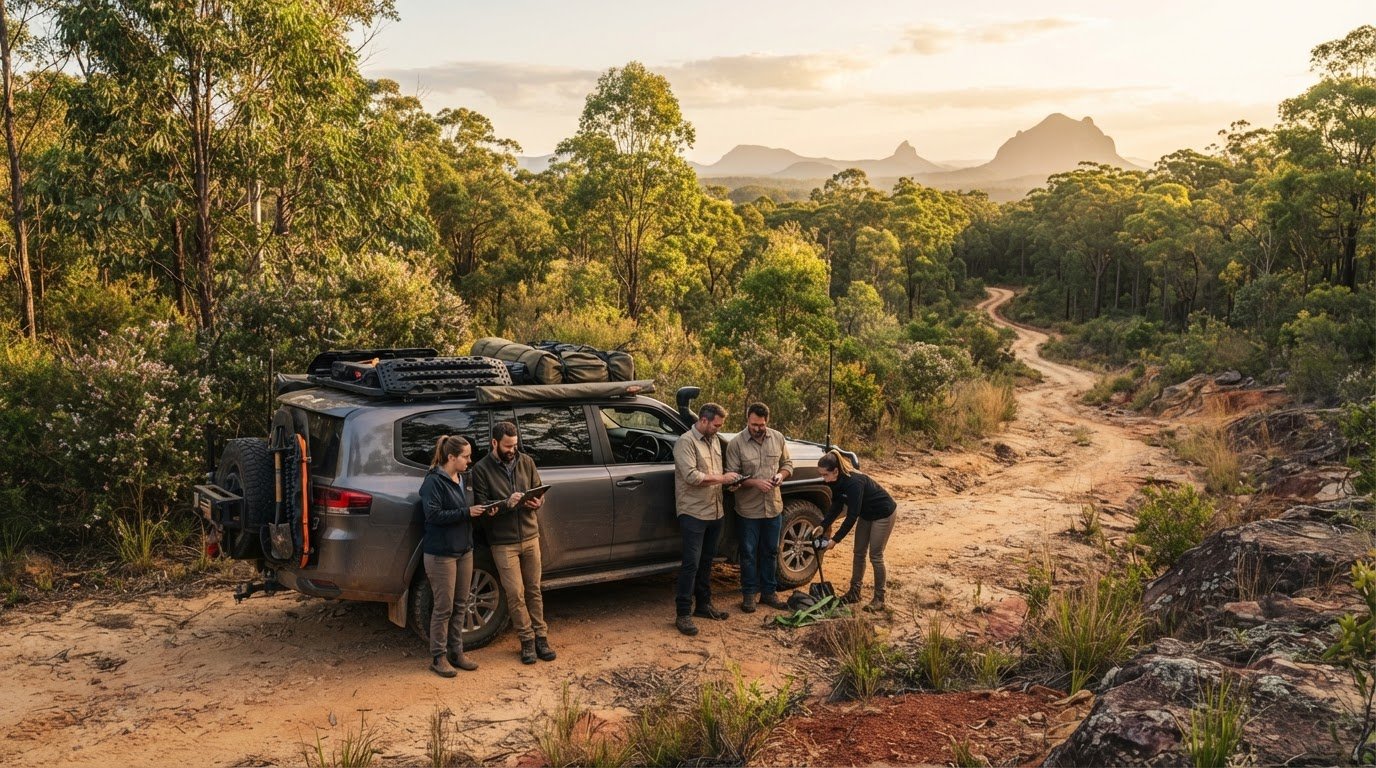
The real game-changer for 2026 is the widespread use of Starlink. Having high-speed satellite internet in the middle of the Gibson Desert allows us to scout the next 500 kilometres in real-time. We use Google Earth to zoom in on potential camps, verifying if a track is wide enough for our setup or if a “free” spot is actually just a tiny bitumen pull-over. We also keep a close eye on the Bureau of Meteorology (BOM) app. Flash floods are a serious risk at creek-side sites; being able to see a rain event happening 100 kilometres upstream can save your life. Before you head out, make sure your setup is ready for the heat with our best 4wd awnings reviews and recommendations.
Never trust your live connection once you’re deep in the scrub. We always download offline maps for the entire region. Whether it’s Hema Maps or the offline layers in WikiCamps, having that data stored locally is a non-negotiable safety protocol. Community Facebook groups also provide that ‘last-mile’ intelligence. Local legends often post photos of washed-out crossings or full campsites, giving us the chance to pivot our itinerary before we hit the ‘Point of No Return’. Mastering how to find free campsites in Australia is as much about the tech in your pocket as the tread on your tyres.
Essential Gear for Self-Sufficient Free Camping
Mastering how to find free campsites in Australia is only half the battle. The real challenge starts once you arrive at a pristine, remote location that requires you to be ‘Certified Self-Contained’ to stay legally. In 2026, this isn’t just a suggestion; it’s a gatekeeper for the most spectacular free spots across the country. To qualify, our rigs must be capable of carrying all fresh water and holding all grey and black water for the duration of the stay. We view this as a badge of honour. It shows we’re committed to leaving no trace and protecting the rugged environments we love to explore.
Power management is the heartbeat of any off-grid setup. We’ve moved beyond heavy lead-acid batteries. Modern lithium (LiFePO4) setups, paired with high-efficiency solar arrays, allow us to run fridges, lights, and even Starlink indefinitely. Without a reliable power source, you’re tethered to commercial parks. With it, the entire map opens up. We recommend a minimum of 200Ah of lithium to ensure you can weather a few cloudy days without stress. This level of self-reliance is what separates a true explorer from a weekend tourist.
The Ultimate Off-Grid Shelter Setup
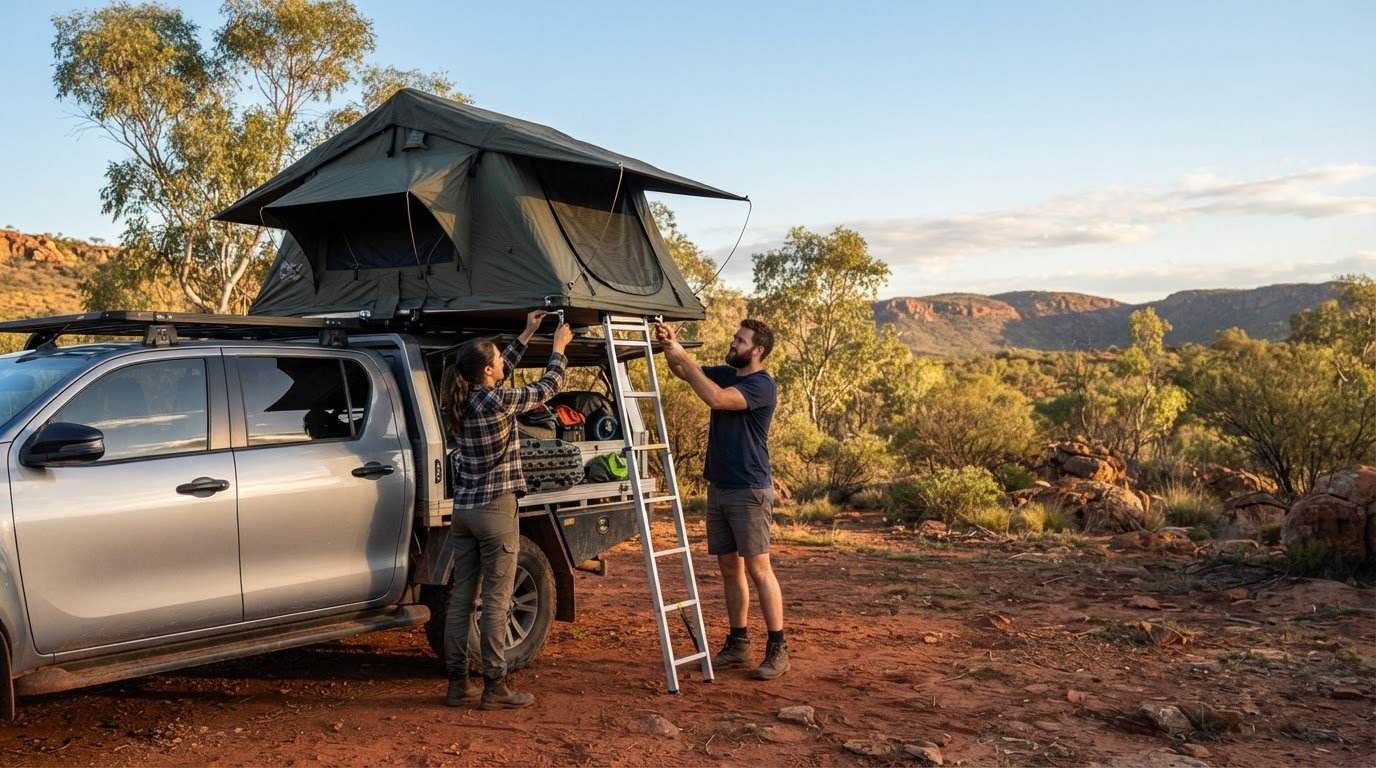
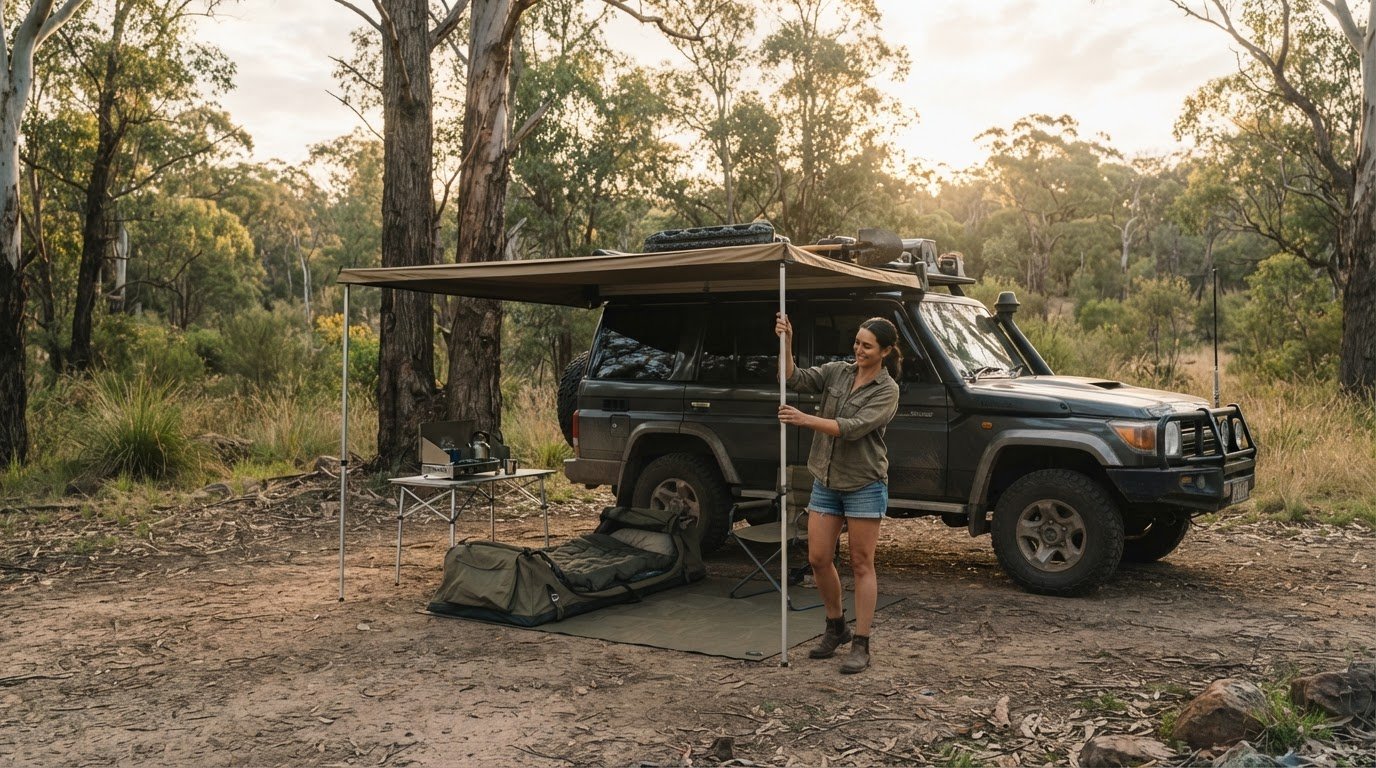
Your choice of shelter dictates where you can go. Knowing how to find free campsites in Australia is a vital skill, but it’s useless if your gear isn’t up to the task when you arrive. We’ve found that roof top tents are the preferred choice for remote travel. They keep you off the ground, away from crocodiles in the north and damp soil in the south. Hard shell setups are particularly popular in 2026 for their rapid deployment; you can be set up in under sixty seconds. To truly maximise your living space, high-quality 4WD awnings are essential. They provide the necessary shade and rain protection that turns a vehicle into a basecamp, allowing you to cook and relax comfortably in any weather.
Self-Containment Checklist
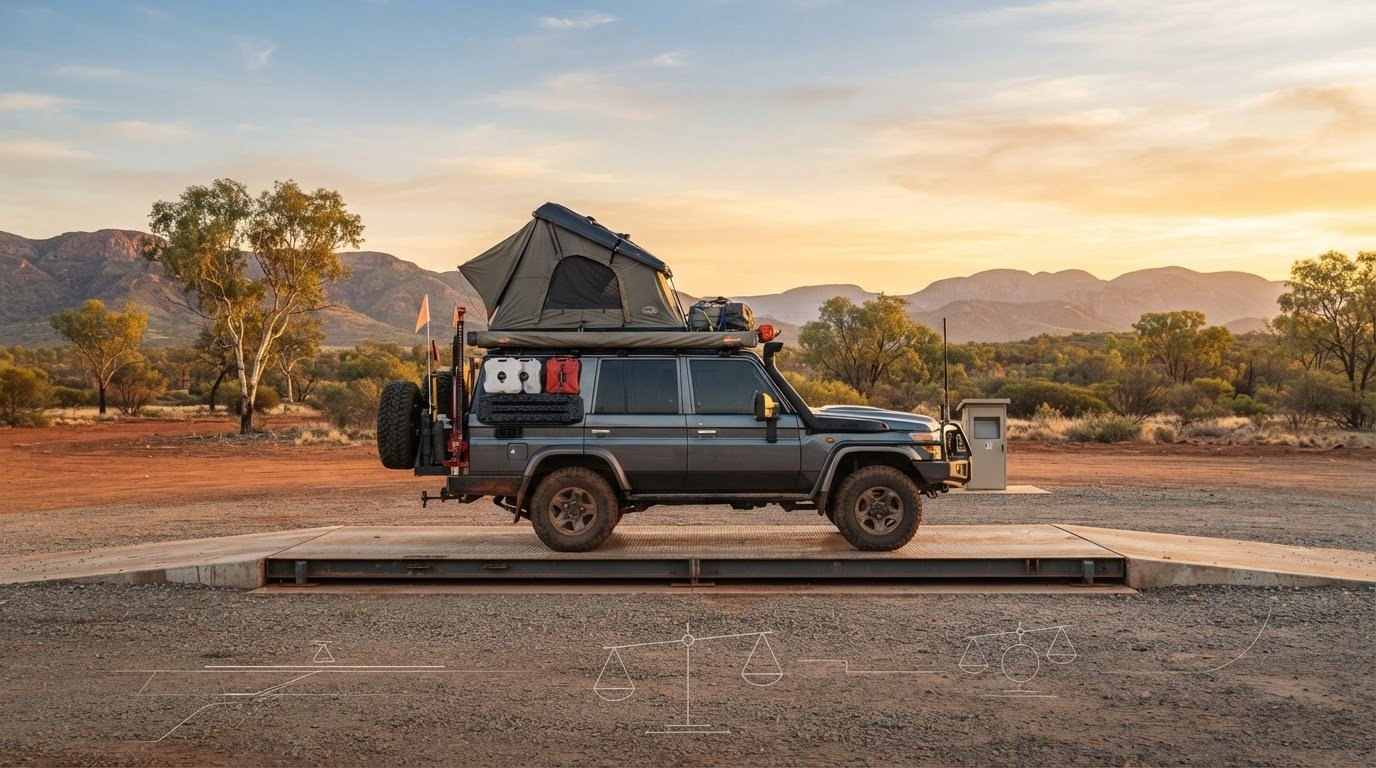
Water is your most precious resource. We calculate a minimum of 5L per person per day for drinking and basic hygiene. For a week in the scrub, that’s a lot of weight to manage. Alongside water, waste management is non-negotiable. To stay legal and respect the land, your rig needs to meet these 2026 standards:
- Fresh water storage: Carry enough for your entire stay plus two days of emergency reserves.
- Waste management: A fixed or portable chemical toilet is now mandatory at almost all council-run free sites.
- Greywater containment: Use a dedicated tank or sealed bladder. Letting your sink drain onto the ground is a quick way to earn a heavy fine in ‘Leave No Trace’ zones.
- Rubbish storage: Use animal-proof containers to haul out everything you haul in.
Portable toilet solutions have come a long way. While cassette toilets are the standard, composting units are gaining ground for long-term travel. Regardless of your choice, the goal is total containment. If we don’t protect these spots, we’ll lose them forever.
Rules, Regulations, and Avoiding Heavy Fines
Don’t let a dream trip turn into a financial nightmare. Understanding how to find free campsites in Australia requires more than just an app; it requires a deep dive into local bylaws and signage. Rangers are increasingly active in 2026, especially in high-traffic coastal zones where illegal camping has led to environmental degradation. In the Moreton Bay region, fines can reach a staggering $8056 if disputed in court, while Noosa Council issued 31 fines of $322 each in a single weekend in July 2025. We’ve seen too many legends get caught out because they didn’t read the fine print on a faded council sign. We always advocate for total compliance to keep these spots open for the long haul.
Decoding ‘No Camping’ vs ‘No Overnight Parking’
This is where many travelers trip up. “No Camping” generally means you cannot set up gear, fold out your awning, or sleep in your vehicle. “No Overnight Parking” is even stricter, meaning your vehicle cannot be there between specific hours, often 10 PM to 4 AM. A common misconception is that “resting” to avoid fatigue is a legal defense. While safety is paramount, rangers often view a fully set up rig as evidence of camping rather than a quick nap. Illegal stays on the edges of iconic sites have led to permanent closures of once-loved spots. We must respect these boundaries to ensure future access for our community.
Environmental Ethics and ‘Leave No Trace’
Our privilege to explore comes with a heavy responsibility. Fire bans are a daily reality in the Australian summer and can be declared instantly. We always check the local fire authority apps before even thinking about a campfire. If fires are permitted, we only use existing pits and never harvest local timber, which provides vital habitat for native species. Wildlife etiquette is equally critical. Keep your distance and never feed animals, as it disrupts their natural behavior and diet. Finally, the “Take In, Take Out” rule is absolute. If a site has no bins, every scrap of rubbish, including fruit peels and tissues, must go back in your rig. For those looking to upgrade their off-grid setup to meet these high standards, check out our roof top tents reviews and recommendations to stay comfortable and self-contained.
Stay alert for biosecurity signs too. Moving soil or firewood between certain regions can spread devastating pests like fire ants or fungal diseases. If a ranger asks you to move on, stay calm and respectful. They’re doing a tough job to protect the places we love. Ask for the nearest legal alternative; often, they’ll point you toward a hidden gem you won’t find on any map. Mastering how to find free campsites in Australia means being a diplomat for the camping community as much as an explorer.
Planning Your Free Camping Itinerary
We’ve covered the digital tools and the essential gear, but the true magic of a remote trip lies in the strategy of the journey itself. Knowing how to find free campsites in Australia is just one piece of the puzzle. To sustain a long-term adventure in 2026, we need a plan that keeps our gear maintained, our supplies stocked, and our safety guaranteed. We don’t just wing it; we map out our route with a focus on self-reliance and community respect. This ensures we aren’t just passing through these rugged landscapes, but actively contributing to their preservation while enjoying the ultimate freedom of the road.
The 70/30 Rule for Sustainable Travel
We advocate for a “Hybrid” approach to itinerary planning. We typically spend about 70% of our time in remote free camps and 30% in commercial caravan parks. Why? Because those service days are vital for the longevity of our trip. We use these stops for deep cleaning, refilling fresh water tanks, and catching up on laundry. More importantly, these parks are often the economic lifeblood of small rural towns. When we use free community camps, we make it a point to buy our fuel, groceries, and perhaps a counter meal at the local pub. This ensures our presence as campers is a net positive for the regional areas that host us.
Safety and Communication in the Outback
Remote camping demands a healthy respect for the environment’s unpredictability. We never leave the bitumen without a registered Personal Locator Beacon (PLB). While Starlink provides excellent data coverage for scouting, a PLB is your direct, failsafe line to emergency services when things go south. We also encourage building a ‘Nomad Network’ by checking in with fellow travellers at rest stops or via radio; knowing who is ahead of or behind you on a track adds a critical layer of security. Always verify current road conditions through local government portals before committing to any unsealed tracks to avoid getting bogged or stranded in remote areas.
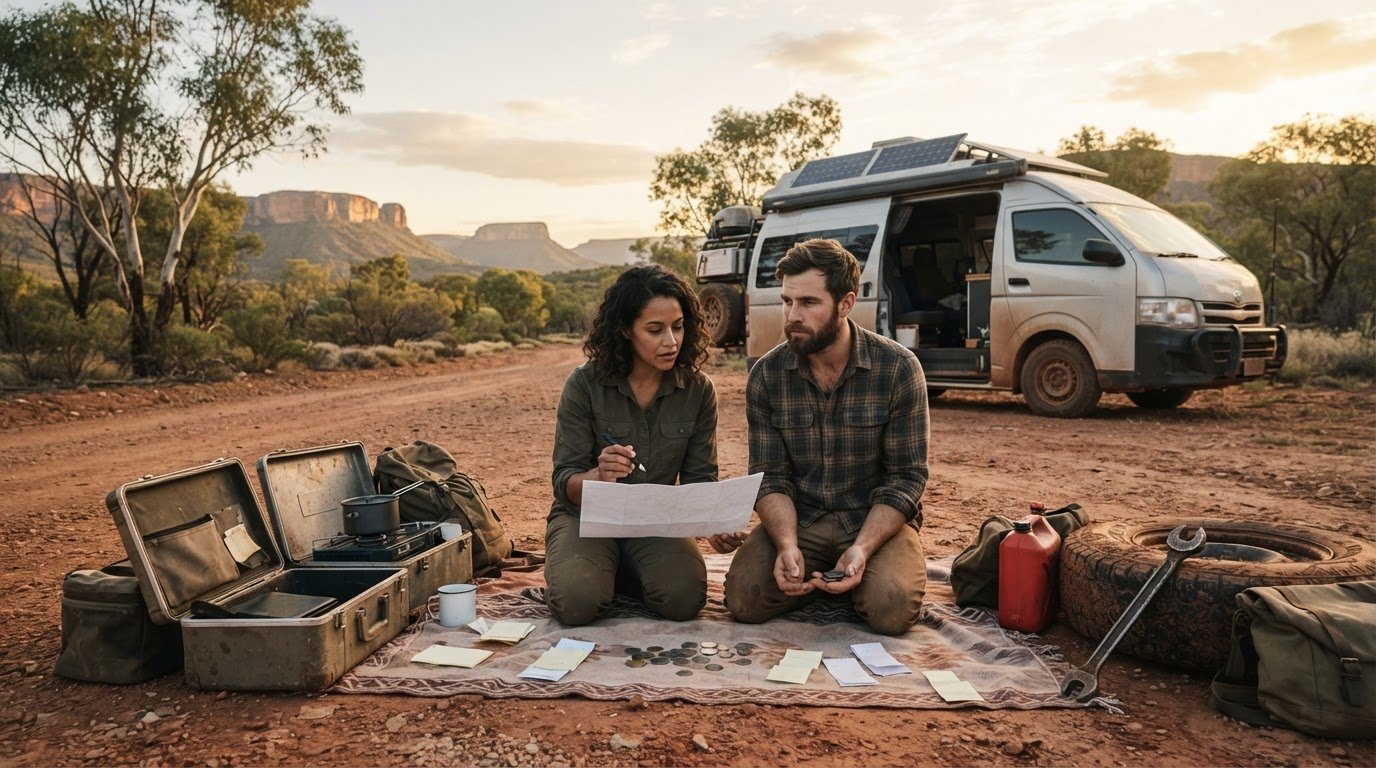
Before you shift into low range, you must map your ‘Point of No Return.’ This is the specific geographic coordinate where you no longer have enough fuel to turn back and must reach your next destination. We never guess this. We calculate our consumption based on heavy 4WD conditions, not highway speeds. Ready to lock in your next escape? Finalize your 2026 route with The Ultimate Adventure Travel Planner to ensure every detail is covered. By combining the art of how to find free campsites in Australia with a disciplined logistics framework, you’re set for a safe and legendary adventure.
Gear Up for Your Next Remote Horizon
The horizon is calling, and with the right strategy, the best of the outback is yours to discover. We’ve mastered the digital tools like WikiCamps and Starlink that redefine how to find free campsites in Australia in 2026. We also know that staying legal means embracing the ‘Certified Self-Contained’ mandate with the right gear and a ‘Leave No Trace’ mindset. These aren’t just rules; they’re the keys to keeping our wild spaces open for the entire community. Every trip we take is an opportunity to prove that responsible exploration and rugged adventure go hand in hand.
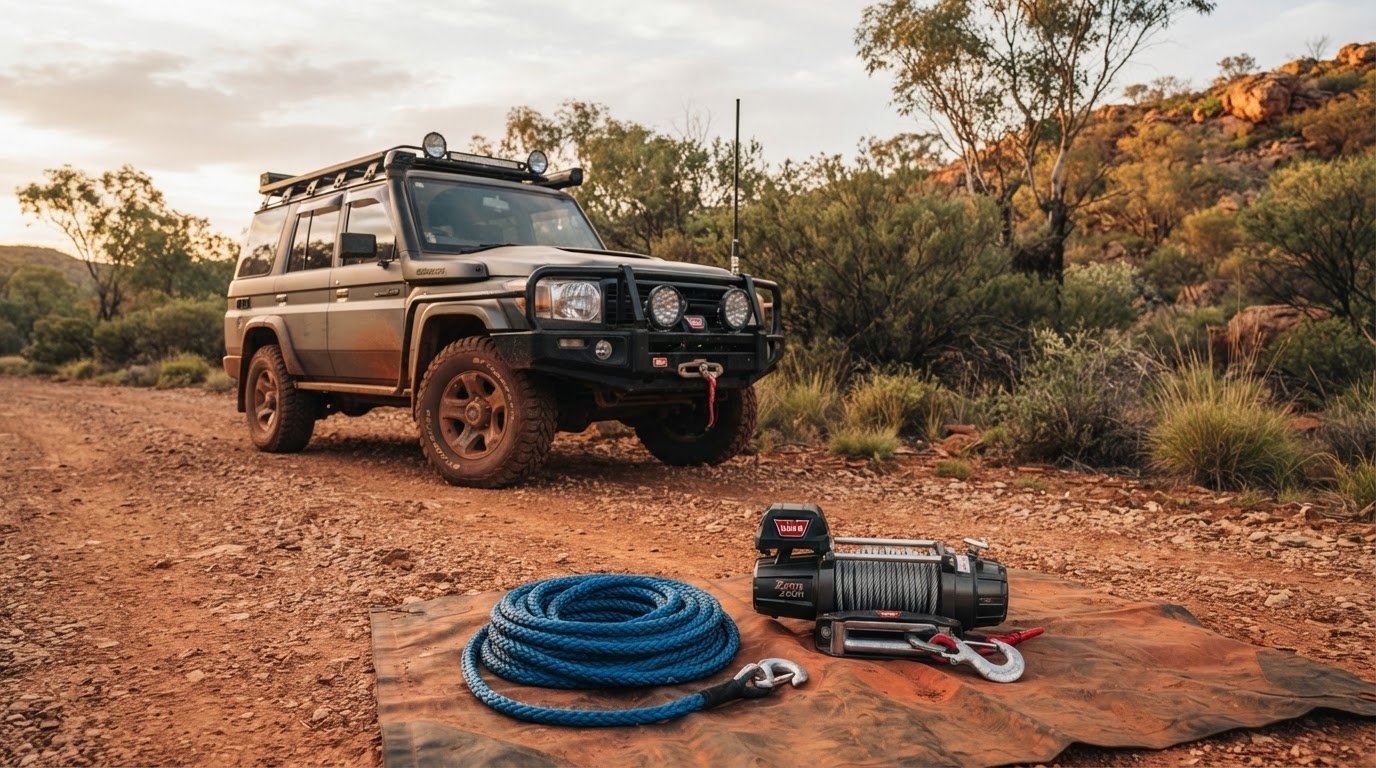
Preparation is the difference between a stressful night and a legendary memory under the stars. As dedicated sustainable travel advocates for the Australian outback, we’re here to help you dial in your setup for maximum durability. Our expert reviews on the latest 2026 4WD accessories provide the technical depth you need to stay off-grid longer. Ready to upgrade your adventure? Explore our community recommendations for the best off-grid gear and join us on the path to the perfect remote escape. We’ll see you out on the tracks!
Frequently Asked Questions
Is it legal to sleep in your car in Australia in 2026?
Sleeping in your car depends entirely on local council regulations and specific signage at your location. While it’s generally legal in designated rest areas or free campsites, many coastal and urban areas have strict bylaws prohibiting overnight stays in street parking or public parks to prevent environmental impact. We always recommend checking for “No Overnight Parking” signs to avoid a knock from a ranger. Ignorance of local bylaws won’t stop you from receiving a fine.
What is the best app for finding free campsites in Australia?
WikiCamps Australia remains the top-rated tool for our community, offering a massive database of over 65,000 sites for a one-off fee of $9.99. It’s the most effective way to learn how to find free campsites in Australia because of its real-time user reviews and offline map capabilities. We also use CamperMate and Anycamp as secondary tools to verify site conditions and check for specific facilities like dump points before we arrive.
Do I need a 4WD to access free campsites?
You don’t strictly need a 4WD to access free sites, but it significantly expands your options for remote exploration. Many council-run rest areas and showgrounds are accessible via sealed roads for 2WD vehicles and caravans. However, if you’re chasing those pristine, secluded bush camps on crown land, a high-clearance 4WD is often essential to navigate sandy tracks or creek crossings safely. Always check recent track reports before heading off-road.
How long can I legally stay at a free campsite?
Stay limits typically range from 24 to 72 hours depending on the specific location and local council rules. These limits are strictly enforced to ensure everyone in our community gets a chance to enjoy the spot and to minimize the impact on the local environment. Always check the site signage immediately upon arrival to ensure you don’t overstay your welcome. Some sites even use digital registration to track stay durations.
What does ‘fully self-contained’ mean for camping?
Being ‘fully self-contained’ means your vehicle can carry all fresh water, grey water, and black water without discharging anything into the environment. In 2026, this usually requires a fixed or portable toilet, a sealed greywater tank, and a secure rubbish storage system. This standard is the gatekeeper for many of the best sites. It proves we can camp without leaving a trace on the landscape and protects our access to sensitive areas.
Are there free campsites with showers and toilets?
Most free sites are “no-frills,” but some community-run showgrounds or donation camps do offer basic pit toilets and occasionally cold showers. However, we always plan for zero facilities. Mastering how to find free campsites in Australia means being prepared to be entirely self-sufficient. Use your own onboard systems for hygiene and waste management to keep the site pristine for the next traveller and avoid reliance on limited local infrastructure.
Can I have a campfire at a free campsite?
Campfires are only permitted if there isn’t a current fire ban and the specific site rules allow them. We always check the local state fire authority app daily, as conditions in the outback change rapidly. If fires are allowed, we only use existing fire pits and bring our own milled timber. Never strip the local environment of fallen branches, as they provide vital habitat for native wildlife and insects.
What happens if I get a fine for illegal camping?
If you’re caught camping in a prohibited area, you’ll receive an infringement notice from a council ranger or police officer. Fines vary significantly by region; for example, Noosa Council issues $322 fines, while others can be much higher. You can choose to pay the fine or dispute it in court. Be aware that disputing a fine can lead to significantly higher penalties if the matter is unsuccessful, so it’s always better to stay legal.