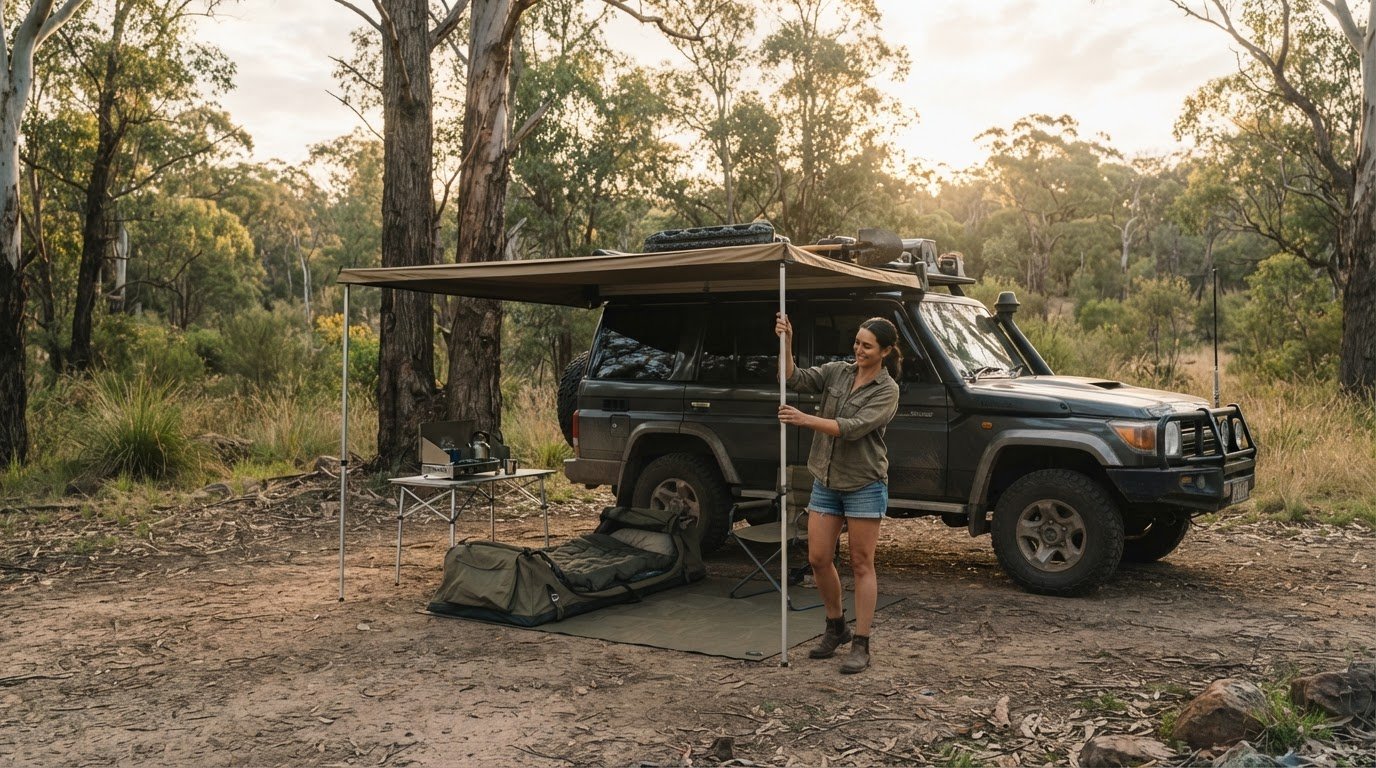
Most tourers think shade area is the only metric that matters, but a massive awning is just a giant sail if the hinge snaps on the Canning Stock Route. We’ve all felt that spike of anxiety when the wind picks up during a solo remote trip; it’s a common fear when your gear isn’t built for the outback. We know you want a reliable sanctuary that doesn’t take half an hour to pitch. Finding the best 180 degree awning Australia offers means looking beyond the canvas to the engineering that keeps us moving responsibly through the scrub.
In this 2026 expert guide, we promise to help you discover the most durable, wind-resistant 180-degree awnings tested for our harshest environments. We’ll compare everything from the latest 23kg ultralight models to heavy-duty freestanding units that deploy in under 60 seconds. You’ll get a clear look at technical specs like GSM ratings and integrated LED tech from brands like Darche and Rugged 4×4, ensuring your next investment survives the corrugations and supports your self-reliant adventures. Whether you’re navigating a dual-cab ute or a dedicated touring rig, we’ve found the gear that balances weight and strength for the long haul.
Key Takeaways
- Discover why 180-degree models are the perfect fit for dual-cab utes and short-wheelbase setups, offering maximum shade without the bulk of a full 270-degree unit.
- Learn the technical specs that define the best 180 degree awning Australia provides, focusing on hinge engineering and high GSM ripstop fabrics that survive outback corrugations.
- Uncover the truth about freestanding capability and how to manage wind lift so your equipment stays grounded during sudden desert storms.
- Get a clear checklist for calculating your vehicle’s dynamic roof load limits and GVM impacts before you mount your new setup.
- Compare our field-tested recommendations for 2026, featuring the latest innovations in light suppression and heavy-duty alloy construction.
Why the 180-Degree Awning is the Goldilocks of 4WD Shade
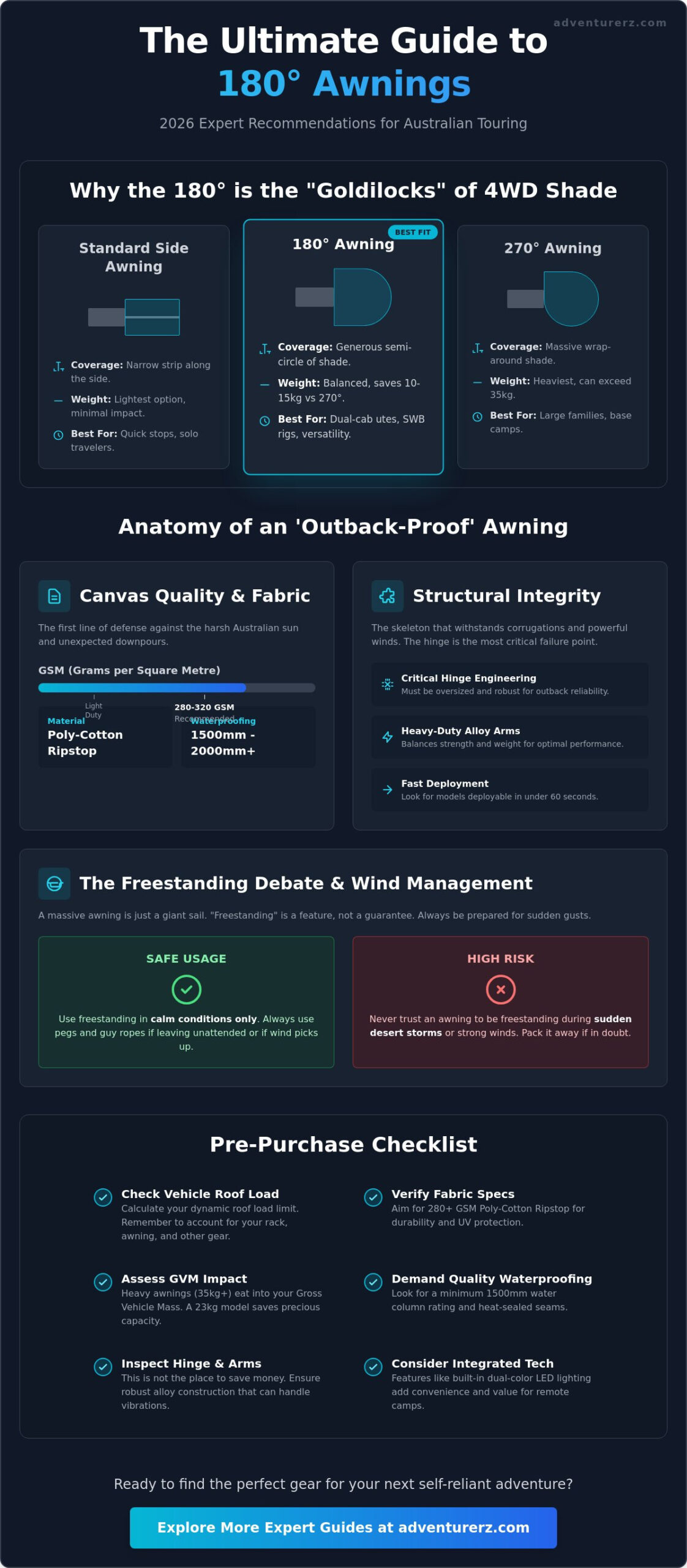
Choosing the right shade setup is often a game of trade-offs. We find that the 180-degree awning hits the sweet spot for many in our community. Unlike a standard side awning that only covers a narrow strip, or a massive 270-degree unit that wraps around the rear, a 180-degree model fans out from the side of your vehicle to provide a generous semi-circle of protection. It’s the ideal choice for dual-cab utes where a rear-wrapping awning might interfere with a canopy or high-mount spare tires. When searching for the best 180 degree awning Australia has to offer, we look for that perfect balance between rapid deployment and enough footprint to keep the whole crew out of the sun. Whether you’re pulling over for a quick billy tea or setting up for a multi-day stay in the Pilbara, the 180-degree configuration provides the versatility we need without the unnecessary bulk.
180 vs. 270 Degree Awnings: Which Suits Your Rig?
Weight is the enemy of every remote tourer. We’ve seen 270-degree awnings tip the scales at over 35kg, while a high-quality 180-degree model often saves you 10 to 15kg. That’s a significant chunk of your roof load limit saved for fuel or water. If your 4WD has a vertical rear door or you simply don’t need shade behind the vehicle, the 180-degree setup is far more efficient. Deployment is also a breeze. With a single main hinge, you aren’t wrestling with multiple arms or complex tensioning systems. It makes those quick roadside lunch stops much more appealing. Modern vehicle and camping awnings are designed for solo operation, ensuring you spend less time on the setup and more time soaking in the environment. We Adventurerz value gear that gets us into the wild faster.
The Australian Advantage: UV Protection and Heat Reduction
Our sun doesn’t play fair, especially when it’s low on the horizon in the late afternoon. The 180-degree design offers excellent vertical coverage that blocks that harsh, angled glare. We recommend looking for heavy-duty poly-cotton ripstop canvas, ideally 280 GSM or higher, or silver-lined materials that actively reflect heat. This isn’t just about personal comfort; it’s about gear longevity. Keeping your fridge and kitchen setup in the shade prevents heat soak, which means your batteries don’t have to work nearly as hard. This self-reliance is key when you’re hundreds of kilometers from the nearest service station. For more insights on choosing the right gear for your setup, check out our guide on the best 4wd awnings. By choosing a setup that prioritizes durability and thermal protection, we can minimize our impact on the environment by using less energy and making our equipment last through years of rugged exploration. We believe that better gear leads to better stewardship of the land we love.
Technical Specs: What Makes a 180-Degree Awning ‘Outback Proof’?
We’ve all seen a cheap awning buckle under the first sign of a Southerly Buster. While some might claim that “canvas is canvas,” our community knows that the technical details are what keep us safe and shaded in the deep outback. To find the best 180 degree awning Australia offers, we must look at the raw materials that survive the corrugations of the Canning Stock Route. In 2026, the industry has shifted toward higher-spec alloys and smarter fabric blends that prioritize both durability and environmental accountability. We look for gear that doesn’t just work on day one, but remains a reliable mentor for years of exploration.
Canvas Quality and Waterproofing Ratings
Canvas weight is measured in GSM, or grams per square metre. While lighter 230 GSM polyester fabrics are easier to pack and less prone to mold if you’re forced to pack up wet, they often lack the thermal insulation we need in the desert. We generally recommend a poly-cotton ripstop canvas between 280 GSM and 320 GSM for the best balance of weight and UV protection. Look for a water column rating of at least 1500mm to 2000mm; this ensures you stay dry during a tropical downpour. While we analyze these specs, it’s helpful to remember that advocacy groups often reference the Standards Australia guide for caravan awnings to ensure consumer safety and product reliability. High-quality units also feature UV-stable thread and heat-sealed seams, preventing the slow degradation that turns a premium awning into a leaky mess.
Structural Integrity: Hinges and Arms
The hinge is the heart of any 180-degree setup. We look for 304-grade stainless steel or high-tensile T6 aluminium to prevent rust, especially for those of us who love coastal camping. Trussed arm designs provide much better rigidity against wind lift compared to simple solid box sections. Structural hinge fatigue is the progressive weakening of the pivot point caused by repeated wind-induced stress cycles and vibration, eventually leading to catastrophic failure if the material grade is insufficient. To combat this, premium brands now use oversized pivot bolts and reinforced mounting brackets. We are also excited to see the move toward sustainability, with Darche leading the way through their ECO range made from recycled materials. If you’re looking to pair your shade with a sleeping setup, our reviews of roof top tents can help you find a compatible mounting solution. By choosing gear with these technical markers, we ensure our footprint is light but our protection is heavy.
The Freestanding Debate: Can You Trust the Wind?
The allure of a 30-second setup is what often leads us to search for the best 180 degree awning Australia can provide. We’ve all seen the marketing videos: a solo traveler hops out, swings the arm, and clicks it into place without a single pole in sight. It’s a game-changer for those quick roadside breaks. However, we need to talk about what “freestanding” actually means in the unpredictable Australian outback. A true freestanding awning relies on the sheer strength of its hinge and arms to support the weight of the canvas without vertical assistance. While this is incredibly convenient, it’s not a “set and forget” solution for every environment. We believe in being methodical and prepared, ensuring our gear doesn’t become a liability when the weather turns.
Physics doesn’t take a holiday. Because of their large surface area and aerodynamic shape, 180-degree awnings effectively act like wings. A sudden gust can create massive upward lift, putting immense strain on your roof rack and the awning’s pivot points. We follow a simple 20km/h rule of thumb: if the wind is pushing past a light breeze, the poles come out. It’s a small step that protects your investment and your vehicle’s panels from torque damage. For more advice on mastering your camp setup, check out our guide on the best 4WD awnings where we dive deeper into various configurations.
Wind Ratings vs. Reality
You’ll rarely find an official wind rating on an awning. Manufacturers avoid them because there are too many variables; the angle of your vehicle, the type of roof rack, and the gust frequency all play a role. Instead of looking for a number, look for the quality of the tension straps and guy-rope points. We always recommend securing your setup even if it feels sturdy. In sandy or rocky terrain where standard pegs fail, we use heavy-duty sand pegs or weight bags. This contemplative approach to safety ensures we can enjoy the vista without worrying about a snapped hinge.
Integrated vs. Detachable Poles
For solo travelers, integrated drop-down poles are a blessing. They’re tucked away in the arms, ready to be deployed in seconds if the wind picks up. We’ve found that these are far more likely to be used than detachable poles buried in a storage bag. Self-reliance is about having the right tools at your fingertips. If your chosen model doesn’t include them, carrying a dedicated set of telescopic poles is a non-negotiable safety protocol. By taking these extra seconds to secure our shade, we respect the power of the natural environment and ensure our equipment lasts for years of responsible exploration. We’re here to guide each other toward better, safer adventures.
Buyer’s Checklist: Weight, Mounting, and Compatibility
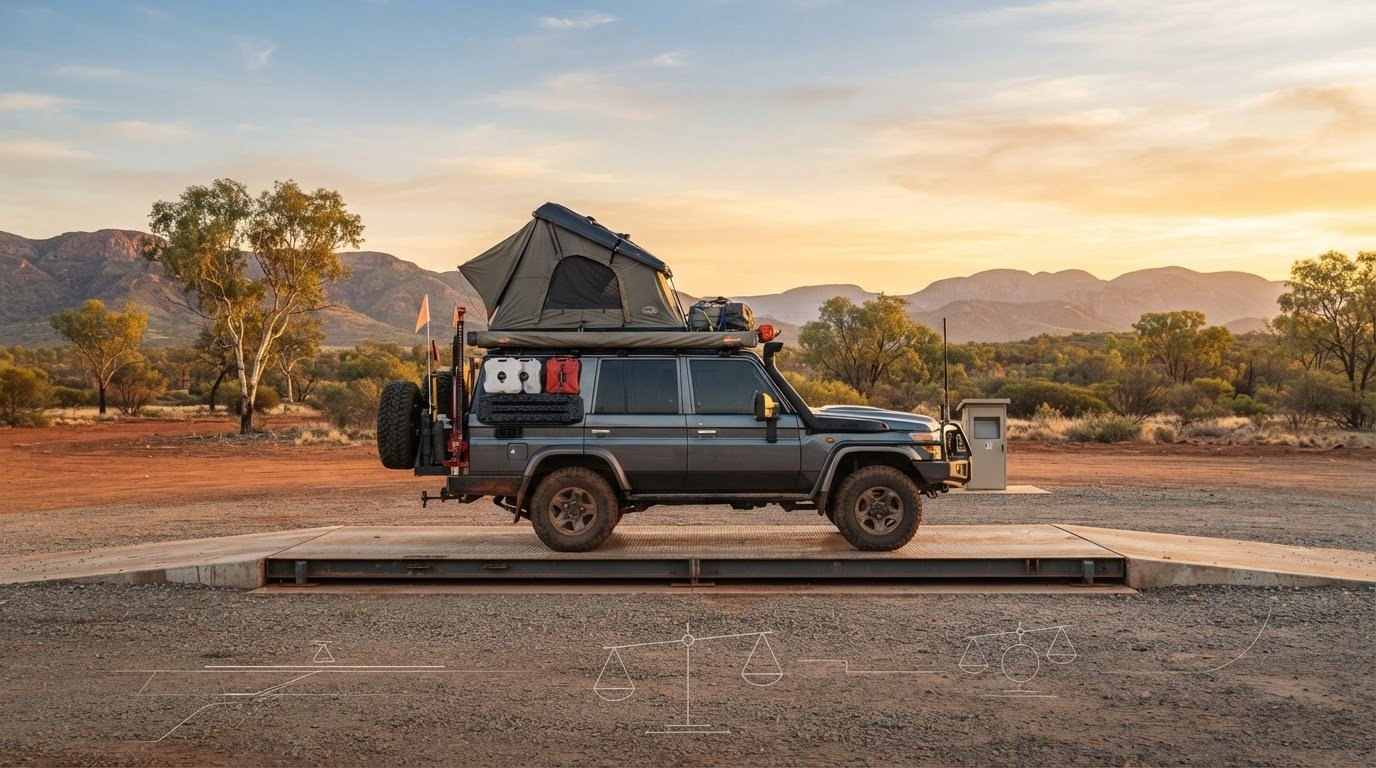
Preparing your rig for a remote crossing is about more than just bolting on the shiny stuff. We need to be methodical about our weight budget. Every kilogram we add to the roof affects our Gross Vehicle Mass (GVM) and, more importantly, our center of gravity. Finding the best 180 degree awning Australia offers involves checking the fine print of your vehicle’s manual before you commit to a purchase. We’ve seen tourers focus purely on shade area while ignoring the dynamic roof load limits that govern how a vehicle handles at 100km/h on a bitumen stretch or 40km/h on a corrugated track. See how awnings pair with roof top tents for the ultimate setup that respects your vehicle’s limits.
Dynamic load limits are typically much lower than static ones. While your roof rack might support 300kg when you’re parked at camp, it might only be rated for 100kg or less when the vehicle is in motion. A heavy-duty 180-degree awning, such as the Rugged 4×4 Platinum 2.5m, weighs in at 32kg. This weight sits high and to one side, which can noticeably change your vehicle’s roll and handling characteristics. We always advocate for a balanced approach to rig building to ensure we stay safe on the shared path toward discovery.
Weight Distribution and Center of Gravity
A 25kg to 32kg side-mounted weight creates a natural lean. To counter this, we often recommend balancing your setup by mounting lighter gear like shovels or recovery tracks on the opposite side. Choosing between a 2-metre and 2.5-metre awning isn’t just about shade; it’s about leverage. A longer awning box often requires more robust mounting points to prevent the brackets from flexing. If you’re running a short-wheelbase vehicle, the compact 23kg Destination4WD D180 might be a better fit than a massive 32kg unit that overshoots your roofline. We want our equipment to be hardy, not a hazard.
Mounting to Different Roof Rack Systems
Compatibility is where many DIY installs go wrong. Most premium 180-degree awnings require specialized L-brackets or rack-specific mounts rather than generic crossbar clamps.
- Platform Racks: Systems like Rhino-Rack, Front Runner, and Yakima usually have dedicated T-slot channels that provide the most secure attachment for heavy awnings.
- Traditional Crossbars: Be extremely cautious here. The torque generated by a fanning awning can twist standard bars, potentially damaging your roof rails.
- Corrugations: After a day of rattling on outback tracks, bolts can and will vibrate loose. We make it a ritual to check all mounting hardware every morning before we head out.
Self-reliance means knowing every nut and bolt on your rig. Before you make your final choice, explore our field-tested recommendations for the best 4wd awnings to see which mounting systems have survived our toughest expeditions. By being methodical in our preparation, we protect both our vehicles and the pristine environments we travel through.
The Best 180-Degree Awnings in Australia for 2026
Selecting the right gear is the difference between a relaxing sunset and a stressful recovery session. After thousands of kilometers of testing across the Simpson Desert and the Kimberley, we’ve identified the top performers that define the best 180 degree awning Australia has available this year. Our community values equipment that respects the environment through durability, ensuring we don’t leave broken frames in our wake. Whether you’re after the fastest 30-second deployment or the most advanced light-blocking fabrics, these models have earned their place on our rigs. Once you’ve picked your shade, use The Ultimate Adventure Travel Planner to map your next awning-ready trip through the red center.
- The Bush Company 180: This is the undisputed heavy-duty king. Its trussed arm design and massive 304 stainless steel hinges make it a true freestanding powerhouse that laughs at coastal gusts.
- 23Zero Peregrine 180: If you struggle with the heat, this is your solution. Their Light Suppression Technology (LST) blocks up to 95% of sunlight, keeping the area underneath significantly cooler than standard canvas.
- Darche Eclipse 180: We love the versatility here. The Gen 2 model offers incredible modularity with wall sets, while the ECO version aligns with our ethics by using recycled materials without sacrificing that 320 GSM ripstop strength.
- Oztent Foxwing 180: A classic for a reason. It remains a top pick for those who prioritize a rhythmic, structured setup process and want a product with a long history of spare parts availability across regional Australia.
Premium vs. Budget: Is the Extra $500 Worth It?
We often see a $500 price gap between entry-level models like the Kozi at $999 and premium LED-integrated units at $1,499. In the remote outback, we follow a “Buy Once, Cry Once” philosophy. Budget brands often cut corners on the small things that matter most: plastic hinge bushings that crack in the heat, zips that jam with fine bulldust, and storage bags that degrade under intense UV. A premium investment usually buys you T6 aluminium arms and a structural warranty that actually means something when you’re in a remote town. We believe in being methodical. Check the availability of replacement hinge bolts before you head off; it’s a small detail that keeps you self-reliant.
Modular Add-ons: From Awning to Annex
Your 180-degree setup is just the beginning. By adding front or side walls, you can transform 6 to 12 square meters of shade into a fully enclosed, weather-proof kitchen or sleeping area. This is a game-changer for long-term stays where the wind won’t quit. We also recommend looking at integrated lighting. Models like the Tuff Terrain or the Darche Freestanding LED version save you from fumbling with headlamps while cooking. Integrating dimmable LED strips directly into the awning arms keeps your camp organized and minimizes your impact on the nocturnal environment by controlling light spill. We’re all in this together, so let’s gear up responsibly and keep the adventure alive.
Ready for the Track: Your Path to Better Shade
Preparing your rig for the next big crossing is a methodical process that rewards those who prioritize engineering over marketing hype. We’ve explored how the right hinge materials and canvas GSM can make or break a trip on the Canning Stock Route. By keeping your GVM in check and respecting the physics of wind lift, you ensure your setup remains a reliable sanctuary rather than a liability. Finding the best 180 degree awning Australia offers means choosing gear that stands up to authentic outback conditions while supporting our shared commitment to responsible, sustainable travel.
Part of being ready for the track is ensuring you have access to essential services even in the deep outback; you can learn more about Aussie Scripts to discover how their telehealth platform supports remote travelers.
We’re here to help you navigate these technical choices with confidence. Our team of 4WD enthusiasts has spent years testing this equipment in the dust and heat to provide you with expert, field-proven reviews. We focus on gear that promotes self-reliance and durability for those visiting our most isolated locations. Ready to finalize your touring setup? Explore our community’s top-rated 4WD gear recommendations! We believe that the right preparation leads to deeper discovery and a lighter footprint on the land we love. See you out on the tracks!
Frequently Asked Questions
Is a 180-degree awning better than a 270-degree awning?
It depends entirely on your vehicle’s layout and weight capacity. We find that 180-degree models are often superior for dual-cab utes and short-wheelbase rigs because they save between 10kg and 15kg compared to full wrap-around units. While they offer less total shade area, their simpler single-hinge design makes them faster to deploy for quick roadside stops. If you don’t need shade directly behind your vehicle, the 180-degree setup is the more efficient, lightweight choice.
Can I install a 180-degree awning on a small SUV?
Yes, you can install one as long as you remain within your vehicle’s dynamic roof load limits. We recommend looking for lighter models like the Destination4WD D180, which weighs approximately 23kg, to minimize the impact on your center of gravity. Always verify that your roof rack or crossbars are rated for the weight of the awning plus the torque generated during deployment. Smaller vehicles benefit greatly from the compact footprint of these units.
Do I really need poles for a freestanding 180-degree awning?
Poles are essential whenever the wind speed exceeds a light breeze. While “freestanding” means the arms can support the canvas weight in calm conditions, we follow a strict 20km/h rule of thumb for remote safety. Using poles and guy ropes prevents upward wind lift from damaging your hinges or putting excessive torque on your roof rack. It’s a small step that ensures your equipment survives the unpredictable outback environment.
How much weight does a 180-degree awning add to my roof rack?
Most 180-degree awnings in Australia weigh between 23kg and 32kg. For example, the Rugged 4×4 Platinum 2.5m model sits at the heavier end at 32kg, while more compact 2-metre versions typically weigh around 24kg to 27kg. This weight is a permanent addition to your GVM and sits high on the vehicle, so it’s vital to account for it when calculating your total load for a remote expedition.
What is the best way to clean and maintain my 4WD awning?
Use a soft brush and cool, clean water to remove dust and salt spray after every trip. We advise against using harsh detergents or pressure washers, as these can strip the waterproofing treatments and damage the UV-stable threads. Periodically check the hinge bolts for tightness and apply a dry silicone lubricant to moving parts to ensure smooth operation. Maintenance is about being methodical so your gear remains a reliable mentor on the tracks.
Can 180-degree awnings be mounted on either side of the vehicle?
Most 180-degree awnings are side-specific, meaning you must choose between a Left-Hand Side (passenger) or Right-Hand Side (driver) model at the time of purchase. The hinge orientation and fanning direction are fixed during manufacturing to ensure the arms swing toward the front and rear correctly. We generally recommend passenger-side mounting so you are shaded on the side of the vehicle furthest from passing traffic during roadside breaks.
What happens if my awning gets wet before I pack it away?
You can pack a damp awning temporarily, but you must open it to dry completely within 24 to 48 hours. Poly-cotton ripstop canvas is a hardy material, but it’s susceptible to mold and mildew if stored wet in a sealed bag for extended periods. If you’re forced to pack up in a tropical downpour, make it a priority to deploy the awning at your next dry camp to preserve the fabric’s integrity and waterproofing.
Are there 180-degree awnings that include built-in LED lighting?
Integrated technology is a growing trend for the best 180 degree awning Australia offers in 2026. Models like the Tuff Terrain 180 and the DARCHE Freestanding LED Awning feature dimmable LED strips built directly into the rafter arms. This setup reduces camp clutter and provides efficient, targeted light for your kitchen area. It’s a brilliant way to maintain self-reliance while minimizing your light spill in pristine natural environments.