You’re three days into a remote trek through the Kimberley when the midday sun hits its peak and your watch screen becomes a useless mirror of glare. We’ve all felt that sinking feeling when a battery percentage drops faster than the sun over the horizon, leaving you without the maps you rely on. Finding the best outdoor smartwatch Australia demands more than just checking a spec sheet; it requires gear that’s as hardy and methodical as the people wearing it. As Bush-Trackers, we understand that a watch is a survival tool, not a luxury gadget, especially when you’re navigating deep gorges or heavy scrub where GPS signals struggle.
Our team has spent months testing the latest 2026 releases to see which ones actually survive the red dust and salt water of our unique environment. We promise to help you discover a high-performance companion that offers weeks of battery life and readable offline maps without needing a phone signal. This guide previews the top rugged picks, from the solar-powered endurance of the Garmin Instinct 3 to the satellite-ready Apple Watch Ultra 3. We’ll also cover essential AMSA safety regulations for those using new emergency messaging features, ensuring you’re prepared for every kilometer of the track ahead.
Key Takeaways
- Understand how to transition from casual trackers to ruggedised navigation tools that act as a vital safety backup for your primary GPS.
- Identify the best outdoor smartwatch Australia for your specific needs by comparing battery endurance in high-intensity GPS modes versus solar-assisted longevity.
- Explore why we’ve selected the Garmin Fenix 8 and Coros Vertix 2S as the leading choices for durability and value on the 2026 market.
- Learn the essential steps for calibrating sensors and syncing offline maps to maintain accurate data when you’re well beyond mobile reception.
- Access our final pre-purchase checklist to ensure your chosen gear can withstand the dust, mud, and heat of the Australian trail.
Table of Contents
Why an Outdoor Smartwatch is Essential for Australian Remote Travel
In 2026, we don’t just view our gear as gadgets; we view them as lifelines. Choosing the best outdoor smartwatch Australia has to offer isn’t about counting steps on a treadmill. It’s about having a ruggedized navigation tool that survives where your phone or a standard tracker would fail. When you’re hundreds of kilometers from the nearest town, self-reliance is everything. For those new to the tech, you can find a comprehensive overview of smartwatch technology to understand the basics, but for our community, the focus is purely on the bush. We need tools that match our hardy, methodical approach to exploration.
We also believe in buying gear that lasts. Low-quality electronics end up in landfills far too often, which contradicts our commitment to environmental ethics. By investing in a high-performance, durable watch, we’re reducing electronic waste and ensuring our community stays accountable to the environments we love to explore. A watch that survives five years of dust and mud is far better for the planet than a cheap model that breaks after one trip to the Kimberley. In the 2026 remote travel landscape, our tech must be as resilient as our spirit.
Beyond the Step Counter: Navigation and Safety
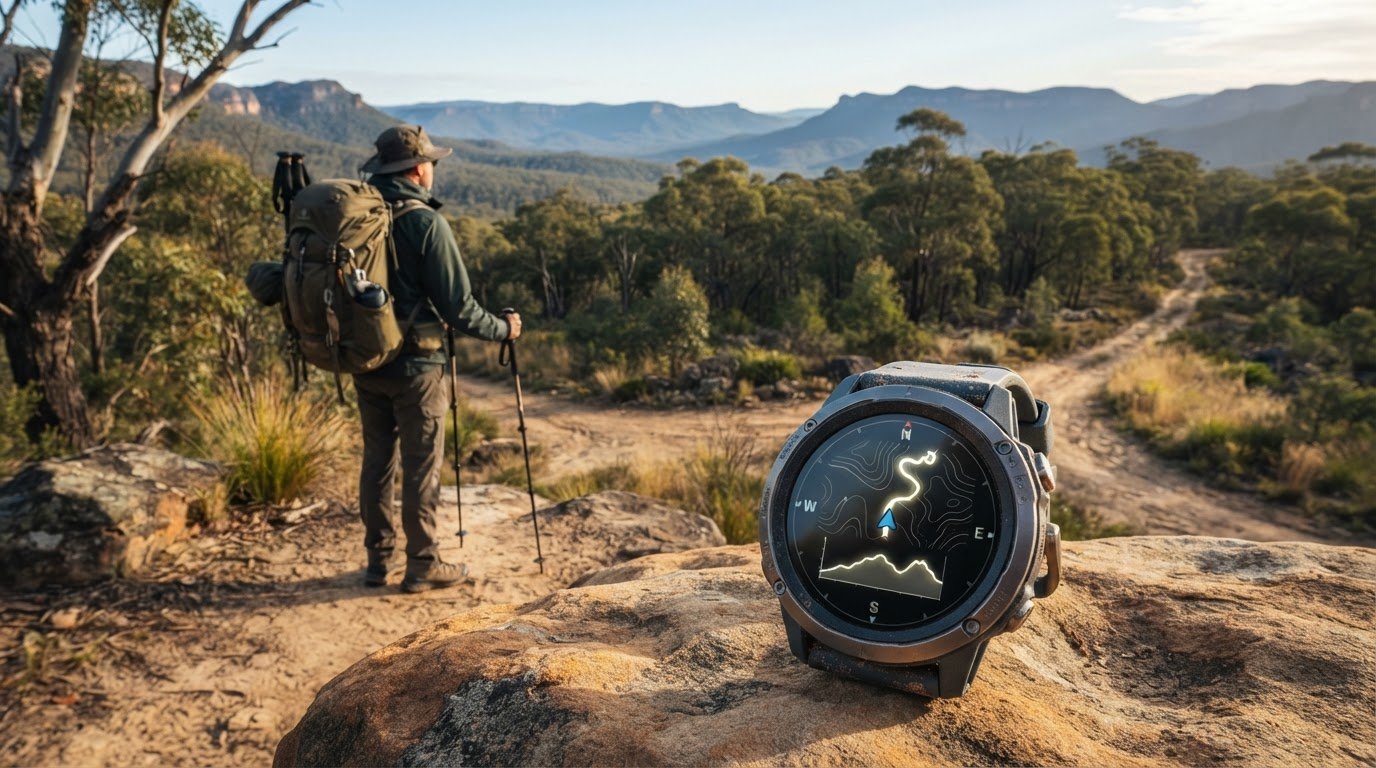
Offline maps are a non-negotiable requirement when you’re trekking through the High Country. If you lose your primary GPS or your phone battery dies from searching for a signal, your watch becomes your primary guide. Modern units now integrate seamlessly with satellite communication systems, allowing for emergency SOS triggers directly from your wrist. We also rely heavily on barometric altimeters. These sensors track changes in air pressure to provide storm alerts. This gives us plenty of time to secure the camp before the weather turns. It’s about having that “safety first” mindset in every piece of kit we carry.
Durability Standards for the Australian Outback
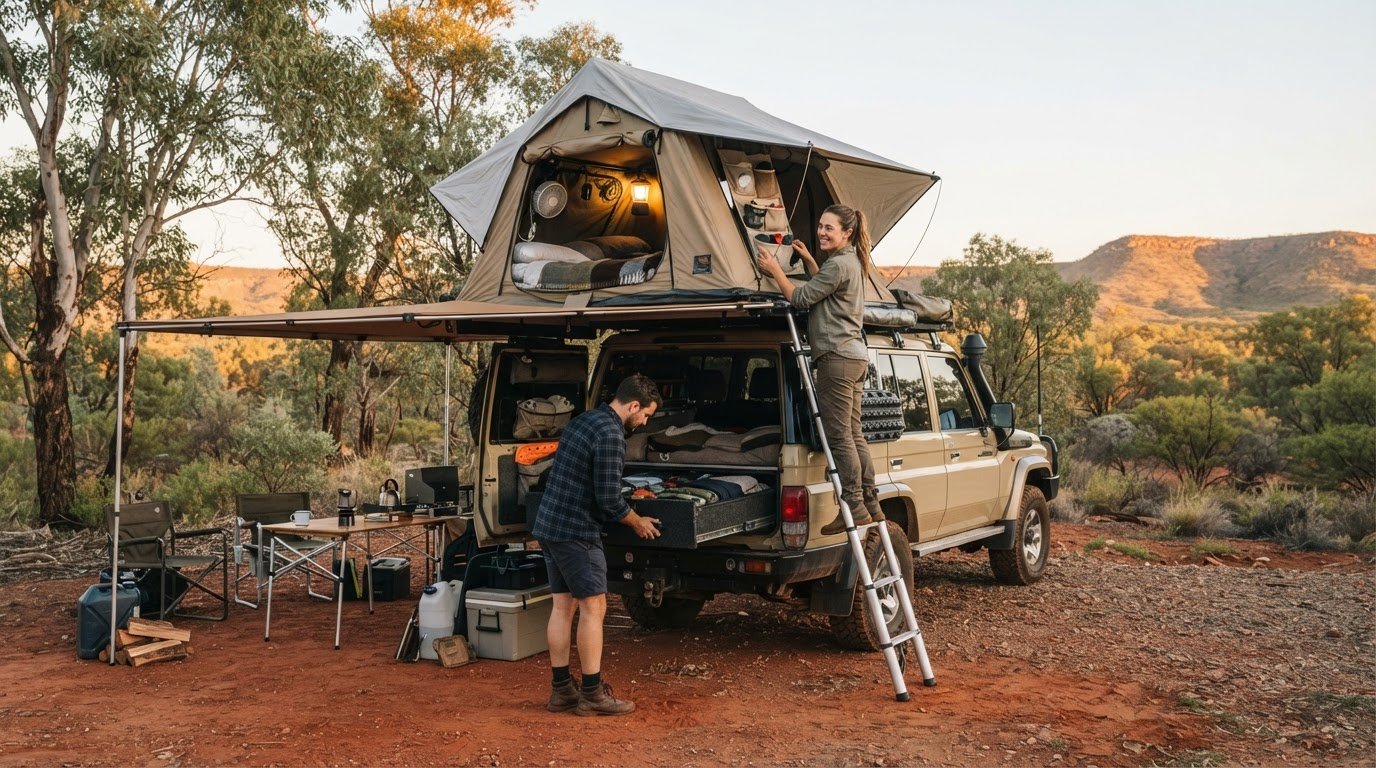
The Australian environment is famously harsh on equipment. We always look for the MIL-STD-810 rating. This is a military standard testing for thermal, shock, and water resistance. It’s the difference between a watch that fogs up in the humidity and one that keeps ticking after a dunk in a creek. When it comes to the screen, sapphire crystal is our top recommendation. While Gorilla Glass is tough, sapphire is almost impossible to scratch, even when it’s covered in the abrasive red grit of the Outback. Once you’ve secured your wrist-based tech, pair your gear with a reliable roof top tent for the ultimate remote setup. This combination of high-tech navigation and hardy shelter ensures we’re ready for any track we choose to tackle.
Key Selection Criteria: How to Choose Your Adventure Partner
Finding the best outdoor smartwatch Australia offers involves more than just picking the most expensive model on the shelf. We look for a partner that matches our methodical approach to the bush. In the remote corners of the country, your watch needs to handle three core challenges: relentless sun, deep terrain, and the total absence of a power grid. We prioritise functional reliability over flashy lifestyle features every time. While global tech reviewers might focus on how a watch looks at the gym, our community knows that a device is only as good as its performance in the red dust of the Pilbara.
One critical factor we always test is GNSS accuracy. Standard GPS often struggles in deep gorges or under heavy canopy in the wet tropics. We recommend looking for multi-band (L1+L5) satellite support. This technology allows the watch to filter out signal reflections from cliff walls, ensuring your track remains accurate even when the sky is partially obscured. Pair this with high-detail TOPO maps. We prefer maps that show clear contour lines and reliable water sources, which are far more valuable than basic street layouts when you’re navigating off-track.
Solar charging is another area where Australian conditions provide a massive advantage. While European or American testers might find solar tech underwhelming, our high UV levels and clear skies mean we can harvest significant energy. A high-quality solar watch can extend a trip by days or even weeks. We’ve found that efficient solar rings can keep a device running almost indefinitely in “Expedition Mode” if you’re getting enough lux hours each day. It’s a great way to stay environmentally accountable by reducing our reliance on portable power banks and disposable batteries.
The Battery Endurance Challenge
Battery life is the ultimate metric for remote travel. We distinguish between “Smartwatch Mode,” which is fine for the suburbs, and “Full GPS Mode,” which is what matters on the trail. Some 2026 flagship models now push beyond 300 hours of continuous GPS tracking. We always suggest managing your power profiles before you leave. By turning off non-essential background syncing and heart rate alerts, you can ensure your navigation stays live for the duration of a multi-week trek. If you’re still dialling in your gear list, check our roof top tent recommendations to see how we balance high-tech tools with hardy shelter.
Display Technology: Visibility in Harsh Light
The debate between MIP (Memory-in-Pixel) and AMOLED screens is settled by the sun. AMOLED displays look stunning in the shade, but they often struggle with glare and high power consumption in the midday Australian heat. We generally prefer MIP displays for serious exploration. They use ambient light to become more readable as the sun gets brighter, and they sip power compared to their vibrant cousins. This choice ensures you can glance at your wrist and see your coordinates instantly without fumbling with brightness settings while your hands are covered in grit.
The Best Outdoor Smartwatches in Australia for 2026
We’ve put the latest 2026 releases through their paces to find the best outdoor smartwatch Australia has available for our community. Whether you’re a hardcore trekker or a casual weekend warrior, these picks represent the peak of reliability and environmental accountability. We look for gear that survives the long haul, reducing the need for frequent replacements and keeping our footprint small. Our testing focuses on how these units handle the heat and isolation of the outback, ensuring they won’t let you down when you’re off the grid.
Top Picks Comparison Table
| Model | Battery (GPS Mode) | Mapping Style | Best For |
|---|---|---|---|
| Garmin Fenix 8 | 90+ Hours | Full TOPO Color | Multi-sport Pro |
| Coros Vertix 2S | 118 Hours | Global Offline | Remote Expeditions |
| Apple Watch Ultra 3 | Up to 35 Hours | Vector Maps/Satellite | Weekend Adventurers |
| Garmin Instinct 3 Solar | Unlimited (Expedition) | Breadcrumb/Basic | 4WDers & Hunters |
The Garmin Fenix 8 remains the gold standard for versatility. It balances advanced health metrics with incredible durability, making it the top choice for those who switch between hiking, surfing, and 4WDing. For those who prioritize raw endurance, the Coros Vertix 2S is a standout. It offers massive battery life that suits multi-week trips where charging isn’t an option. If you need to stay connected to civilization while exploring the fringes, the Apple Watch Ultra 3 provides the best urban to bush transition, now featuring enhanced satellite connectivity for emergency messaging in areas without cellular coverage.
For the unbreakable category, we always point 4WDers toward the Garmin Instinct 3. At A$729.00 for the Solar version, it’s built to survive being dropped on rocks or covered in mud. It doesn’t have the fancy color maps of the Fenix, but its high-contrast screen is perfect for quick glances while bouncing along a corrugated track. It’s a methodical tool for those who value function over form.
Value for Money: The “Harga” Factor
When we discuss the “harga” or price factor, we’re looking at more than just the initial receipt. Spending more upfront on a titanium bezel and sapphire crystal build often saves money over a five-year gear lifecycle. A cheaper plastic watch might crack after one season in the desert, whereas a premium build like the Coros Vertix 2S (A$1,149.95) is designed to be a lifelong partner. We also recommend keeping an eye out for deals on older flagships. For example, the Garmin Epix Pro Gen 2 is currently seen as a high-value alternative at A$862.00, offering premium sapphire glass and an AMOLED screen at a significantly reduced price point compared to its launch.
Maximising Your Gear: Practical Tips for Bush Navigation
Before we even lock the hubs or shoulder our packs, we always perform a trailhead ritual: calibration. Even the best outdoor smartwatch Australia can offer will drift if you don’t account for local magnetic declination or sudden pressure changes. We take sixty seconds to calibrate the compass and altimeter at the start of every track. This ensures our breadcrumb trail is precise, especially when we’re relying on the “Backtrack” feature to find our way back to camp after a day of exploring off-track. It’s about being methodical with our tech so it remains a reliable partner when the terrain gets tough.
Syncing your data is just as vital. We never rely on 4G or 5G signals once we’re past the cattle grate. We use our home Wi-Fi to download high-resolution TOPO maps directly to the device before we leave. This ensures every contour line and creek bed is available offline. Once we’ve set up our basecamp, we often use a high-quality 4WD awning as our dedicated tech station. It’s the perfect spot to review the day’s data or plan the next leg while protected from the sun. Check out our 4wd awnings reviews and recommendations to find the best shade for your next tech-enabled escape.
Safety and Emergency Protocols
While modern watches offer incident detection, we view them as one part of a wider safety net. In the event of a roll-over or serious injury, your watch can provide precise GPS coordinates in seconds. We practice reading these coordinates aloud to ensure we can relay them over a UHF radio or to emergency services. Remember that while some watches now have satellite messaging, they don’t replace a dedicated Personal Locator Beacon (PLB). All PLBs must be registered with the Australian Maritime Safety Authority (AMSA); a process that is free and valid for two years. We always carry a physical map as a third-tier backup because tech can fail, but paper doesn’t need a battery.
Sustainable Tech Practices
We believe in gear that lasts a decade, not just a season. To maintain your watch’s battery health between trips, we recommend storing it at around 50 percent charge rather than letting it go flat. This simple habit extends the lithium-ion lifespan and reduces electronic waste. We also prioritise brands that offer repair programmes for broken screens or worn seals. This aligns with our commitment to environmental ethics and responsible exploration. For more advice on minimising your footprint, explore our sustainable travel tips for your next journey through the wild.
Choosing Your Adventure Partner: Final Recommendations
Selecting the best outdoor smartwatch Australia has to offer is the final step in refining your remote travel kit. We’ve explored the technical specs and the practical bushcraft applications, but the right choice ultimately comes down to your specific travel style. Whether you’re a methodical trekker or a high-energy 4WDer, your watch should feel like an extension of your own capabilities. We believe that the right piece of tech doesn’t just track your path; it empowers you to explore more responsibly and with greater self-reliance.
Before you commit to a new device, we’ve put together a final checklist to ensure your choice meets the demands of our unique environment. Don’t let a flashy screen distract you from the core requirements of survival and navigation. We use this same methodical approach when we evaluate other essential gear, such as our roof top tent reviews and recommendations. Your kit is a system, and every part must be hardy enough to survive the red dust.
- Does the device feature multi-band GNSS for accuracy in deep gorges?
- Is the battery rated for at least 80 hours of continuous GPS tracking?
- Does the build include sapphire crystal and a titanium or reinforced polymer bezel?
- Can you store high-detail TOPO maps for the entire region offline?
- Is there a dedicated solar charging ring to harvest the Australian sun?
The Adventurerz Verdict
Once you’ve made your choice, we recommend testing your new watch on a local trail before you head out on a major trek. Learn the button layout and practice calibrating the sensors until it becomes second nature. We also invite you to join the Adventurerz community to share your own gear reviews and track logs. Your insights help us all travel safer and smarter. Subscribe to our newsletter for more 2026 gear insights and adventure ideas across this great country. If you want to turn your own trail knowledge into professional narrated tours, click here to explore how to create custom audio guides. We’re all on this shared path toward responsible exploration, and we can’t wait to see where your new tech takes you!
Ready for the Track Ahead?
Equipping yourself with the best outdoor smartwatch Australia has to offer is about more than just tracking stats; it’s about building a reliable safety net for your remote travels. We’ve seen how essential it’s to prioritise multi-band GNSS accuracy and solar endurance to survive the harsh conditions of the outback. By choosing gear that meets military standards for shock and water resistance, you’re not just protecting your navigation; you’re making a sustainable choice that reduces electronic waste in our community. We believe every piece of equipment should be a long-term partner on our shared path toward responsible exploration.
Since 2018, our team has provided independent, community-driven advice based on gear field-tested in the most rugged Australian environments. We don’t just review products; we live the lifestyle and share the hard-won lessons from the trail. If you’re ready to dive deeper into our latest field tests and sustainable travel tips, Join the Adventurerz Community for Expert Gear Reviews. Together, we’ll keep our kits hardy and our impact low as we tackle the next great Australian track. See you out there!
Frequently Asked Questions
Is a smartwatch GPS accurate enough for remote Australian navigation?
Modern smartwatches are incredibly precise, especially those equipped with multi-band (L1+L5) GNSS technology. We’ve found this feature essential for filtering out signal reflections in the deep gorges of the Blue Mountains or under heavy tropical canopy. While they’re accurate enough for primary navigation, we always treat them as one part of a wider system. We never head out without a physical map as a final backup in case of hardware failure.
How much should I spend on a good outdoor smartwatch in 2026?
You should expect to invest between A$729.00 for a rugged entry-level model like the Garmin Instinct 3 Solar and up to A$1,249.95 for a premium titanium solar unit like the Suunto Vertical. We believe spending more upfront for sapphire glass and titanium bezels is a methodical choice. It ensures your gear survives the abrasive red dust of the interior, saving you money on replacements over a five-year lifecycle.
Can I use an Apple Watch for multi-day hiking in the Outback?
The Apple Watch Ultra 3 is the only model we recommend for this, as it offers up to 35 hours of GPS battery life. It’s the best outdoor smartwatch Australia provides for those who need to balance urban connectivity with weekend trail runs. However, for multi-week expeditions without a charging source, we still prefer the endurance of dedicated adventure watches like the Coros Vertix 2S or Garmin Fenix 8.
Does solar charging actually work in the Australian sun?
Solar charging is exceptionally effective in our environment due to Australia’s high UV levels and clear skies. We’ve tested models like the Garmin Instinct 3 Solar that can achieve unlimited battery life in certain expedition modes if they get enough direct sunlight. It’s a fantastic way to stay environmentally accountable by reducing your reliance on portable power banks and disposable batteries during long trips.
Which outdoor smartwatch has the best Australian topographic maps?
Garmin currently leads the pack with their pre-loaded TOPO Active Australian maps. These provide clear contour lines, creek beds, and reliable water sources that are vital for off-track navigation. We also appreciate the ability to sync third-party maps via Wi-Fi before we leave. This ensures we have the most detailed data available even when we’re hundreds of kilometers from the nearest mobile tower.
What happens if my smartwatch battery dies in the bush?
If your watch dies, you lose your digital breadcrumb trail and precise coordinate tracking. This is why we’re so vocal about our “Safety First” mindset. We always calibrate our gear before leaving the trailhead and carry a dedicated Personal Locator Beacon (PLB) for emergencies. Remember, a PLB must be registered with AMSA for free every two years to ensure emergency services can find you if your tech fails.
Are these watches resistant to the fine red dust of Central Australia?
Watches built to MIL-STD-810 standards are specifically designed to handle fine grit and thermal shock. We always look for sapphire crystal lenses because they’re nearly impossible to scratch, even when covered in abrasive Central Australian dust. We’ve seen Gorilla Glass screens get hazy after a few weeks in the desert, but sapphire stays clear. It’s a hardy choice for anyone visiting isolated locations.
Do I need a subscription plan for the GPS features to work?
Standard GPS tracking and offline mapping don’t require any ongoing subscription fees. You can navigate, track your heart rate, and use your compass for free once you’ve bought the device. However, if you choose a watch with satellite messaging features like the Garmin inReach integration, you’ll need a paid plan to send and receive texts. We recommend checking these costs before your trip to avoid surprises.