What if the most critical piece of survival gear on your rig isn’t a winch or a recovery board, but a simple piece of canvas tucked inside a PVC bag? We’ve all been there, staring at a premium 270-degree setup and wondering how to justify buying a 4wd awning when the price tag rivals a new set of all-terrains. It’s easy to worry that you’re just paying for a gimmick that adds weight to your roof and drags down your fuel economy. We understand that hesitation because every kilo and every dollar matters when you’re prepping for a remote trek across the Kimberley or the high country.
Key Takeaways
- See how an awning creates a protective “mud room” that saves your vehicle’s interior from the elements while providing vital UV protection in harsh remote environments.
- Use our cost-per-use framework to learn how to justify buying a 4wd awning by weighing the durability and resale value of high-end gear against cheap, disposable alternatives.
- Explore the ethical benefits of vehicle-mounted shelter, which helps minimize our environmental footprint by preventing soil compaction and gear sprawl in sensitive natural areas.
- Compare side-mount and 270-degree options to find the perfect balance between weight, coverage, and setup speed for our shared path of exploration.
- Gain the confidence to launch more spontaneous adventures by choosing a setup that transforms your rig into a ready-to-use basecamp in under a minute.
Table of Contents
- The Functional Justification: Why an Awning is More Than Just Shade
- Calculating the ROI: Durability, Resale, and the Cost of Cheap Gear
- The Ethical Justification: Sustainable Camping and Leave No Trace
- The Selection Framework: Matching the Awning to Your Mission
- Unlocking Spontaneity: The Emotional Case for the 4WD Awning
The Functional Justification: Why an Awning is More Than Just Shade
We often see travelers viewing a side-shade as a luxury, but for those of us who live for the dust and the track, it’s a tactical necessity. Understanding the tactical benefits is the first step when you’re learning how to justify buying a 4wd awning for your rig. Think of it as a weather-proof “mud room” for your vehicle. When a sudden tropical downpour hits, having a dry zone to kick off muddy boots or peel off a wet raincoat before climbing inside prevents your interior from becoming a swamp. Modern Vehicle and camping awnings provide this vital transition space, keeping your sleeping quarters and electronics bone-dry while you manage the chaos outside.
Cooking is another area where a mounted shelter changes the game. Trying to boil a kettle or prep a meal on a tailgate during a gusty afternoon is frustrating. An awning creates an instant kitchen with consistent coverage. It shields your burner from the wind and your ingredients from the relentless Australian sun. We’ve found that the role of UV protection is often underestimated. In remote regions, the sun doesn’t just burn skin; it degrades your expensive plastic storage bins and overheats your portable fridge. By keeping your vehicle’s side in the shade, you actually reduce the power draw on your dual-battery system because your fridge isn’t fighting an oven-hot door panel all day long.
Wind management has come a long way since the flimsy poles of the past. Modern freestanding designs are engineered to handle significant gusts, allowing us to set up camp on exposed ridgelines without fear. These systems expand your living square footage dramatically without increasing your ground footprint. This is a massive win for the environment, as it prevents “campsite creep” where gear spills out into untouched vegetation. If you’re curious about which models handle the breeze best, check out our guide to the best 4wd awnings currently on the market.
The Mobile Basecamp Concept
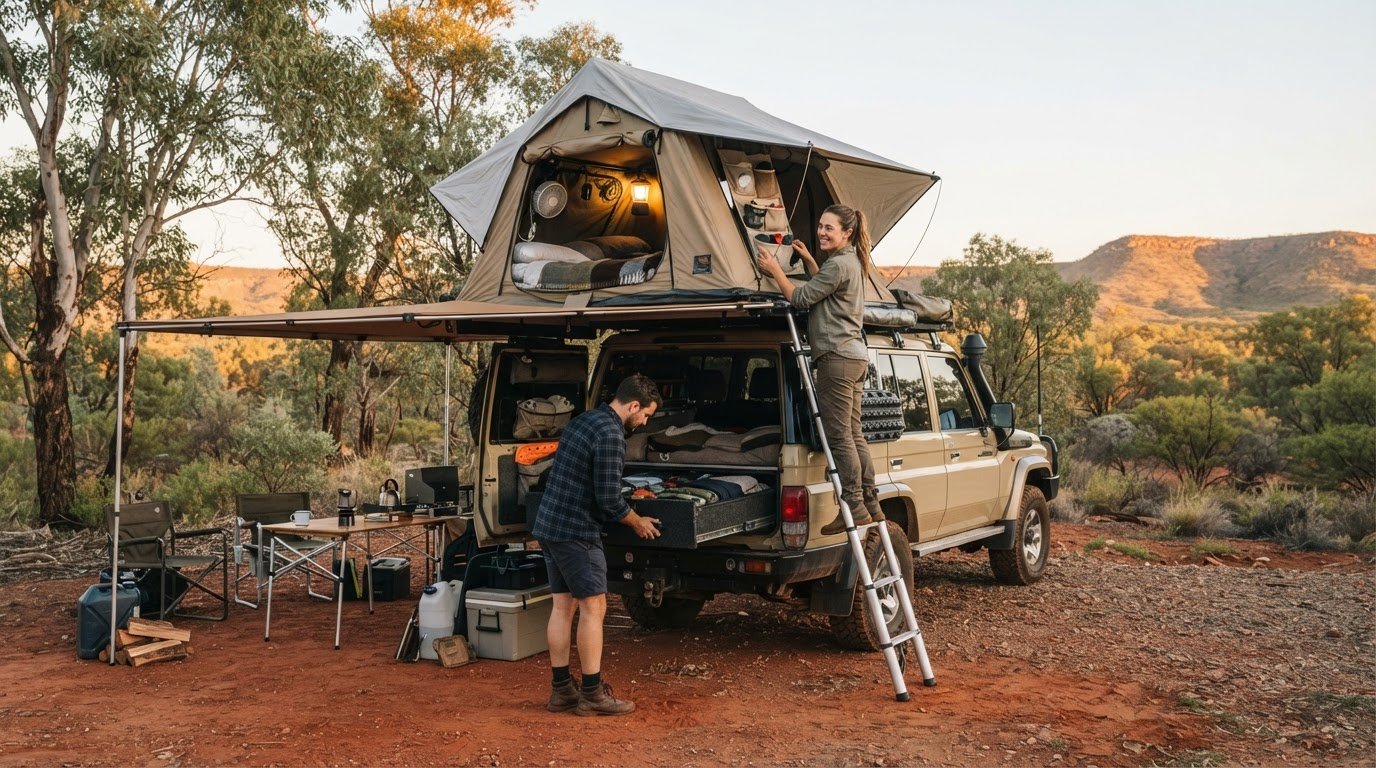
We view our vehicles as the anchor of every adventure. A mounted awning centralizes all camp activities, from coffee at sunrise to gear repairs at dusk. It creates a defined outdoor living space that offers a massive psychological boost. Having a “porch” makes a remote campsite feel like a home. This organized setup saves us time because everything from the kitchen to the roof top tents stays within a tight, efficient radius. When you look at the total utility, how to justify buying a 4wd awning becomes a question of how much you value your time and comfort in the wild.
All-Weather Protection Strategies
Whether we’re facing the humidity of the Top End or the freezing dews of the desert, protection is key. Thermal comfort in the context of poly-cotton ripstop canvas refers to the material’s ability to breathe and reduce heat radiation while maintaining a water-resistant barrier against the elements. This specialized fabric keeps you cooler in the heat and prevents condensation from dripping on your gear at night. It’s about more than just staying dry; it’s about maintaining a comfortable environment so you can stay out on the tracks longer.
Calculating the ROI: Durability, Resale, and the Cost of Cheap Gear
We’ve all heard the old saying: buy once, cry once. When you’re standing in the middle of a remote track with a snapped pole and a flapping piece of polyester, that “bargain” gear starts to feel very expensive. The real secret of how to justify buying a 4wd awning lies in looking past the initial transaction and calculating the long-term return on your investment. A premium awning isn’t just a purchase; it’s a durable asset that survives the corrugated roads and salt spray that destroy entry-level alternatives within a single season.
Consider the lifespan of your setup. We often see community members cycle through three or four cheap, pop-up gazebos over a few years. These budget options frequently end up in landfills after their plastic joints fail in a stiff breeze. By contrast, a high-quality mounted awning utilizes cast metal joints and heavy-duty extrusions that are fully repairable. This reliability is vital for our collective goal of responsible exploration. By choosing gear that lasts a decade rather than a season, we reduce our environmental footprint and stay true to the Leave No Trace Seven Principles by minimizing waste. Plus, when it’s time to upgrade your rig, a reputable brand name on your roof rack significantly boosts your vehicle’s resale value. Buyers recognize quality, and a well-maintained awning signals that the entire vehicle has been kitted out with care.
Premium Materials vs. Entry-Level Disposables
The difference is in the details, specifically the GSM (grams per square meter) rating of the canvas. A higher GSM means a thicker, more resilient fabric that won’t tear at the first sight of a low-hanging branch. Cheap awnings often use thin polyester that degrades quickly under the harsh Australian sun. We always suggest our fellow explorers look for poly-cotton ripstop materials that offer superior UV resistance and water shedding. If you’re ready to see which setups truly stand up to the test, take a look at our curated list of the best 4wd awnings for serious travel.
Fuel Economy and Weight Considerations
We know the concern about roof load is real. Every extra kilo affects your center of gravity and your fuel bill. However, modern slimline awning cases are designed with a low drag coefficient to minimize wind noise and resistance. When you’re deciding how to justify buying a 4wd awning, weigh the small increase in fuel consumption against the massive utility it provides. For a solo traveler, a lightweight side awning is often enough. For families, the extra weight of a 270-degree wrap-around is a fair trade for the massive, centralized living space that keeps the whole crew happy and dry. It’s about finding that perfect balance for your specific mission.
The Ethical Justification: Sustainable Camping and Leave No Trace
How to justify buying a 4wd awning isn’t just about your bank account; it’s about the legacy we leave on the trails. As we explore isolated corners of the country, our impact matters. A vehicle-mounted awning is a powerful tool for conservation because it dictates where and how we occupy a space. Unlike a heavy ground tent or a sprawling gazebo that requires a large, flat, cleared area, an awning extends directly from your rig. This encourages us to stay on durable surfaces like established tracks or gravel pads, which aligns perfectly with the Leave No Trace Seven Principles. By keeping our activities localized to the side of the vehicle, we prevent the crushing of native grasses and the compaction of sensitive soil.
We’ve all seen “campsite creep” in action. It happens when gear, chairs, and kitchen boxes slowly migrate away from the vehicle, expanding the disturbed area. A fixed awning acts as a boundary. It centralizes our waste, our cooking, and our relaxation into a single, high-efficiency zone. When you integrate an awning with roof top tents, you create a vertical camp. This small-footprint approach is the gold standard for modern, responsible overlanding. It keeps the ground clear for wildlife and allows the environment to recover much faster after we move on. By concentrating our activity, we ensure that the next group of explorers finds the site as pristine as we did.
The durability factor also plays a massive role in our environmental ethics. Every time we invest in a piece of equipment that lasts a decade, we’re keeping broken, cheap gazebos out of Australian landfills. It’s a conscious choice to step away from “disposable” camping. We believe that our gear should be as hardy as the landscapes we visit. When you’re calculating how to justify buying a 4wd awning, consider the reduction in waste as a major win for the planet. High-quality canvas and metal components don’t just serve you; they protect the environment from the cycle of constant replacement.
Minimizing Your Campsite Footprint
Staying on designated tracks is the most effective way to protect our public lands. Because a mounted awning doesn’t require pegs or guy ropes in many conditions, especially with freestanding models, we can set up on hard-packed ground where traditional tents would struggle. This flexibility is vital in fragile environments like coastal dunes or alpine meadows. Awnings facilitate “Leave No Trace” principles by localizing all camp activity to a single, durable area directly adjacent to the vehicle.
Promoting Long-Term Environmental Stewardship
Choosing high-quality gear is a direct stand against the “throwaway” culture that plagues the camping industry. We believe that comfortable camping actually leads to a deeper appreciation for remote nature. When you aren’t fighting a failing shelter, you have the mental space to observe and respect the environment. This mindset is a core part of the sustainable travel movement we champion. Our gear choices reflect our values, proving that we can explore the wild without leaving it worse for wear.
The Selection Framework: Matching the Awning to Your Mission
We choose our gear based on the terrain ahead and the specific needs of our crew. When you’re figuring out how to justify buying a 4wd awning, the specific model you choose dictates your daily workflow on the track. Side awnings offer a budget-friendly entry point for weekenders who just need a bit of relief from the afternoon sun. They’re simple, lightweight, and effective. If you’re running a full kitchen setup from your tailgate, a 270-degree awning is the ultimate wrap-around solution. It covers the side and the entire rear of the vehicle, providing a seamless dry zone for cooking and gear access. For those of us with smaller rigs or short-wheelbase vehicles, 180-degree models provide a perfect balance of coverage without the excessive weight of a full wrap.
The choice between freestanding and poled designs often comes down to safety and speed. Freestanding models are engineered with heavy-duty internal bracing that eliminates the need for poles in moderate conditions. This removes trip hazards around the campsite and allows for a 30-second deployment. We’ve found that in high-wind coastal environments, the extra cost of a freestanding unit is actually a safety requirement. It prevents the frantic midnight scramble to collapse a failing shelter when the gusts pick up. If you’re still weighing up the technical specs, our deep dive into the best 4wd awnings will help you narrow down the field.
Touring vs. Base-Camping
Your travel style is the biggest factor in your decision. If your travel planner goals involve packing up and moving to a new spot every single day, setup speed is your top priority. You want a freestanding system that doesn’t fight you. However, if you prefer base-camping for a week at a time, look for models that support optional awning walls. These transform your shelter into a fully enclosed room, offering protection from horizontal rain and pesky insects during extended stays.
Mounting and Compatibility
We can’t stress the importance of roof rack ratings enough. You must ensure your rack is rated for the dynamic loads (when the vehicle is moving) of a heavy 270-degree awning. High-vibration remote environments put immense stress on mounting brackets, so we always recommend using stainless steel or reinforced aluminum hardware. Use this quick comparison to see where your needs land:
| Awning Style | Setup Time | Ideal Use Case |
|---|---|---|
| Side Awning | 2-3 Minutes | Weekenders and budget-conscious builds |
| 270-Degree | 30-60 Seconds | Family travel and tailgate kitchen setups |
| 180-Degree | 1-2 Minutes | Solo touring and short-wheelbase rigs |
Ready to upgrade your rig? Check out our expert recommendations for the best 4wd awnings to find a setup that matches your next mission.
Unlocking Spontaneity: The Emotional Case for the 4WD Awning
We’ve all had those Friday afternoons where the urge to escape the city is strong, but the thought of wrestling with a complex campsite setup feels like a second job. This “gear fatigue” is the silent killer of many great adventures. When you’re looking at how to justify buying a 4wd awning, the emotional return on investment is often the most significant factor you’ll experience. A 30-second setup doesn’t just save time. It completely changes your psychological relationship with the wild. It lowers the barrier to entry for quick afternoon escapes, turning a “maybe next week” into a “let’s go right now.”
Beyond the individual benefit, a quality awning becomes the heartbeat of the convoy. It’s the social hub where we gather to swap stories and check maps after a long day on the tracks. In isolated locations, this sheltered space provides a vital sense of security and a defined “home base.” Having a porch on your rig makes a vast, intimidating landscape feel welcoming and safe. It’s the place where community is built, one campfire conversation at a time, sheltered from the wind and dust.
Overcoming Gear Fatigue
An awning eliminates the dread of setting up camp when you’re exhausted. We love the “roadside lunch” factor, where a dusty rest stop is instantly transformed into a scenic destination just by pulling a zipper. This rapid deployment is also critical for safety. When the weather in remote Australia takes a sudden turn, being able to deploy a sturdy shelter in seconds can keep your gear dry and your spirits high. It removes the friction from travel, making every part of the journey more enjoyable. If you’re still deciding on the right model to beat the fatigue, our guide to the best 4wd awnings offers some fantastic low-effort options.
Investing in Your Mental Health
The true ROI of your gear is measured in how often you actually get outside to unplug. Easier logistics lead to more frequent trips, and more frequent trips lead to a better state of mind. Reliable equipment builds the confidence to explore further into the unknown, knowing you have a dependable sanctuary attached to your vehicle. When you combine this with other easy-access gear like roof top tents, your rig becomes a literal gateway to freedom. How to justify buying a 4wd awning eventually becomes clear: you aren’t just buying a product. You’re investing in an invitation to explore more of this incredible country with the people you care about most. See you on the tracks!
Ready to Transform Your Basecamp?
Choosing the right shelter is about more than just dodging a few raindrops. We’ve seen how a mounted awning creates a vital weather-proof transition zone for your rig and helps us all adhere to Leave No Trace principles by localizing our impact. When you consider the long-term durability and the massive boost to your campsite efficiency, the path of how to justify buying a 4wd awning becomes clear. You’re investing in a more spontaneous, comfortable, and responsible way to explore the rugged beauty of our natural environments.
We’ve combined our expert reviews from 10+ years of remote Australian travel with community-vetted feedback to ensure you find gear that lasts. Our focus remains on sustainable, durable equipment that stands up to the most isolated tracks. View our expert-curated list of the best 4WD awnings for 2026 and get ready to launch your next mission with confidence. The tracks are calling, and we can’t wait to see your setup out there!
Frequently Asked Questions
Is a 270-degree awning worth the extra cost over a standard side awning?
A 270-degree awning is absolutely worth the investment if your camp setup revolves around the rear of your vehicle. It provides a continuous sheltered zone from the side door to the tailgate, which is a game-changer for those of us running kitchen sliders or storage drawers. Standard side awnings are lighter and cheaper, but they leave your rear recovery gear and cooking station exposed to the elements during a downpour.
Do 4WD awnings affect fuel consumption significantly?
You’ll notice a small increase in fuel consumption, typically ranging from 1% to 3% depending on the aerodynamic profile of the awning case. While the extra weight and wind resistance on your roof rack do add up, most modern slimline designs minimize this drag. We find that the trade-off is easy to accept once you see how to justify buying a 4wd awning through the massive boost in campsite comfort and setup speed.
Can I install a 4WD awning by myself, or do I need a professional?
Most of us can handle the installation ourselves with a basic set of tools and a helpful mate. The process involves securing brackets to your roof rack and bolting the awning to those brackets. However, if your rig requires custom drilling or if you’re dealing with a heavy 270-degree model that exceeds your rack’s dynamic load rating, seeking professional advice ensures your setup remains safe and secure on corrugated tracks.
How do freestanding awnings perform in high winds compared to poled versions?
Freestanding awnings utilize reinforced internal truss systems that handle moderate winds without any support. In high-wind scenarios, however, poled versions often provide better stability because they are physically anchored to the ground. We always recommend using guy ropes and pegs for any awning when the gusts pick up. This proactive approach prevents structural damage and ensures your basecamp stays intact during a sudden storm.
What maintenance does a canvas awning require to last 10+ years?
Longevity comes down to regular cleaning and proper storage. You should wash off salt spray and dust with fresh water after every trip and ensure the canvas is completely dry before packing it away for long periods. Checking the tension of your mounting bolts and lubricating the hinges with a dry silicone spray will keep the mechanism moving smoothly. This simple routine helps our community keep gear out of landfills for over a decade.
Are 4WD awnings universal, or do I need a specific roof rack?
Most awnings are considered universal, but the mounting brackets must be compatible with your specific roof rack or crossbars. Whether you have a platform rack or traditional bars, you’ll need to ensure the hardware can support the weight of the unit during off-road travel. We suggest checking the manufacturer’s fitment guide to confirm that the bracket spacing aligns with your vehicle’s roof structure and load limits.
What happens if my awning gets wet? How do I prevent mold?
If you have to pack up in the rain, you must deploy the awning to dry as soon as you get home or reach a dry camp. Trapped moisture is the primary cause of mold and mildew, which can rot the canvas and ruin the waterproof coating. We make it a rule to never leave a wet awning packed for more than 24 hours. A quick afternoon in the sun is all it takes to keep your gear fresh.
Can I attach an awning to a soft-shell roof top tent?
You generally cannot attach an awning directly to the fabric or frame of a soft-shell roof top tent. Awnings require a solid, structural mounting point like a roof rack or a dedicated backbone system to handle the weight and wind leverage. While some hard-shell tents have integrated accessory rails for small awnings, most of us find that mounting the awning directly to the vehicle’s rack provides the most stable and reliable setup.