What if your brand-new 2.5m awning actually makes your vehicle less safe the moment you hit highway speeds? We’ve all seen that one rig on the tracks with an awning vibrating like a tuning fork because it’s too long for its mounting points. It’s genuinely confusing to figure out what size awning for my 4wd when you’re juggling “awning length” versus “extension length” and worrying about your rear door hitting the brackets. We want our community to feel prepared and stable, not stressed about structural failure or exceeding legal weight limits.
We know the struggle of balancing maximum shade with a setup that won’t compromise your vehicle’s GVM or safety. This guide provides the exact measurements and mounting rules you need to choose the perfect awning size for your specific 4WD setup. We’ll explore our “Golden Ratio” for roof rack matching, how to solve tailgate clearance issues on wagons, and why understanding ADR compliance is vital for your 2026 build. Let’s get your rig sorted so you can focus on the horizon.
Key Takeaways
- Differentiate between awning length and extension to accurately calculate your true shade footprint and gear weight.
- Master our step-by-step measurement process to determine exactly what size awning for my 4wd based on your specific roof rack dimensions.
- Apply the “30cm Rule” for mounting to ensure your setup remains stable and vibration-free at highway speeds.
- Choose the right awning style for your mission, whether it’s a compact linear model for quick trips or a 270-degree wraparound for remote basecamps.
- Learn how to maintain structural integrity and avoid common fitment errors that can lead to gear failure on rugged tracks.
Understanding 4WD Awning Dimensions: Length vs. Extension
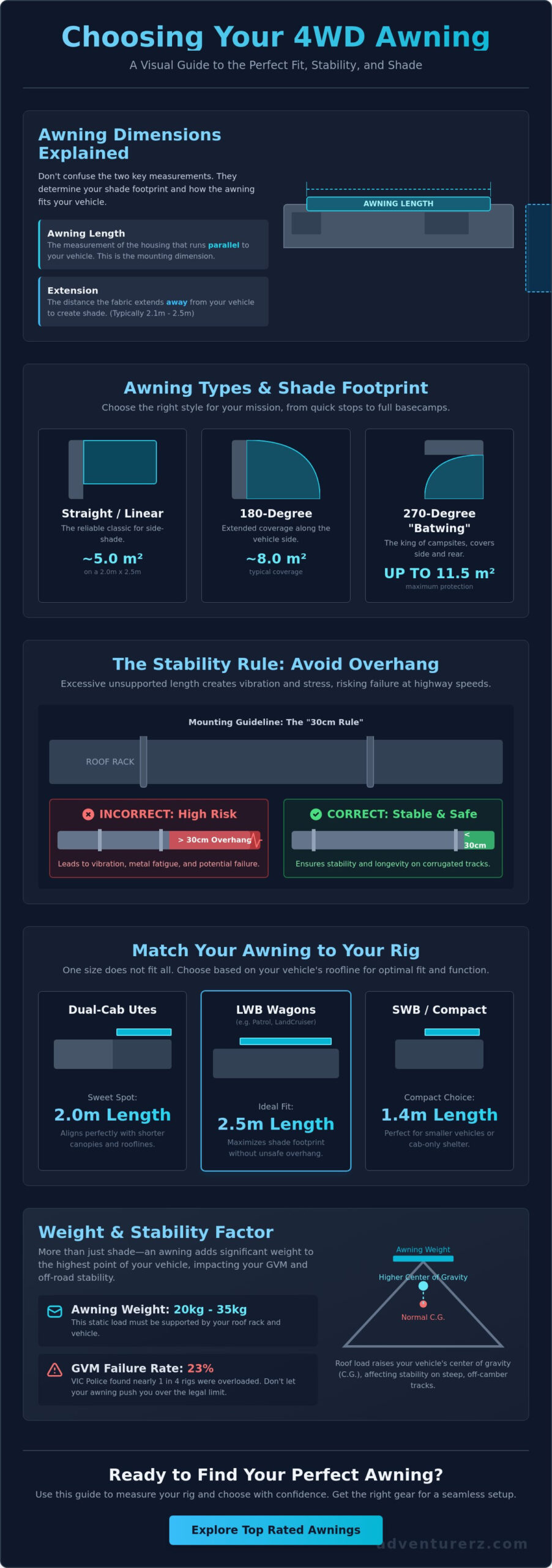
Before we bolt anything to our roof racks, we need to speak the same language. When we’re trying to figure out what size awning for my 4wd is best, we’re looking at two distinct axes that dictate our comfort and our vehicle’s performance. The “Awning Length” refers to the measurement of the housing that runs parallel to the side of your vehicle. This is your mounting spine. If you have a short-wheelbase rig, a 2.5m length might hang off the front like a diving board. The “Extension” is the distance the fabric travels away from the car when you pull it out. Most standard units in the Australian market offer an extension of 2.1m to 2.5m. An awning isn’t just a piece of fabric; it’s a structural addition to your mobile home that needs to be sized correctly for the tracks.
The difference between these two dimensions matters because it defines your campsite footprint. A long awning with a short extension might give you plenty of length to walk under, but it won’t provide much depth for a table and chairs. Conversely, a massive extension on a short mounting base can become a kite in high winds. We’ve found that the standard 2.0m x 2.5m setup is a sweet spot for many, providing roughly 5.0m² of coverage. However, your choice should always depend on how many people you’re sheltering and where you plan to mount the brackets. You can explore our detailed reviews of the best 4wd awnings to see how these different footprints perform in the wild.
The Three Main Awning Categories
We generally see three styles on the tracks today. Straight side awnings are the reliable classics, offering a simple rectangular shade area. 180-degree models push that coverage further along the vehicle’s side for a bit more breathing room. The 270-degree “batwing” models are the kings of the campsite. These wrap around the rear to provide up to 11.5m² of protection. They’re perfect for wagons where you need cover while accessing the fridge or kitchen at the tailgate.
Why Size Impacts Your Fuel Economy and Stability
A larger awning isn’t just more shade. It’s more weight and wind resistance. These units typically weigh between 20kg and 35kg. This weight sits at the highest point of your vehicle, which can impact stability on steep, off-camber inclines. Additionally, a longer awning housing increases wind drag, which we definitely notice at the fuel pump. Since Victoria Police weighbridge operations have found a 23% failure rate for overloaded vehicles, we must ensure our awning choice doesn’t push us over our GVM. Always check your roof rack’s load rating before committing to a massive setup.
How to Measure Your 4WD for the Perfect Awning Fit
Grab your tape measure and a mate; we need to get specific. Measuring for your rig isn’t just about the car’s total length; it’s about the structural foundation of your mounting hardware. First, measure the total length of your roof rack or crossbars. This is your baseline. Second, identify exactly where your mounting points sit and their distance from the ends. This dictates the “overhang” that determines your setup’s stability on corrugated tracks. If you’re still feeling unsure about the technical side of brackets, this Guide to Choosing 4×4 Awnings offers excellent context on how different mounting systems interact with your vehicle’s frame.
Third, we must check for door and tailgate clearance. If you have a wagon, open the rear door fully and measure its highest point and swing path. A bracket that sits too low or too far back will turn your tailgate into a battering ram against your new gear. Fourth, look at the front of the vehicle. Is there a snorkel or a tall UHF aerial in the way? These frequently interfere with the leading edge of larger awnings. Finally, take these numbers and compare them against standard market sizes like 2.0m or 2.5m. If your rack is only 1.8m long, a 2.0m awning is likely your limit to maintain a safe, vibration-free mount.
Sizing for Dual-Cab Utes vs. Wagons
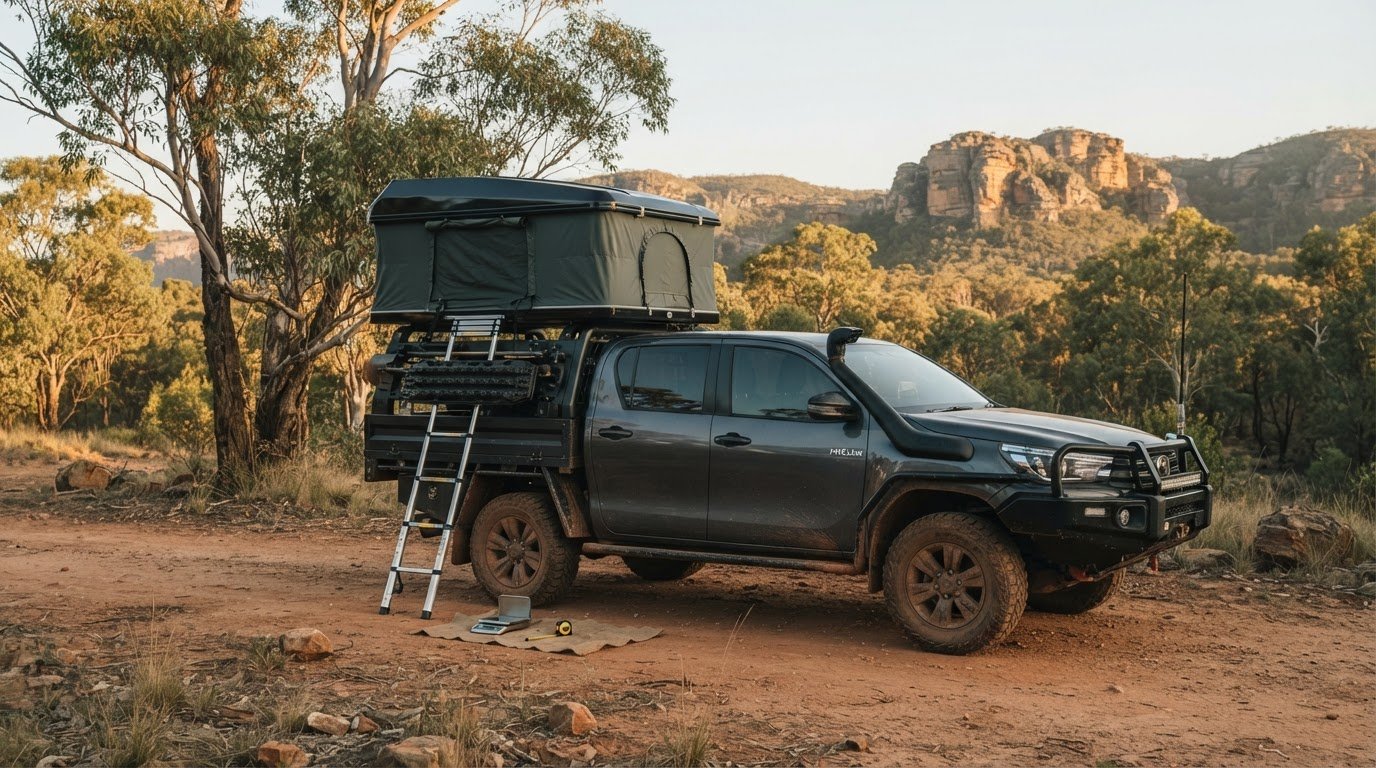
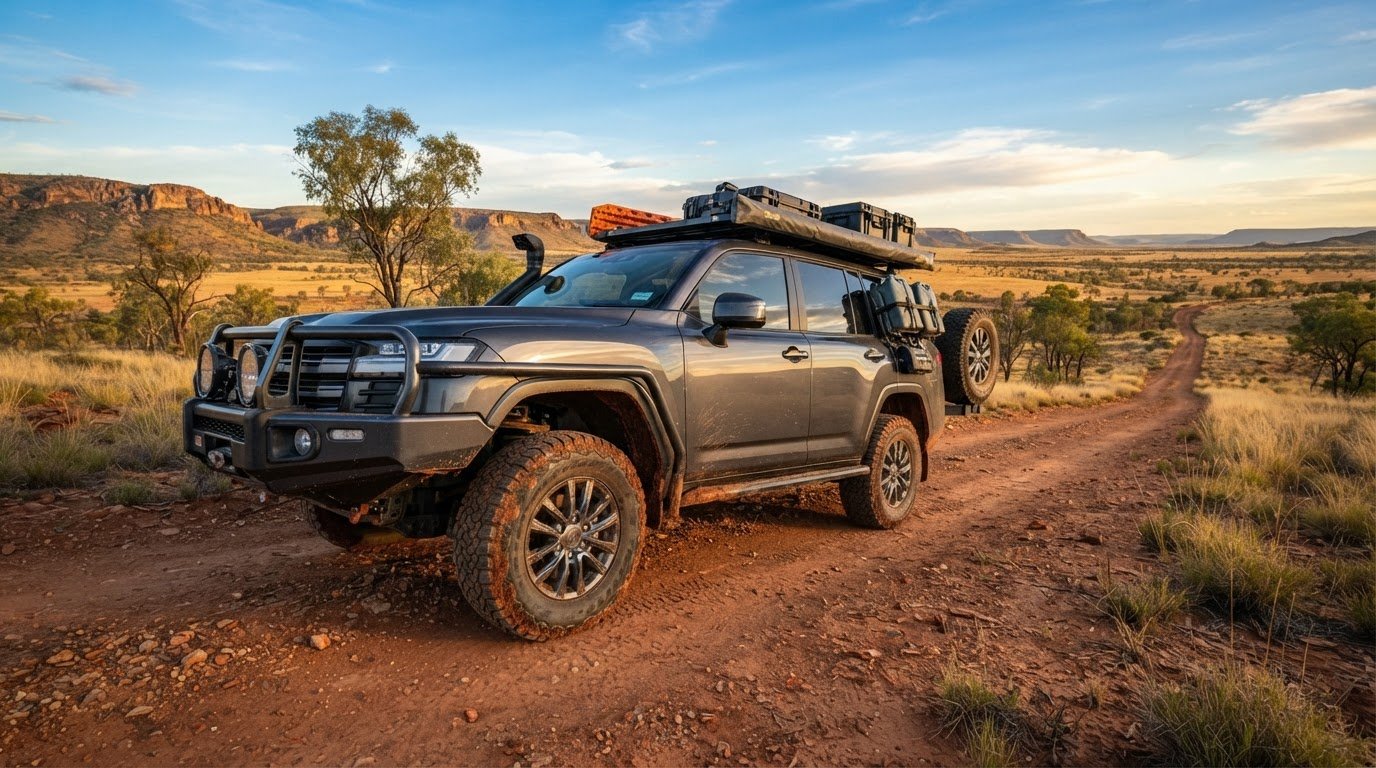
We’ve found that 2.0m awnings are the sweet spot for dual-cab canopies. They align perfectly with the shorter roofline without excessive, unsupported overhang. For those of us piloting long-wheelbase wagons like a LandCruiser 300 or a Y62 Patrol, a 2.5m awning fits like a glove and maximizes your shade footprint. If you’re rocking a short-wheelbase rig or just want a small shelter over the cab, look at compact 1.4m options. Matching the right gear to your specific vehicle is the first step toward a seamless setup. You can check our latest recommendations for the best 4wd awnings to see which models fit these vehicle profiles best.
Tailgate and Swing-Away Considerations
When we’re deciding what size awning for my 4wd, vertical height is just as critical as horizontal length. If your 4WD is lifted or has a high roofline, ensure the awning’s integrated poles can actually reach the ground. For 270-degree setups, the hinge point must clear the top of the open tailgate. We recommend measuring from the ground to your mounting rail and then adding the height of your open rear door. This ensures you won’t be ducking every time you grab a cold one from the fridge or reach for the recovery gear.
Comparing Shade Footprints: Which Size Do You Actually Need?
Choosing the right footprint is about more than just numbers on a spec sheet; it’s about how we live outside our vehicles. When we ask ourselves what size awning for my 4wd is necessary, we have to calculate the actual square meter coverage. A standard linear awning measuring 2.0m x 2.5m provides exactly 5.0m² of shade. While that sounds like plenty, we use the “Family Test” to keep things practical. If you’re trying to fit four camp chairs and a folding table, that 5.0m² fills up remarkably fast. Once you account for the angle of the sun and the inevitable gear creep, you might find yourself sitting in the dirt just to stay in the shade.
Weather protection is another vital factor. We don’t just use these for the sun; we use them to stay dry during those sudden tropical downpours. A larger footprint offers a significant advantage here because rain rarely falls straight down. Wind-blown spray can easily soak your kitchen setup if your coverage is too tight. To see how the top brands stack up in real-world conditions, take a look at our best 4wd awnings guide for 2026. We’ve tested these footprints across various Australian environments to ensure they actually deliver the protection they promise.
Linear Awnings: Simple and Effective
Linear awnings are the backbone of the solo tourer’s setup. They’re best for quick roadside lunch stops and overnight stays where simplicity is king. Typical coverage ranges from 4.2m² for compact units up to 6.25m² for larger 2.5m x 2.5m models. We also see many community members using narrow 1.4m “rear” awnings. These are fantastic for providing a small dry zone over the back door, though they lack the space needed for a full campsite lounge area.
The 270-Degree Advantage
For families and basecampers, the 270-degree awning is a game-changer. These “batwing” styles typically offer between 9m² and 11.5m² of coverage, though some premium modular systems can push even further. The real magic is the “rear wrap.” By covering the side and the back of the vehicle, we create a massive, protected L-shaped living area. This is perfect for those of us who cook out of the rear of our wagons or utes. It transforms the back of the car into a sheltered kitchen, allowing us to prep meals out of the wind and rain while staying connected to the rest of the campsite.
Stability and the “Overhang Rule”: Avoiding Awning Failure
We’ve all seen that one rig on the tracks with an awning vibrating like a tuning fork. It’s not just annoying; it’s a structural failure waiting to happen. When we’re deciding what size awning for my 4wd is safe, we must follow the “30cm Rule.” This is our community’s golden rule for fitment. It states that the awning housing should never extend more than 30cm past your last mounting bracket at either the front or the rear. If you exceed this, the unsupported ends act like a diving board. Every bump on a corrugated road sends a shockwave through the aluminum spine, which eventually leads to metal fatigue or a snapped mounting bolt.
This brings us to the most common question we hear: “Can I mount a 2.5m awning on a 1.5m roof rack?” Our answer is a firm no. Doing this leaves 50cm of unsupported housing at each end, which is a recipe for disaster. Vibration causes “flexing,” and that constant movement can actually rip the tracks right out of your roof or cause the awning arms to buckle while you’re driving. We value durability and self-reliance, so we always recommend matching your awning length to your rack’s footprint. If you need a massive shade area but have a short rack, it’s better to look at a 270-degree model with specific reinforced brackets rather than overextending a linear one.
Mounting Hardware and Brackets
Stable setups start with quality hardware. Stainless steel “L” brackets are the industry standard because they offer the best balance of vertical and horizontal support. For any awning over 2.0m in length, we strongly advise using three mounting points instead of two. This distributes the weight more evenly across your roof rack. Gutter mounts are incredibly strong and great for older rigs, while modern track mounts offer more versatility. Just ensure your rack’s internal channel is rated for the dynamic loads of a heavy awning. You can see which brands include the best hardware in our comprehensive 4wd awning reviews.
Managing Wind Loads
A larger awning means a larger “sail area.” Even a light breeze can exert hundreds of kilograms of force on your mounting brackets if the fabric isn’t secured. We’ve seen “freestanding” awnings flip over vehicles because a sudden gust caught them off guard. As responsible explorers, we must peg down our gear every time we set up. This protects our equipment and ensures we don’t leave broken gear behind in our beautiful national parks. Always use guy ropes and heavy-duty pegs, especially if you’ve opted for a massive 270-degree setup with a large footprint.
Before you commit to a purchase, make sure your mounting plan is rock solid. Check out our top-rated 4wd awnings to find a model that includes the heavy-duty brackets you need for a stable, long-lasting setup.
Matching Awning Size to Your Adventure Style
Your choice of gear should always reflect the tracks you travel. When we’re deciding what size awning for my 4wd is best, we first look at our primary mission. For those of us who head out for quick Friday to Sunday escapes, a 2.0m linear awning is often the champion of practicality. It’s light, quick to deploy for a roadside lunch, and doesn’t significantly impact our fuel range. These “weekender” setups prioritize ease of use over massive square meterage, allowing us to spend more time exploring and less time faffing with poles and guy ropes.
The remote tourer, however, needs a fortress. If you’re planning to spend weeks in the Red Centre or exploring the Kimberley, prioritizing a 270-degree awning is the right move for long-term comfort. The massive wraparound coverage provides a dedicated zone for your kitchen, fridge, and living area. If you’re already running one of our recommended Rooftop tents, ensure your awning brackets don’t interfere with the ladder or the tent’s opening mechanism. We’ve found that some 270-degree models have specific hinge heights that can clash with fold-out tent bases, so always double-check those vertical clearances before you bolt everything down.
Beach campers face a different challenge: the relentless movement of the sun across open sand. In this environment, the extension length matters more than the housing length. A 2.5m extension provides a much deeper shadow than a 2.1m model, which is vital when you’re trying to hide from the midday glare. Since there’s often no natural shade on the coast, every extra centimeter of fabric helps keep your fridge from working overtime and your community members from getting scorched.
Solo vs. Group Travel Requirements
Solo travelers can often get away with smaller footprints, but group travel demands a different approach. We find that adding modular awning walls can double your usable area without the need for a heavier, larger awning unit. This is a smart way to keep your vehicle’s weight down while still providing a windproof shelter for the whole crew. Keep in mind the “Pack-Down” factor; while a massive 270-degree setup is glorious at camp, it takes longer to stow away. If you’re the type of traveler who likes to hit the tracks early every morning, a simpler linear setup might suit your rhythm better.
Final Checklist Before You Buy
Before you commit to a purchase, we recommend a final run through the numbers to ensure your rig remains safe and legal. Always verify your vehicle’s Dynamic Roof Load Limit and ensure your total accessory weight doesn’t push you over your GVM. It’s also worth checking for compatibility with your existing adventure routes to ensure your setup doesn’t make the vehicle too tall for overgrown bush tracks. Once you’re sorted, join the Adventurerz community to share your setup photos and get real-world feedback from fellow explorers! We love seeing how our members solve these fitment puzzles to create the ultimate remote escape.
Ready for the Tracks: Your Final Fitment Checklist
Choosing the right setup is about more than just maximizing shade; it’s about ensuring your rig is balanced, legal, and ready for the toughest Australian tracks. We’ve seen how the 30cm Overhang Rule protects your roof rack from vibration failure and why matching your awning to your vehicle’s specific wheelbase is critical for stability. Whether you’re a weekend explorer needing a compact 2.0m linear unit or a remote tourer requiring the massive footprint of a 270-degree batwing, the goal is a setup that respects your vehicle’s GVM and the environments we love to explore.
Determining exactly what size awning for my 4wd doesn’t have to be a guessing game when you use our field-tested measurements. We’re committed to sustainable Australian touring, which means recommending gear that lasts and setups that don’t compromise safety. Ready to make your final choice? Find the perfect 4WD awning size in our expert reviews, where we feature community-driven gear feedback and rigorous field tests. Let’s get your rig sorted so we can see you out there on the horizon soon!
Frequently Asked Questions
Is a 2.5m awning too big for a dual-cab ute?
A 2.5m awning is usually too long for a standard dual-cab ute canopy unless you’re running a full-length roof rack. For most dual-cabs, a 2.0m unit is the ideal fit. It aligns with the roofline without excessive overhang that causes wind noise and vibration. If the housing extends too far forward or back, it risks catching on branches or vibrating loose on the highway.
Can I fit a 270-degree awning on any roof rack?
You can’t mount a 270-degree awning on just any rack. These units are significantly heavier and require robust mounting points to handle the torque they generate when open. We always recommend checking your rack’s dynamic load rating first. Most 270-degree models need heavy-duty steel brackets and at least three mounting points to remain stable during our rugged Australian adventures.
What is the most common 4WD awning size in Australia?
The 2.0m x 2.5m pull-out model is the most common size found on Australian tracks. It strikes a perfect balance between weight, cost, and shade area. When we look at what size awning for my 4wd is most versatile, this 5.0m² footprint wins because it fits everything from compact SUVs to large wagons without requiring complex modifications.
How much overhang is safe for a 4WD awning?
We follow the 30cm rule for maximum safety on corrugated roads. This means the awning housing shouldn’t extend more than 30cm past your front or rear mounting brackets. Keeping the overhang minimal prevents the “diving board” effect. This vibration can lead to metal fatigue in the awning’s spine or even damage your vehicle’s roof channels over time.
Do I need a different size awning for beach camping vs. bush camping?
Beach camping demands a larger extension length to provide maximum shade in open, sandy environments. We recommend an extension of at least 2.5m for coastal trips. In the bush, a more compact awning length is often better. This prevents the housing from snagging on tight, overgrown tracks or low-hanging branches that could rip the gear right off your roof.
Can I mount a rear awning and a side awning at the same time?
Yes, mounting both a side and a rear awning is a popular setup for remote tourers. It creates a massive, protected L-shaped living space. You might run a 2.0m unit on the passenger side for relaxing and a 1.4m unit over the rear door for cooking. Just be mindful of your total payload and ensure you don’t exceed your vehicle’s GVM.
How does awning size affect my fuel consumption?
Larger awnings definitely increase your fuel consumption by creating more wind resistance. A bulky 270-degree unit or a long 2.5m housing adds to your vehicle’s frontal area and drag. While the impact might be small on a single trip, it adds up during long-distance touring. We always suggest choosing the most aerodynamic profile possible to keep your fuel costs manageable.
What size awning do I need for a family of four?
A family of four needs a shade footprint of at least 9m² to 11m² to stay comfortable. When deciding what size awning for my 4wd for group travel, a 270-degree model is usually the best investment. It provides enough room for four chairs, a large table, and a fridge slide area while keeping everyone protected from the sun and rain.