Most “heavy-duty” awnings are actually one 30-knot gust away from becoming expensive scrap metal. We’ve all felt that spike of adrenaline when a sudden coastal breeze rattles the poles and threatens to buckle our entire campsite. It’s a specialized kind of heartbreak to watch a flimsy “budget” setup fail in a remote area, leaving you without shade and out of pocket. Finding a truly wind resistant 4wd awning is about more than just thick canvas; it is about finding a system that can handle the unpredictable nature of our favorite wild places.
We believe you shouldn’t have to spend your entire trip worrying about the weather. We’re here to help you understand the tech behind structural forgiveness so you can choose gear that stands firm. This 2026 guide previews the latest freestanding innovations, breaks down real-world performance ratings, and shares our expert recommendations for storm-proof shade that lets you focus on the horizon instead of your guy ropes. Let’s make sure your next setup is as hardy as the tracks you travel.
Key Takeaways
- Learn why high-grade hinges and truss arm geometry are the true backbone of any wind resistant 4wd awning, ensuring your frame flexes without snapping.
- Understand the real-world limits of “freestanding” claims and exactly when we recommend deploying poles to survive a sudden 30-knot coastal gust.
- Master expert setup tactics, including strategic vehicle orientation and the “double peg” method, to keep your camp secure in soft sand or harsh desert winds.
- Explore our 2026 recommendations to find the ideal balance between indestructible structural strength and weight-conscious design for your specific 4WD setup.
Table of Contents
- Why Wind Resistance is the Ultimate Metric for 4WD Awnings
- The Anatomy of a Wind-Resistant 4WD Awning: What to Look For
- Freestanding vs. Pole-Supported: Which Design Survives the Gusts?
- How to Secure Your Awning: Expert Tips for High-Wind Scenarios
- Finding Your Match: Top Wind-Resistant Awning Picks for 2026
Why Wind Resistance is the Ultimate Metric for 4WD Awnings
We’ve all seen it: a beautiful afternoon at a coastal campsite suddenly interrupted by a sharp crack and the sight of an awning flipping violently over a roof rack. This is the “Awning Over the Roof” phenomenon. It happens because traditional shade setups often act like sails, catching upward gusts that exert massive leverage on the hinges. A truly wind resistant 4wd awning isn’t just about thick fabric; it is a specialized system designed to flex, tension, and withstand these sudden loads without snapping its frame or damaging your vehicle.
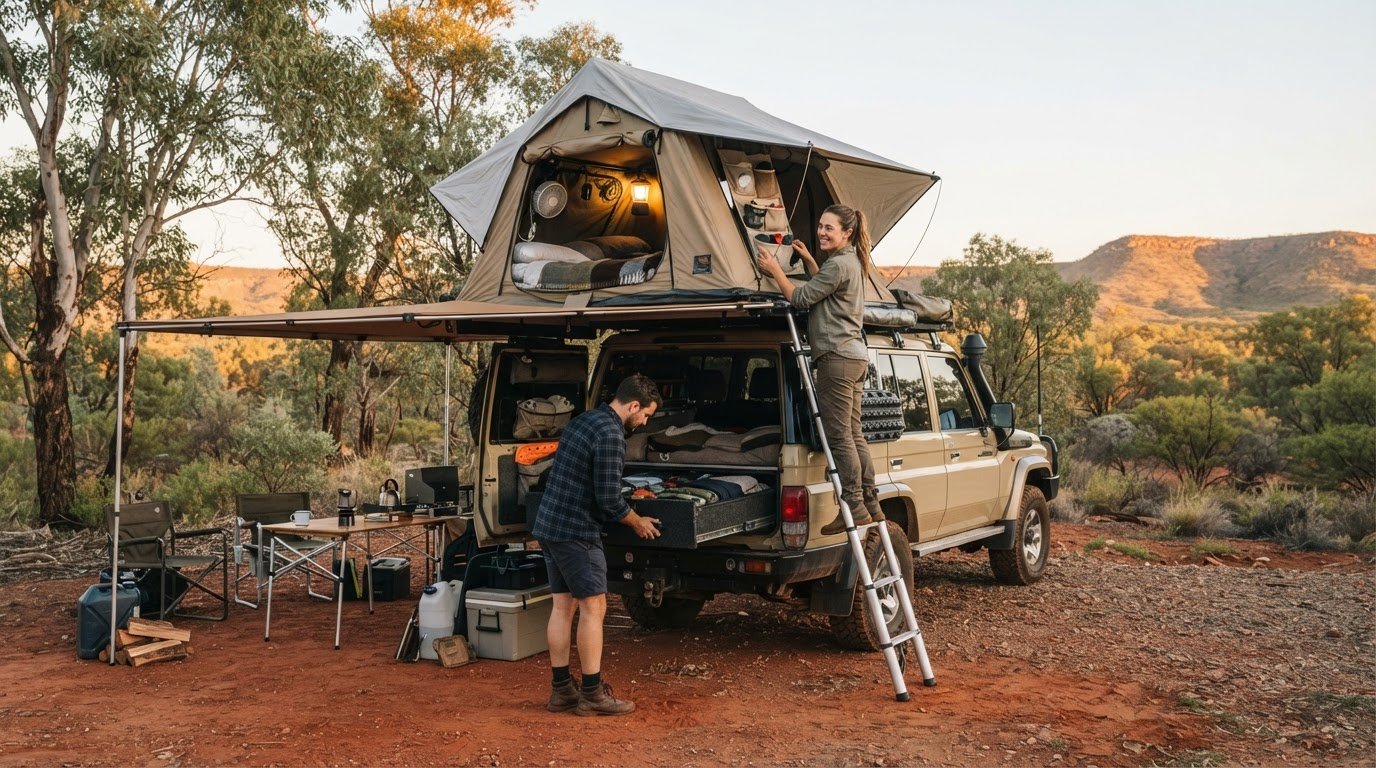
Australia’s environments are notoriously unpredictable. One minute you’re enjoying a quiet lunch in the Simpson Desert, and the next, a dust devil is trying to rip your gear apart. Whether you are exploring different types of awnings for a quick surf stop or a long-term basecamp, structural integrity is what gives us the confidence to leave the vehicle for a hike or a swim. Without that trust, you’re constantly tethered to your rig, ready to pack down at the first sign of a breeze.
The True Cost of a Flimsy Awning
Saving a few hundred dollars on a budget awning often leads to a much larger bill later. When a frame fails, those metal arms don’t just break; they often swing back and gouge your door panels or dent the roof of your 4WD. Beyond the financial hit, there is a heavy environmental cost. We hate seeing “disposable” camping gear piled up in remote regional landfills. Investing in a durable, storm-proof setup is an act of stewardship for the tracks we love. It ensures a single 30-knot gust doesn’t end your multi-week expedition prematurely.
Understanding Wind Ratings and the Beaufort Scale
You might notice that most manufacturers don’t provide a single, hard “km/h” limit. This is because wind behavior is chaotic. Instead, we look at the Beaufort Scale to gauge conditions at camp. A “Fresh Breeze” (29 to 38 km/h) is usually the limit for most standard setups before they require additional support. To stay safe, watch for whitecaps on the water or swaying saplings; these are signals to stake down or pack up. Gust speed is the sudden, peak burst of energy that causes the most structural damage, whereas sustained wind speed is the average force over time. For more on choosing the right gear for your rig, check out our guide on the best 4wd awnings available today.
The Anatomy of a Wind-Resistant 4WD Awning: What to Look For
When we evaluate a wind resistant 4wd awning, we look far beyond the marketing labels. The true strength of a storm-proof setup lies in its skeleton. While many budget options rely on thin, hollow poles, a premium system uses heavy-duty boxed or C-channel truss arms. This geometry is vital because it distributes the massive energy of a 30-knot gust across the entire roof rack rather than concentrating the force on a single point. A well-engineered arm allows for a small amount of flex, which prevents the metal from reaching its breaking point during sudden atmospheric shifts.
Fabric tension is the second half of the equation. If the canvas is loose, it captures air like a parachute, creating immense upward lift. Modern designs focus on “water shedding” angles that also happen to improve the aerodynamic properties of fabric, reducing drag and preventing the violent “flapping” that keeps campers awake at night. We always aim for that “sweet spot” where the frame is robust enough to handle the load but light enough to stay within your vehicle’s GVM limits. Every kilogram matters when you’re loaded for a remote trek.
Hinge Design: The Critical Failure Point
Canvas Quality and UV Resistance
In 2026, 320gsm+ poly-cotton ripstop canvas has become the industry standard for those of us heading into harsh environments. This weight provides the necessary density to resist tearing while remaining manageable during pack-down. UV resistance is equally important; over time, the harsh Australian sun degrades inferior fibers, making them brittle and prone to catastrophic failure during a storm. If you’re unsure which materials are right for your setup, check out our guide on the best 4wd awnings to see how different brands stack up. Choosing high-quality textiles means your gear won’t end up in a landfill after one season of hard use.
If you’re planning your next coastal escape, take a moment to review our top gear picks to ensure your shade stays grounded when the sea breeze picks up.
Freestanding vs. Pole-Supported: Which Design Survives the Gusts?
The rise of the 270-degree freestanding awning has changed how we explore the Australian bush. It is the ultimate convenience for a quick lunch stop or a roadside break where you want shade in under thirty seconds. However, the term “freestanding” is often misunderstood by new adventurers. While these systems are engineered to support their own weight without vertical legs, they are not invincible. A truly wind resistant 4wd awning must balance the convenience of a pole-free setup with the structural reality of atmospheric pressure.
In our experience, the debate isn’t about which design is “better” but about knowing when to transition from one to the other. Traditional pull-out awnings are the gold standard for stability because they rely on a constant tension triangle created by poles and guy ropes. They take longer to set up, but they offer a predictable level of security. Freestanding models offer speed, but they become vulnerable once the wind hits a certain threshold. Understanding these limits is what keeps your gear in one piece when a coastal breeze turns into a gale.
When to Go Freestanding
We love the freestanding feature for rapid deployments. It is perfect for those moments when you need a bit of relief from the sun but don’t want the hassle of a full camp setup. To make this work safely, your vehicle needs a rock-solid foundation. The torque generated by a large 270-degree arm is immense. We always suggest mounting these units to a heavy-duty rack or a reinforced roof top tent frame. If your mounting points are weak, the wind will twist your brackets long before the awning frame snaps. Use the freestanding mode for winds under 20 knots; anything higher requires a different strategy.
The Case for Integrated Poles
Why do most premium freestanding models still come with built-in legs? It is because “freestanding” doesn’t mean “pole-free” when the weather turns. Verified data shows that even top-tier models like the OVS Nomadic 270 LTE are rated for roughly 32 to 40 km/h in freestanding mode, but can survive up to 64 km/h when fully secured with poles and hardware. Integrated poles provide a vital fail-safe by converting upward lift into downward force. We recommend dropping at least one pole on the leading edge even in moderate conditions. This simple habit reduces the stress on your hinges and ensures your wind resistant 4wd awning remains a reliable part of your kit for years to come.
How to Secure Your Awning: Expert Tips for High-Wind Scenarios
Setting up your gear is only half the battle; keeping it grounded when the weather turns is where the real skill comes in. We’ve all felt that moment of doubt when the tent starts to shake and the sea breeze gains a sharp, aggressive edge. A truly wind resistant 4wd awning relies on a combination of smart engineering and expert deployment. By following a few simple wind-survival protocols, you can protect your investment and ensure your camp stays comfortable even when Mother Nature decides to test your limits.
Strategic Parking and Wind Breaks
Your vehicle is the most effective windbreak you own. If you anticipate a blowy night, park your rig so the body of the 4WD shields the awning from the prevailing wind. We prefer positioning the vehicle with its nose or rear facing the gusts to slice through the air rather than catching it broadside. Be cautious with solid walls in these conditions. While they offer great privacy, solid awning walls create a parachute effect that traps air and exerts massive upward pressure on your roof rack. If the wind is truly howling, it’s often safer to leave the walls off and let the air flow through the frame rather than fighting against it.
Essential Wind-Safe Accessories
The standard pegs that come with most awnings are fine for a backyard BBQ, but they won’t cut it in the Simpson Desert or on a soft coastal dune. We recommend carrying a mix of heavy-duty sand pegs and screw-in stakes. Screw-in stakes are a game-changer for hard-packed ground, offering a level of grip that traditional hammered pegs simply can’t match. Another vital addition to your kit is a set of spring-loaded guy ropes. These act as shock absorbers, soaking up the violent energy of a sudden gust before it can snap a hinge or bend a truss arm. For more advice on building a reliable setup, take a look at our guide to the best 4wd awnings for 2026.
In soft soil or sand, we swear by the “Double Peg” method. Instead of a single vertical stake, drive two pegs into the ground at 45-degree angles, forming a “V” shape away from the awning. Loop your guy rope around both points. This anchor technique creates significantly more surface area resistance, making it much harder for a gust to pull your line loose. It’s a simple trick that has saved many a campsite from disaster.
Tensioning your ropes correctly is a delicate balance. You want the fabric taut enough to prevent the flapping we discussed earlier, but you must avoid the over-tightening trap. If you pull your guy ropes too hard, you leave no room for the frame to flex, which actually makes it more likely to snap under pressure. If you’re struggling to keep the stakes in the ground or the frame is bowing under the load, it’s time to call it. Packing away early isn’t a defeat; it’s a smart move that ensures you’ll have a working awning for the rest of your trip. Before you head off on your next remote trek, check out our expert gear reviews to make sure your kit is up to the task.
Finding Your Match: Top Wind-Resistant Awning Picks for 2026
Choosing a wind resistant 4wd awning is a personal decision that depends on your vehicle’s weight capacity and how you like to camp. We’ve spent months in the field, from the windy cliffs of the Great Australian Bight to the dusty plains of the Red Centre, testing these units to see which ones actually live up to their marketing. If you are looking for adventure inspiration from other iconic desert regions, you can visit Desert Detour to see how premium off-road equipment handles the massive dunes of Dubai. Our community reviews prioritize real-world reliability and environmental durability because we believe gear should last a lifetime, not a single season.
The “Indestructible” category is dominated by heavy-duty 270-degree models like the 23Zero Peregrine PRO 270. This unit provides a massive 127 square feet of coverage and has proven its mettle by remaining rigid in gusts exceeding 25 mph. It’s a serious piece of kit for the dedicated overlander who needs a reliable basecamp in exposed environments. For those watching their GVM, the OVS Nomadic 270 LTE is a brilliant weight-conscious choice. At just 31 lbs, it offers 75 square feet of shade and can withstand 20 to 25 mph winds when freestanding, though we always recommend securing it for anything higher.
Traditional side-mount awnings remain the “Value” play for many adventurers. Because they have a smaller surface area, they naturally catch less wind than their wrap-around cousins. When you combine a quality side-mount with the “Double Peg” method and spring-loaded guy ropes we discussed earlier, these units punch well above their weight. They are an excellent option for smaller SUVs and dual cabs that don’t have the roof real estate or load rating for a heavy 270-degree system.
Top 270-Degree Performers
In 2026, the best 270-degree models feature reinforced arm joints and integrated LED lighting to make camp life easier. We always look for brands that offer strong Australian-based warranty and support; it’s vital when you’re exploring remote regions. These high-end models use 280gsm to 320gsm poly-cotton canvas to ensure your shade stays taut and water-resistant. If you want to see our full breakdown of the top performers, check out our comprehensive list of the best 4wd awnings currently on the market.
Compact and Side-Mount Solutions
If you don’t need a full kitchen wrap-around, a compact side-mount like the Rhino-Rack Batwing Compact (offering 68.9 square feet of coverage) is a smart alternative. These models are easier to pack down quickly if a storm rolls in unexpectedly. Always match your awning choice to your specific 4WD setup and roof rack capacity. A lighter awning reduces the leverage on your vehicle’s pillars, which can be a deciding factor in high-wind survival. We encourage you to prioritize structural integrity and ethical manufacturing to ensure your adventures leave a minimal footprint on the wild places we love to explore.
Ready Your Rig for the Next Great Blow
We’ve covered the essential engineering that separates a true wind resistant 4wd awning from a flimsy imitation. By focusing on heavy-duty hinges, understanding when to deploy integrated poles, and mastering strategic parking, you’ve gained the tools to protect your vehicle and your peace of mind. Our community-vetted reviews stem from years of specialized remote travel expertise, ensuring we only recommend gear that is as durable as it is environmentally responsible. We believe in investing in quality once so your equipment stays on your rig and out of the landfill.
Now that you’re armed with the technical know-how, it’s time to find the specific model that fits your vehicle’s GVM and your travel style. Check out our expert-tested list of the best 4WD awnings for 2026! Whether you are chasing coastal swells or desert sunsets, we’re here to help you build a setup you can trust. The tracks are waiting, and with a storm-proof camp behind you, there’s nothing stopping your next great exploration. See you out there!
Frequently Asked Questions
What is the maximum wind speed a 4WD awning can handle?
Most standard retractable awnings are rated for winds between 20 and 30 km/h before they require retraction. Premium models, such as the 23Zero Peregrine PRO 270, have been verified to remain rigid in gusts exceeding 40 km/h when fully secured. Always remember that no universal standard exists, so we suggest checking your specific manufacturer’s manual before testing the limits in the wild.
Can I leave my freestanding awning out overnight?
We don’t recommend leaving any awning out overnight without poles and guy ropes deployed. Sudden atmospheric shifts happen while we sleep, and a calm night can quickly turn into a gear-breaking storm. If you aren’t willing to fully secure the frame with stakes and tensioners, it is much safer to pack it down before you crawl into your swag or tent.
Do I really need to use guy ropes if my awning is ‘freestanding’?
Yes, guy ropes are essential for a wind resistant 4wd awning whenever the breeze picks up past 20 knots. While the truss arms support the fabric’s weight in still air, they cannot counteract the massive upward lift of a sudden gust. Guy ropes provide the necessary downward tension that keeps your hinges intact and prevents the entire system from flipping over your roof rack.
How do I fix a bent awning arm after a wind gust?
You should avoid trying to bend an aluminium truss arm back into its original shape because the metal becomes brittle once it’s been stressed. The safest and most environmentally responsible fix is to order a replacement arm from the manufacturer. Most high-end brands design their frames to be modular, allowing us to swap out damaged sections without throwing the entire unit into a landfill.
Are solid awning walls better or worse in the wind?
Solid walls are significantly worse in high-wind environments because they act like giant sails. They catch the wind and transfer all that energy directly into your hinges and vehicle mounting points. If you need protection from the elements, we suggest using mesh walls that allow some airflow or simply parking your vehicle to use the body as a natural windbreak instead.
What is the best way to peg down an awning in soft sand?
Use long, specialized sand pegs driven in at a 45-degree angle away from the vehicle for the best grip. In extremely soft conditions, we swear by the “deadman anchor” method, which involves burying a peg or a heavy object horizontally deep in the sand. This creates a massive amount of resistance that a single vertical peg just can’t match when the wind starts to howl.
How does the weight of a wind-resistant awning affect my roof load limit?
A heavy-duty wind resistant 4wd awning can weigh between 25kg and 35kg, which directly impacts your vehicle’s dynamic roof load limit. You must factor this weight into your total calculation, including your roof rack and other gear. Exceeding these limits can affect your vehicle’s stability on the tracks and potentially void your insurance if something goes wrong during a remote trek.
Is a 180-degree or 270-degree awning better for wind resistance?
A 180-degree awning often handles wind better simply because it has a smaller surface area and fewer pivot points. However, a 270-degree model offers superior shade and can be just as resilient if it features boxed truss arms and heavy-duty hinges. The best choice depends on your specific setup; just ensure you have the right hardware to anchor whichever design you choose for your adventures.