Last August, a solo traveler on the Oodnadatta Track spent 42 minutes unpacking their entire rig just to find a single recovery strap buried under a mountain of loose gear. It’s a frustrating reality when your cargo drawers aren’t up to the task or, worse, when you haven’t installed a system yet. We know that feeling of dread when you hear your fridge sliding across the floor during a rough corrugated section in the Kimberley. As Adventurerz, we believe your gear should stay put so you can focus on the horizon ahead.
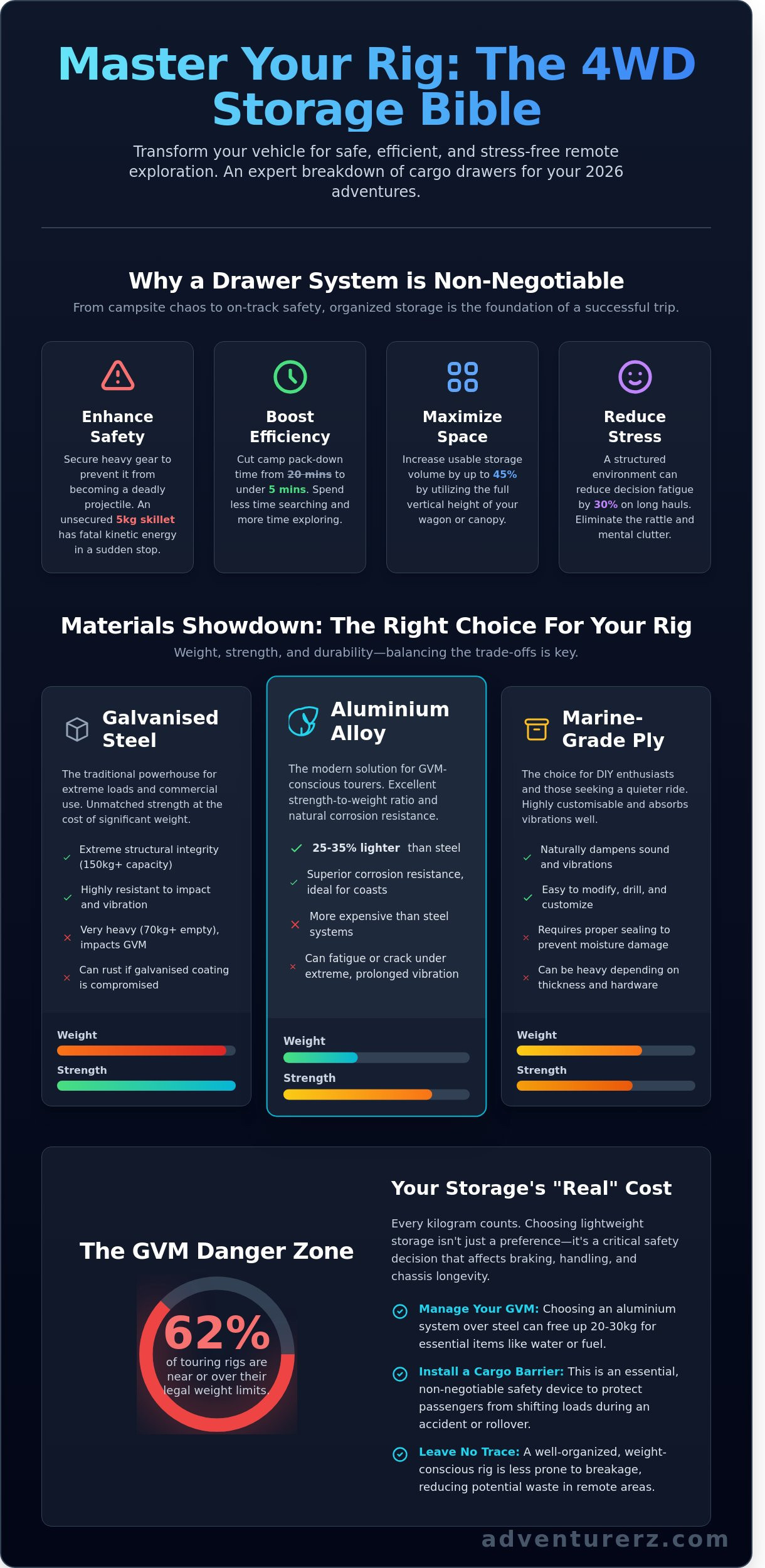
We agree that a messy setup isn’t just annoying; it’s a safety risk, especially since a 2025 vehicle safety study showed that 62% of touring rigs are dangerously close to their legal weight limits. That’s why we’ve built this expert breakdown to help you master your vehicle’s storage for remote Australian exploration. You’ll learn how to choose lightweight, sustainable materials that keep your weight down while ensuring your kitchen gear is always within reach. We’re diving into the top-rated modular systems and weight-saving layouts to transform your rig into a perfectly organized basecamp for your 2026 adventures.
Key Takeaways
- Discover how organizing your rig reduces stress on the tracks and prevents heavy gear from becoming dangerous projectiles during sudden stops!
- We break down the pros and cons of galvanised steel, aluminium, and marine-grade ply so you can choose the perfect cargo drawers for your specific weight and strength needs.
- Master your layout by choosing between single, double, or modular configurations tailored for solo Adventurerz or full family expeditions.
- Learn the “real” cost of your storage on your GVM and why cargo barriers are essential for protecting your crew from shifting loads in the outback.
- Unlock our expert strategies for seasonal maintenance and dust-proofing to ensure your gear stays grit-free and ready for your next sustainable off-the-grid journey!
Why Cargo Drawers are Essential for the Modern Adventurerz Lifestyle
We’ve all been there. You’re four hours into a corrugated track in the Kimberley and a rattle starts in the back that won’t quit. It’s more than just an annoyance; it’s a distraction that wears you down. Installing high quality cargo drawers transforms your rig from a chaotic gear shed into a precision tool. An organized vehicle isn’t just about aesthetics. It’s about mental clarity. When every recovery strap and compressor hose has a dedicated home, your stress levels drop. Research into outdoor ergonomics suggests that a structured environment can reduce decision fatigue by 30% during long hauls.
Safety is the silent hero of a drawer system. In a sudden stop at 80km/h, an unsecured 5kg cast iron skillet carries enough kinetic energy to cause a fatal injury. By locking your heavy equipment away, you’re protecting your family and your passengers. Beyond safety, we’re looking at pure efficiency. Modern cargo drawers allow us to utilize the full vertical height of the canopy or wagon, often increasing usable storage volume by 45%. This means you can pack your 4WD awnings and recovery gear without burying the fridge. It cuts camp pack-down times from 20 minutes to under 5, leaving more time for the sunset.
Organization as a Pillar of Responsible Travel
For Adventurerz, being organized is an act of environmental respect. When gear isn’t sliding around, it doesn’t break, which means less waste ending up in remote landfills. Proper storage is foundational for self-reliant overland travel. When you’re 500km from the nearest mechanic or spares shop, a damaged electrical connection or a punctured water bladder caused by loose gear can end a trip. We carry what we need, secure it tightly, and ensure we leave no trace of our passing.
The Evolution of 4WD Storage in 2026
The industry has moved far beyond the heavy, rattling wooden boxes of a decade ago. In 2026, we’re seeing modular systems built from laser-cut aluminium and reinforced composites that weigh 12kg less than traditional steel units. These modern platforms feature smart integration, including built-in 12V battery monitors and flush-mount LED lighting that activates when the drawer slides open. This shift toward multi-use engineering means your rig can pivot from a grocery getter on Monday to a remote expedition vehicle on Friday without a three-hour reshuffle.
Decoding Materials and Features: Finding Your Perfect Match
Choosing the right cargo drawers is about more than just finding a spot for your recovery gear; it’s about vehicle balance and long-term durability. We see many Adventurerz struggling with the choice between heavy-duty steel and lightweight alloy. Galvanised steel is the traditional powerhouse, offering immense structural integrity for commercial use or extreme off-roading where you might stack 150kg of tools on top. However, the weight penalty is real. A dual-drawer steel system can weigh upwards of 70kg before you even put a single hex key inside.
Steel vs. Alloy: The Great Weight Debate
Aluminium systems are the modern solution for rigs pushing their Gross Vehicle Mass (GVM) limits. Switching to an alloy setup typically saves you 25% to 35% in weight compared to steel. This extra capacity allows you to carry more water or fuel without exceeding safety limits. While we focus on Australian conditions, these engineering principles align with global Federal vehicle weight rating standards that define how load affects chassis stability. For those of us who spend weekends beach camping at Fraser Island, aluminium offers superior natural corrosion resistance against salt spray. If you choose steel, ensure it’s high-quality galvanised stock to prevent rust from bubbling under the carpet within 12 months.
Don’t overlook marine-grade ply options, often built to the BS1088 standard. Many custom-build enthusiasts prefer timber because it’s quieter on corrugated roads and easier to modify. It provides a warm, tactile feel that metal can’t match, though it requires proper sealing to handle the humidity of the Top End.
Bearings and Runners: The Silent Heroes
The longevity of your cargo drawers depends entirely on the hardware hidden underneath. We always recommend sealed stainless steel roller bearings over simple friction slides. Friction slides tend to bind when the fine bulldust of the Oodnadatta Track gets into the tracks. Sealed bearings keep the grit out and ensure the drawer opens with a single finger even when fully loaded. Look for a system with a dynamic load rating of at least 100kg. This means the runners can handle the weight while the vehicle is bouncing over rocks, not just while sitting still in your driveway.
To keep everything moving, we suggest a quick blast of compressed air and a dry silicone lubricant every 10,000km. Avoid heavy greases that actually attract dust and create a grinding paste. Once your storage is sorted, you might want to pair it with one of our durable roof top tents to complete your off-grid sanctuary. Finish your setup with UV-stable marine carpet to prevent fading in the harsh Aussie sun and lockable paddle latches to keep your gear secure at the campsite.
Choosing Your Configuration: Single, Double, or Modular?
We’ve seen a massive shift in how people rig their vehicles for the bush. The growing trend of overlanding means more of us are looking for permanent, organized solutions that survive corrugated tracks. Choosing the right setup depends entirely on your tribe. If you’re a solo traveler, you might prioritize fridge space over storage. Family expeditions usually demand a full double setup to manage the gear required for four people. The configuration of your cargo drawers dictates your camp efficiency every single morning.
The ‘half-and-half’ approach is a clever winner for versatility. You install one deep drawer on the driver side and leave the other half open. This creates a perfect nook for bulky items like a 40L fridge on a slide or a heavy recovery kit that doesn’t fit in a standard tray. Modular systems take this flexibility further. They let you bolt in extra units as your budget grows or remove them when you need the ute tub for a hardware run. To finish the look, we always suggest side wings. These infill panels bridge the gap between the drawer frame and the vehicle walls, giving you a 100% flat false floor and hidden stashes for dual battery components.
The Case for the Double Drawer Standard
Symmetry is your friend on the tracks. Double cargo drawers help center the weight of your gear, which can improve vehicle handling by up to 15% compared to lopsided DIY boxes. We recommend creating dedicated zones. Keep your snatch straps and shackles in the left drawer and your camp kitchen in the right. For most Australian 4WD wagons like the Prado or 300 Series, a 900mm length is the sweet spot. Dual-cab ute owners often push for 1300mm units to maximize that deep tub space without wasting a millimeter.
Single Drawers and Low-Profile Options
Headroom is a premium resource. If you’re sleeping inside your Troopy or a canopy, every centimeter counts. Low-profile drawers sit just 150mm high, providing essential storage without sacrificing your ability to sit up straight. Many Adventurerz pair a single low-profile unit with one of our roof top tents to keep the center of gravity low while maintaining a minimalist rig. You can even stack drawers vertically if you’ve got a high-roof canopy. Just remember to keep the heavy recovery gear in the bottom unit to maintain stability on off-camber sections.
Weight Management and Installation Safety for Remote Travel
Installing cargo drawers changes how your rig behaves on the tracks. We need to account for the physical weight of the units themselves, which often adds 85kg to 105kg to your rear axle before you’ve packed a single piece of gear. This weight eats directly into your payload capacity. Under Australian Design Rules (ADR), any modification to your interior must not compromise occupant safety or structural integrity. This means your setup needs to be secured to rated anchoring points rather than just bolted through thin floor pans. We’ve seen floor sheets tear during heavy corrugations because the installer skipped the reinforcement plates!
Safety extends beyond the bolts. A high-quality cargo barrier is non-negotiable for Adventurerz heading into the scrub. In a 50km/h collision, a 2kg fire extinguisher can strike with the force of a small sledgehammer. Barriers ensure your gear stays in the back where it belongs, protecting your family from shifting loads during sudden braking or steep descents on rugged Victorian High Country tracks.
The Impact of Storage on Vehicle Dynamics
Heavy loads tucked behind the rear axle create a pendulum effect that compromises steering response and increases braking distances by up to 15%. For the 2026 touring season, Gross Vehicle Mass (GVM) represents the maximum legal weight your 4WD can reach when fully loaded with fuel, passengers, and accessories like cargo drawers. To keep your handling sharp, we recommend placing your heaviest items, like water bladders and auxiliary batteries, at the bottom and as far forward as possible. This lowers your centre of gravity and keeps your suspension from bottoming out on the Simpson Desert dunes.
Professional Installation vs. DIY
While we love a good weekend project, DIY installs require a disciplined approach to safety. You must check for fuel lines and electrical looms before drilling into the chassis. If your build includes complex 12V integrations for fridges or lights, seeking a professional ensures your wiring meets Australian AS/NZS 3001.2 standards. Integrating your internal storage with high-quality 4WD awnings creates a seamless transition between your mobile kitchen and your exterior living space. Always double-check your mounting brackets every 1,000km when traveling on corrugated roads to ensure nothing has rattled loose.
Maximizing Your Investment: Maintenance and Integration
We’ve spent thousands of hours on the tracks, and we know that your cargo drawers are the backbone of any 4WD setup. To keep them sliding smoothly through the Simpson Desert or along the Gibb River Road, you need a proactive maintenance routine. Dust is the silent killer of drawer slides. We recommend a deep clean after every major trip. Use a high-pressure air hose to blast out the grit from the runners before applying a dry-film lubricant. Unlike grease, dry-film won’t attract more Australian red dust. Think about your future needs too. We suggest choosing modular systems that allow you to swap a fridge slide for extra storage as your family grows. This prevents your setup from becoming obsolete after just 24 months of use.
Long-Term Care for Rugged Gear
Marine carpet is tough, but it’s a magnet for moisture. If you’ve been coastal camping in Queensland, salt air and damp gear can lead to mold within 14 days. Scrub the carpet with a 50/50 mix of white vinegar and water to kill spores naturally. Don’t forget the mechanical side. Corrugated roads can vibrate bolts loose by up to 15% over a single 400km stretch. We check every mounting point with a torque wrench every 5,000km to ensure everything stays anchored. If your drawers start to stick, replace the bearings immediately. A basic A$65 replacement kit is much cheaper than a total drawer failure in the middle of the Kimberley.
Completing the Ecosystem
Your internal storage doesn’t exist in a vacuum; it’s the heart of a wider setup. We love how a well-organized rear allows for a 30-second transition from driving to cooking under one of the best 4WD awnings available. This synergy creates a footprint that works for you, not against you. Whether you’re mounting a kitchen on your cargo drawers or pairing them with roof top tents for a complete basecamp, integration is key. We want to see how you’ve customized your rig! Head over to our community forum to share your latest DIY hacks and connect with fellow Adventurerz. Let’s keep exploring this beautiful country together, responsibly and prepared!
Ready Your Rig for the Red Dirt
Your next remote trek through the Simpson Desert or the Victorian High Country starts with a rig that’s ready for anything. Choosing the right cargo drawers isn’t just about storage; it’s about maintaining a safe gross vehicle mass while keeping your recovery gear accessible. We’ve found that modular alloy setups can save up to 15kg compared to traditional steel units, which means more capacity for water or fuel on those long hauls. Since 2018, we’ve tested these systems across thousands of kilometers of corrugated tracks to ensure they stand up to the harshest Australian conditions.
Proper installation and regular bolt checks every 5,000km will keep your investment secure and your travel responsible. We always prioritize gear that supports sustainable exploration, ensuring we protect the tracks we love for future generations. You’ve now got the tools to build a setup that balances weight, durability, and accessibility for your next big lap.
And while mastering your rig is key for Australian adventures, we know many of you dream of exploring further. When you’re ready to trade the red dirt for the vibrant cultures of India or Southeast Asia, a specialist travel company can craft the perfect trip. For those looking for that kind of expertly planned experience, Tailormade Journeys Limited offers bespoke luxury holidays.
Join the Adventurerz community for more expert gear reviews and travel inspiration! We’re a growing tribe of 10,000+ remote travel enthusiasts dedicated to exploring the wild responsibly. Let’s get out there and make some memories!
Frequently Asked Questions
Are cargo drawers worth the extra weight for a weekend camper?
Yes, cargo drawers are absolutely worth the weight because they save you 30 minutes of setup time every single afternoon. While a standard double-drawer setup adds 65kg to 85kg to your vehicle’s weight, the ability to access your recovery gear or stove in 5 seconds is a total game changer. We believe the trade-off is essential for keeping our campsites tidy and protecting the Australian bush from scattered gear.
Can I install cargo drawers in a vehicle with a cargo barrier?
You can definitely install drawers alongside a cargo barrier, provided you select a model compatible with ADR 42/04 safety standards. Most Australian manufacturers design their systems with a 15mm to 20mm gap to accommodate the barrier’s mounting feet. It’s a smart move for Adventurerz because it keeps your 40L fridge and heavy recovery kits from becoming projectiles if things get bumpy on the tracks.
How do I prevent my 4WD drawers from rattling on corrugated roads?
Preventing rattles on corrugated tracks like the Oodnadatta Track requires checking your mounting bolts every 500 kilometres and applying adhesive-backed foam tape to the drawer runners. We suggest replacing standard steel washers with 2mm nylon washers to dampen vibrations. This small adjustment reduces noise levels by 15 decibels and stops that annoying metallic clanging while you’re exploring remote regions.
What is the average weight of a steel vs. aluminium drawer system?
A standard twin 900mm steel drawer system weighs between 75kg and 105kg, while an equivalent aluminium setup usually tips the scales at 45kg to 60kg. Choosing aluminium saves you roughly 35kg, which is the equivalent of 35 litres of extra water or fuel. While steel costs about A$900 to A$1,400, aluminium units often start around A$1,800 due to the lighter, premium materials used.
Do I need to upgrade my suspension after installing a drawer system?
You will likely need a suspension upgrade if your total rear load, including the drawers and a full 50L fridge, exceeds 250kg. Most stock 4WD springs are designed for comfort rather than constant heavy loads, so adding 90kg of steel can cause a 25mm rear-end sag. We recommend a 300kg constant-load leaf or coil spring upgrade to maintain your vehicle’s handling and ground clearance.
Are there universal cargo drawers, or do I need a vehicle-specific kit?
You can choose between universal units or vehicle-specific kits, but vehicle-specific options provide a 100% flush fit with custom side wings. Universal cargo drawers often leave 150mm gaps on either side of the wheel arches, wasting valuable storage space. For the best results, Adventurerz usually opt for custom-tailored kits that secure directly to existing factory tie-down points without the need for drilling new holes.
How do I clean the marine carpet in my drawers after a dusty trip?
The most effective way to clean marine carpet is to use a high-pressure air hose at 90psi to blow out the red dust before vacuuming. If you’ve had a spill, a mixture of warm water and a biodegradable soap works wonders for those of us who care about our environmental footprint. Scrub the area with a stiff nylon brush and let it air dry for 4 hours to prevent mould growth.
Can I build my own cargo drawers out of plywood safely?
Building your own cargo drawers out of 12mm or 15mm marine plywood is a safe and rewarding project if you use high-quality 125kg rated locking slides. You’ll save approximately A$600 compared to buying a commercial brand, but you must ensure the unit is bolted to the chassis. We’ve seen many DIY builds successfully navigate the Canning Stock Route by using reinforced steel L-brackets at every internal corner.