Taking your dog camping in Queensland isn’t a compromise on adventure. It’s a discipline all its own. Finding the right dog friendly campsites QLD travellers can actually access means cutting through a tangle of conflicting regulations, understanding which areas permit pets and which strictly don’t, and knowing how to keep your four-legged mate safe once you’re out there.
We get it. You’ve probably hit that wall before: a campsite that looked perfect online, only to discover dogs aren’t allowed past the gate. Or you’ve worried about what’s lurking in the scrub, from eastern browns to 1080 baiting zones that don’t always make it onto the tourist maps. And if you’re running a 4WD setup, figuring out how to configure your rig for a dog on board adds another layer of complexity most guides simply skip over.
That’s exactly why we built this guide. Inside, you’ll find our curated breakdown of Queensland’s best dog-welcoming spots, a clear explainer on National Park versus State Forest rules, practical advice on gearing up your 4WD for pet travel, and how to do all of it with minimal impact on the landscapes we love. Let’s get into it.
Key Takeaways
- Not all public land is created equal — knowing the difference between National Parks and State Forests is the single most important rule for finding dog friendly campsites QLD adventurers can legally access.
- Your 4WD setup isn’t just about getting there — the right rooftop tent, awning, and ventilation configuration can make or break your dog’s safety and comfort in remote Queensland conditions.
- 1080 baiting zones are one of the most underreported hazards for dogs in outback QLD, and knowing how to identify and avoid them could save your mate’s life.
- Queensland’s pet-friendly camping landscape is actively shifting in 2026, with new access opportunities opening up across State Forest networks that most travellers haven’t discovered yet.
- Community knowledge is your sharpest planning tool — learn how to tap into real-world route intel and gear advice to travel smarter, safer, and with less impact on the landscapes you love.
Table of Contents
- Queensland's Dog-Friendly Camping Landscape: What's New for 2026
- Navigating the Rules: Where Can You Actually Take Your Dog in QLD?
- Essential Gear for Camping with Dogs in Remote Queensland
- Paws and Paths: Essential Safety and Etiquette for Remote QLD
- Planning Your Next Escape with the Adventurerz Community
Queensland’s Dog-Friendly Camping Landscape: What’s New for 2026
Something has genuinely shifted. The Queensland camping scene in 2026 looks meaningfully different from even two years ago, and if you’re a dog owner who’s spent years feeling like an afterthought in the planning process, that shift is worth paying attention to. A growing number of private landholders, regional councils, and State Forest operators are actively opening their gates to pet owners, recognising that the demand for dog friendly campsites QLD adventurers can actually use has long outpaced supply.
Part of this is demographic. The traditional grey nomad circuit is being joined by a younger wave of 4WD travellers, many of them working remotely, travelling with dogs as genuine companions rather than an afterthought. These two groups want different things from a campsite, but they share one non-negotiable: they’re not leaving their dogs at home. That shared pressure is reshaping what landholders and local governments are willing to offer.
The Shift Toward Inclusive Outdoor Spaces
Private landholders have become the most dynamic part of this equation. Where National Parks continue to enforce blanket pet bans to protect native fauna, private stations and State Forest networks are filling that gap with genuine alternatives. Social media has accelerated this dramatically. A single well-tagged post from a remote creek camp can turn an obscure property into a booked-out destination within weeks. The upside is discovery. The downside is that not all of those viral spots have the infrastructure or the verified permissions to handle the traffic they attract.
This is where community-driven site reviews have become essential. Peer-verified reports from fellow travellers, cross-referenced with current access conditions, are now more reliable than many official tourism listings. If you’re not tapping into active 4WD and camping communities for ground-level intel before you roll out, you’re planning with incomplete information.
Climate Considerations for QLD Pet Travel
Queensland’s climate doesn’t care about your itinerary. The Wet Season, which runs roughly November through April across the north, closes off enormous sections of otherwise accessible track. For dogs, the risks compound quickly:
- Heat stress in tropical North Queensland can set in faster for dogs than for humans, particularly in high-humidity conditions above 30°C
- Flooded creek crossings that are manageable for a well-kitted 4WD can become fatal for a dog swept from the tray
- Wet season insect pressure, including paralysis ticks and mosquitoes carrying heartworm, peaks during this period
Seasonal planning isn’t just a comfort consideration for your dog. In remote Queensland, it’s a safety protocol. The best window for most dog-friendly tracks across the Cape, the Gulf, and the Channel Country runs May through September, when conditions are predictable and the heat is manageable. Plan around your dog’s physiology, not just the scenery.
Navigating the Rules: Where Can You Actually Take Your Dog in QLD?
Here’s the single most important thing you need to understand before you load up the rig: land classification determines everything. In Queensland, the difference between a legal, relaxed camp with your dog and a hefty on-the-spot fine often comes down to one question: is this a National Park, or is it something else? Get that answer right before you leave the driveway.
National Parks: The No-Go Zones and Exceptions
The Queensland Parks and Wildlife Service (QPWS) enforces a near-blanket prohibition on dogs in National Parks. The reasoning is sound: Queensland’s National Parks protect some of the most sensitive native fauna on the continent, and domestic dogs, regardless of how well-trained they are, pose a genuine predation and disturbance risk to ground-nesting birds, wallabies, and threatened reptile species. This isn’t bureaucratic overreach. It’s conservation with teeth.
Non-compliance carries real consequences. Fines for bringing a dog into a prohibited National Park in Queensland can reach into the hundreds of dollars per infringement, and repeat offences attract escalating penalties. Beyond the fine, the environmental cost, a stressed colony of ground-nesting birds, a disturbed wildlife corridor, compounds across thousands of visitors.
Rare exceptions do exist. A small number of designated walking tracks adjacent to National Park boundaries permit dogs on-lead, but these are the exception rather than the rule and are subject to change. Always verify directly with QPWS before assuming a boundary trail is fair game. Their online mapping tools are the most current source available, and a five-minute check beats an expensive surprise at the gate.
State Forests and Recreation Areas: The Best Bets
This is where the real opportunity lives for anyone hunting down genuine dog friendly campsites QLD travellers can access legally and comfortably. State Forests, managed by the Department of Agriculture and Fisheries rather than QPWS, operate under a different framework. Dogs are generally permitted in State Forest recreation areas, provided they’re kept on a lead and under effective control at all times.
What to look for on the ground:
- Green and white recreation area signage at the entry point, which typically signals a State Forest designation
- “Dogs Prohibited” signs in specific remote pockets, which do appear even within State Forests near sensitive habitat corridors
- Permit or self-registration systems at the campsite entrance, which are increasingly common across Queensland’s State Forest network in 2026
Booking through official channels matters here. Many State Forest campsites now require pre-booking through the Queensland Government’s online camping permit system. Turning up unregistered, even at a dog-friendly site, can still attract a fine. Lock in your permit before you leave home.
Understanding the gear that makes remote State Forest camping work for dogs and their owners is just as important as knowing the rules. If you’re still dialling in your 4WD setup for extended trips, our 4WD awning reviews are a solid starting point for building a camp that keeps your mate comfortable in Queensland’s variable conditions.
Essential Gear for Camping with Dogs in Remote Queensland
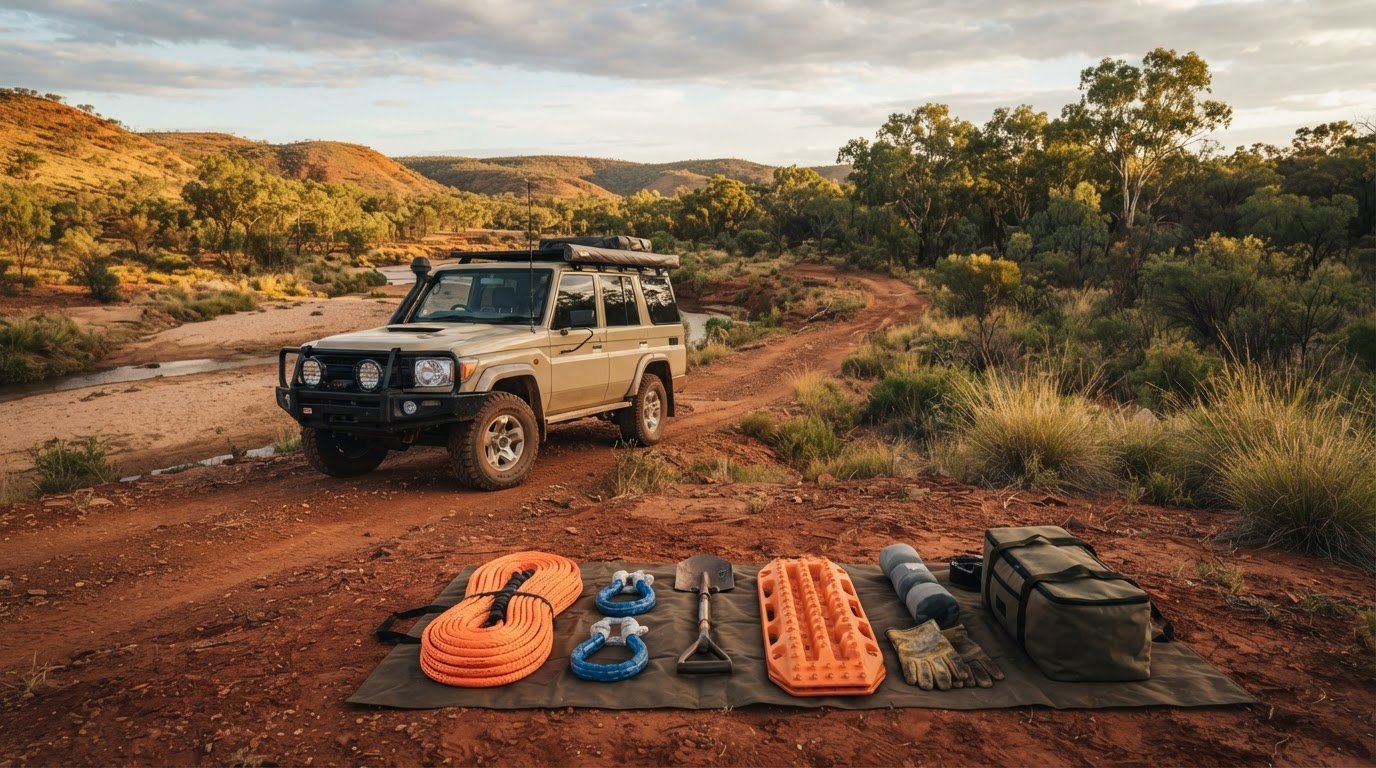
Your 4WD isn’t just transport. Out in remote Queensland, it’s your dog’s life-support system. The right configuration means the difference between a mate who arrives at camp calm, hydrated, and ready to explore, and one who’s heat-stressed before you’ve even set up. Most generic camping guides skip this entirely. We’re not going to.
Start with temperature management, because Queensland will punish you fast if you don’t. Dogs can’t sweat the way we do, and ambient temperatures in the Channel Country or Cape York can push well past 35°C even during the dry season. Your rig needs to function as a cool zone, not just a vehicle. That means thinking about airflow, shade coverage, and where your dog physically sits during transit and at rest.
Containment is the other non-negotiable. A long-line staked to a ground anchor gives your dog freedom to move while keeping them clear of scrub where snakes, ticks, and baiting zones can lurk. Portable mesh fences work well at established camps where you want a defined perimeter without constant supervision. For dogs that haven’t been crate-trained, start before the trip, not during it. A dog that accepts a crate as their space is a dog that travels safely and settles faster at unfamiliar camps.
Hydration in the outback goes beyond filling a bowl twice a day. Carry more water than you think you need, because your dog’s intake will spike in heat. Collapsible silicone bowls are light and packable. Some travellers run a small secondary water container specifically for the dog, separate from the main supply, so there’s no rationing decision to make when you’re a long way from the next bore.
Sleeping Arrangements: Rooftop Tents and Pet Access
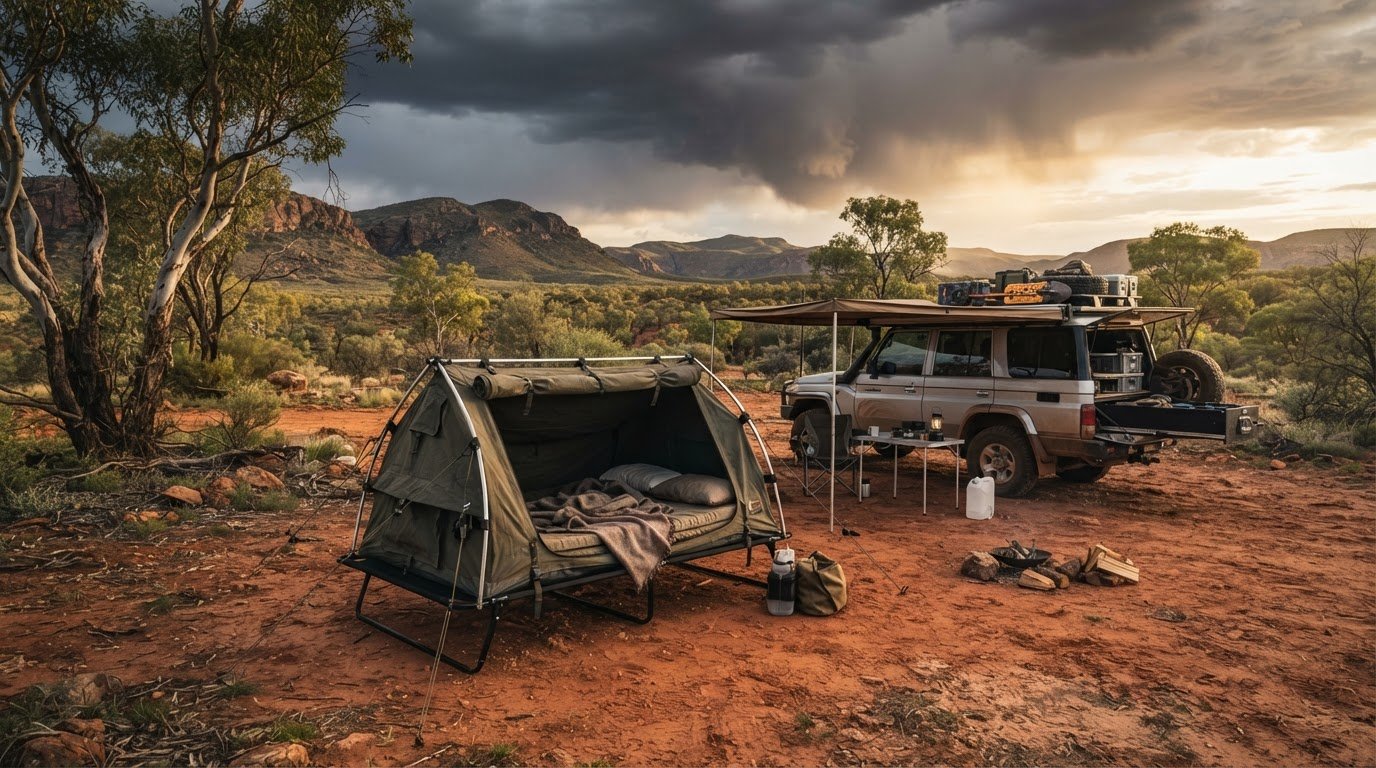
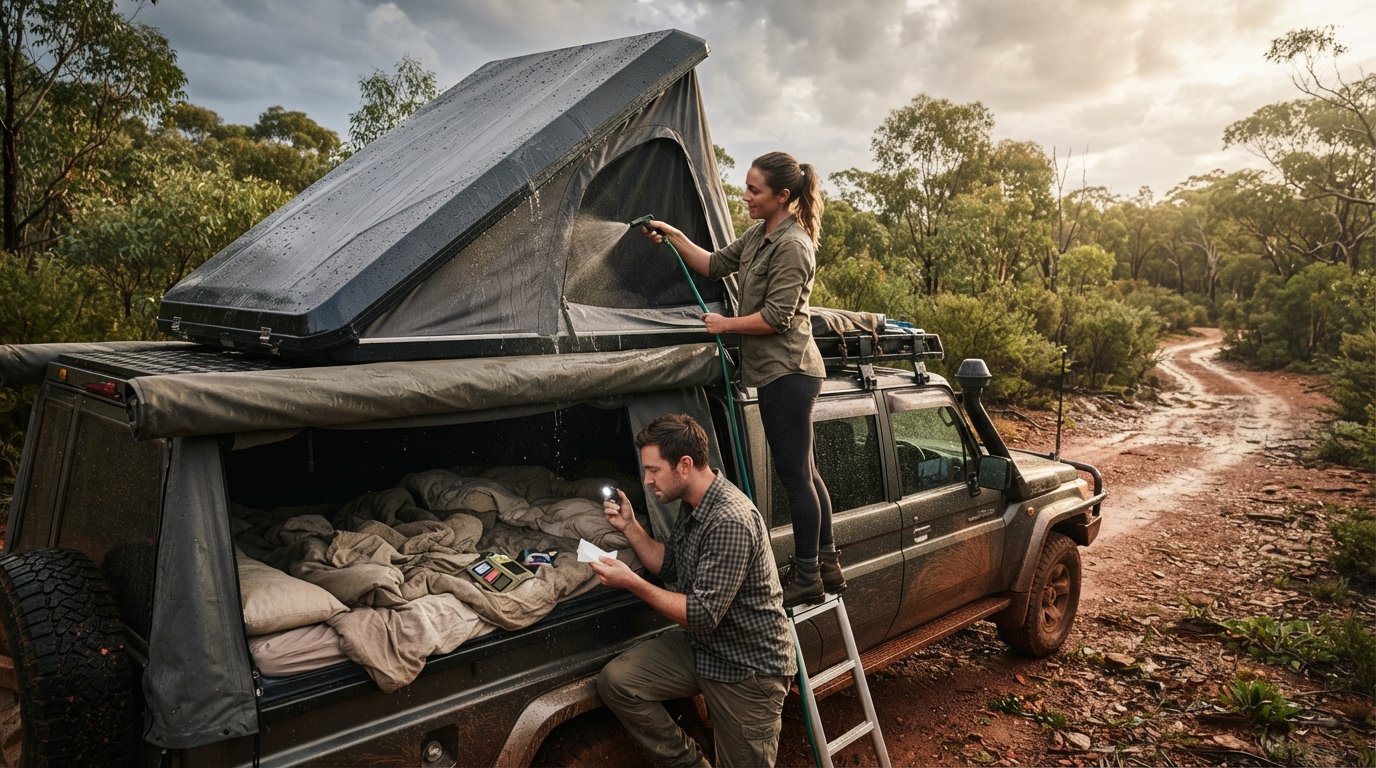
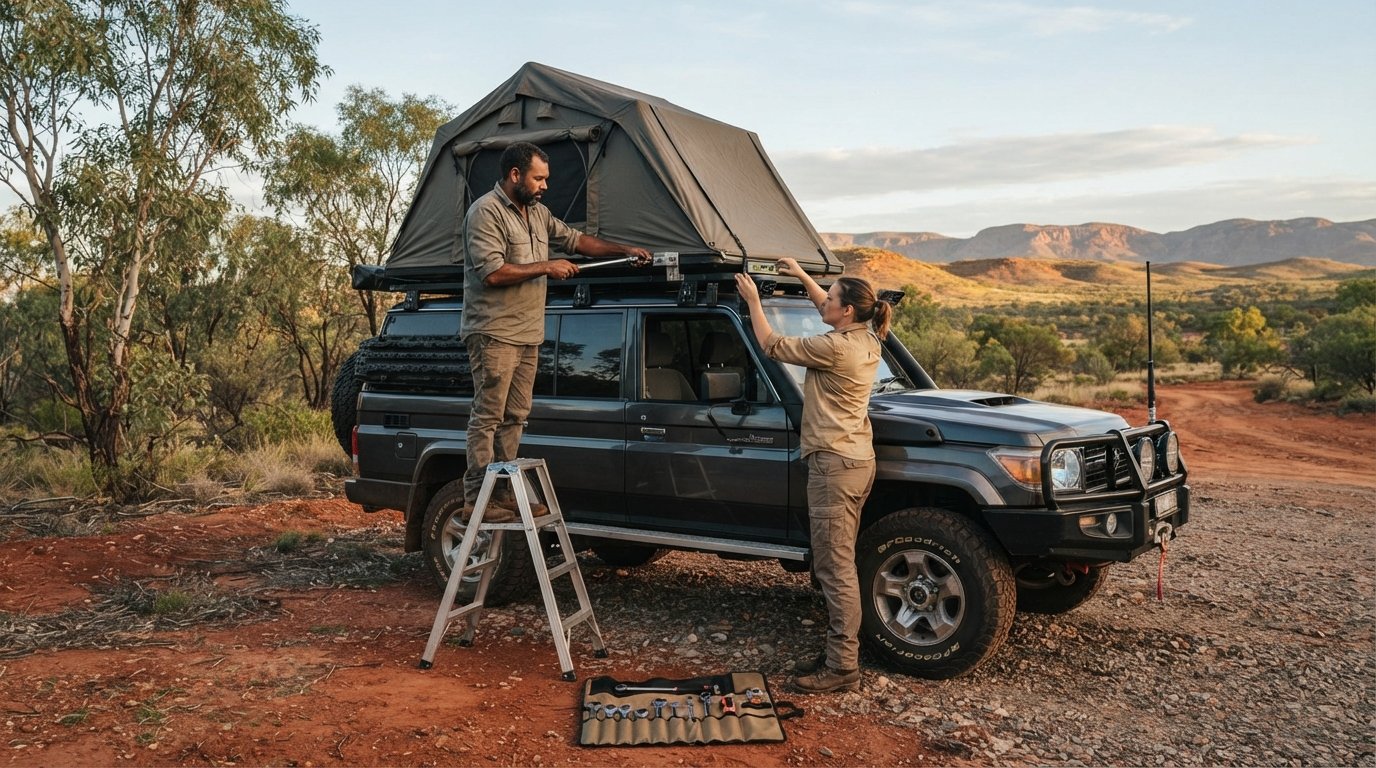
Rooftop tents are brilliant for humans and genuinely complicated for dogs. Most hardshell and softshell rooftop setups aren’t designed for canine access; the ladder angle is awkward, and the platform loading isn’t rated for repeated dog movement. The practical solution most experienced travellers land on is using the annex or ground-level tent as the dog’s sleeping zone. It keeps them secure, off the ground away from insects and moisture, and close enough that anxious dogs settle quickly. If you’re still deciding on a setup, our guide to roof top tents covers the configurations that work best for families travelling with pets.
Shade and Shelter: The 4WD Awning Advantage
An awning isn’t optional gear for dog-friendly campsites QLD travellers should be targeting in summer or shoulder season. It’s core infrastructure. A quality 270-degree awning can shade an area large enough for your dog to rest, eat, and move without stepping into direct sun. Add side walls and a ground mat, and you’ve built a genuinely cool zone that drops the ambient temperature meaningfully. Dogs gravitate to these spaces instinctively. Read our expert review on the best 4WD awnings to find the coverage options that suit Queensland’s intense UV conditions.
The gear-to-destination connection matters here. Knowing which dog friendly campsites QLD adventurers can access is only half the equation. Arriving with a rig that keeps your dog safe, comfortable, and contained is what makes those destinations actually work.
Part of that safety preparation includes ensuring your mate is wearing clear, permanent identification. Since remote areas often lack mobile reception, having a physical tag with your contact details is a crucial backup; you can learn more about Pet ID Tags Australia to find rugged tags that stand up to the elements.
Paws and Paths: Essential Safety and Etiquette for Remote QLD
Remote Queensland is genuinely wild. That’s the appeal. But it also means the hazards your dog faces out there go well beyond a hot day or a rough track. Knowing what’s actually waiting in the scrub, and how to manage it, is what separates a great trip from a catastrophic one.
The 1080 Baiting Threat in Queensland
Sodium fluoroacetate, known as 1080, is a poison used across Queensland’s pastoral and agricultural land to control feral pigs, wild dogs, and foxes. It’s odourless, tasteless, and almost universally fatal to domestic dogs. There is no antidote. The window between ingestion and death can be as short as two hours.
Baited areas are marked, but not always where you’d expect to find the signs. Look for yellow diamond-shaped warning signs at property entrances and along fence lines. The critical mistake travellers make is assuming that a sign at the gate covers the whole perimeter. Bait stations can extend deep into the property, and carcasses of poisoned animals, which are secondary bait sources, can be found well outside the marked zone.
Prevention is your only tool here. In known baiting regions, including much of the Gulf Country, Channel Country, and western Cape York pastoral areas, run your dog on a lead at all times outside of camp. A basket muzzle is worth carrying as a backup in high-risk zones. Never let your dog investigate carcasses, dig near fence lines, or range freely in areas where you haven’t confirmed bait-free status. Check the Queensland Government’s PestSmart resources before your trip to identify active baiting programs along your route.
Wildlife and Livestock Etiquette
A reliable recall is a great start. It’s not enough on its own. The prey drive that kicks in when your dog spots a mob of kangaroos at dusk operates faster than any trained response. At legitimate dog friendly campsites QLD travellers use across State Forest networks, the scrub around camp is active at dawn and dusk. Keep your dog on a long-line during these windows, not because they’re badly trained, but because the stimulus is genuinely overwhelming for most breeds.
Cattle station transit deserves its own discipline. If your route crosses a pastoral lease, dogs must remain contained in the vehicle at all times. A dog that spooks livestock on a working property isn’t just a nuisance; it can cause serious financial harm to the landholder and result in your access being revoked permanently. Treat station entry as lead-mandatory, no exceptions.
Ground-nesting birds, including bush stone-curlews and several threatened plover species, are active at the same campsites where you’ll be pitching up. A dog that ranges freely at night can destroy a nesting site without you ever knowing. Keep your dog contained after dark.
Leave No Trace: The Pet Edition
Dog waste management in remote camps is non-negotiable. Carry biodegradable bags and pack out what you can’t bury. When burying is the only option, dig at least 15cm deep and a minimum of 60 metres from any water source. Dog waste carries pathogens that native wildlife and other campers don’t need in the water table.
Noise is the other dimension most guides skip. A dog that barks through the night at unfamiliar sounds isn’t just an annoyance to neighbouring campers; it’s a sustained disturbance to the nocturnal wildlife that makes these places worth visiting. Crate training, addressed in the gear section, pays dividends here. A settled dog is a quiet dog.
Remote First Aid for Dogs
Your human first aid kit doesn’t cover your dog. Build a separate kit and know how to use it. At minimum, pack:
- Saline solution for flushing eyes and wounds after scrub contact
- Tick removal tool rated for paralysis ticks, not the cheap plastic variety
- Wound closure strips and non-stick dressings for pad and leg injuries on rocky terrain
- Your vet’s emergency contact number and the nearest 24-hour veterinary clinic to your planned route
- A copy of your dog’s vaccination and medication records, particularly if they’re on heartworm or tick prevention
Snake bite protocol for dogs in the field is: immobilise, keep calm, and get to a vet as fast as possible. Don’t attempt to cut, suck, or tourniquet the wound. Time is the variable you can control. Know your evacuation route before you need it.
Travelling smart in dog friendly campsites QLD adventurers are discovering means building a camp that actively protects your mate from the environment around them. A quality 4WD awning gives you a shaded, defined zone that keeps your dog out of direct sun and away from the scrub edge during the high-risk hours of early morning and dusk. Read our expert reviews on the best 4WD awnings to find the coverage configurations that work hardest in Queensland’s conditions.
Planning Your Next Escape with the Adventurerz Community
Every great trip starts with better information than the person next to you has. That’s not a competitive statement; it’s a practical one. The gap between a dog-friendly adventure that runs smoothly and one that falls apart at the first locked gate is almost always a planning gap. And the sharpest planning tool available to you right now isn’t a government website or a tourism brochure. It’s community knowledge.
Fellow travellers who’ve run your intended route last month, who know which State Forest entry point has a new self-registration system, which creek crossing is still passable with a dog on board, and which campsite has quietly become a tick hotspot this season, hold intelligence that no official source can match for currency or specificity. Tapping into that network before you leave home isn’t optional. It’s how you travel smarter.
The Ultimate Adventure Planner
Mapping a 4WD itinerary that integrates genuine dog friendly campsites QLD travellers can rely on requires more than pinning locations on a map. You need to sequence stops around your dog’s physiology, fuel and water resupply points, and the seasonal access windows covered earlier in this guide. Our ultimate adventure travel planner is built for exactly this kind of layered thinking. It walks you through building a remote 2026 escape that accounts for track conditions, campsite availability, and the kind of contingency planning that keeps you and your mate safe when things don’t go to script.
Use it to identify your anchor camps first, the sites you’re committing to, then build flexibility into the days between. Dogs travel better with rhythm. Predictable stop times, consistent feeding windows, and familiar routines at camp reduce anxiety and improve behaviour in unfamiliar environments.
Joining the Adventurerz Movement
Sustainable pet travel in Australia doesn’t happen by accident. It’s built by travellers who leave sites better than they found them, who share honest site reviews rather than just the hero shots, and who advocate for responsible access so that the dog friendly campsites QLD adventurers love today remain open for the next generation of explorers.
That’s what the Adventurerz community is built on. Share your verified campsite experiences. Post the conditions you actually found, not just the conditions you hoped for. Call out access changes when you spot them. That collective intelligence is what keeps the network accurate and keeps gates open for dogs and their owners.
Queensland’s natural wonders don’t need protecting from dog owners. They need protecting from careless ones. Know the difference, travel accordingly, and bring your best mate along for the ride.
Before you roll out, run this check:
- Camping permits confirmed and downloaded for every State Forest stop on your route
- 1080 baiting zones along your corridor checked against current Queensland Government resources
- Dog first aid kit packed and separate from your human kit
- Tick, heartworm, and flea prevention up to date for the season
- Awning and shade setup ready to deploy at every camp
- Emergency vet contacts saved for each region on your route
- Long-line, ground anchor, and containment gear loaded and accessible
- Evacuation route identified for each remote section of the trip
That’s the checklist. Now go build the trip.
Your Next QLD Adventure Starts Here
Queensland is genuinely one of the best places on earth to travel with a dog, but only if you know the rules, respect the landscape, and show up prepared. The difference between a trip that works and one that doesn’t almost always comes down to three things: understanding which land classifications actually welcome dogs, having a rig configured for your mate’s safety and comfort, and knowing how to travel responsibly so those gates stay open for everyone who follows.
Finding dog friendly campsites QLD adventurers can rely on isn’t the hard part anymore. The hard part is doing it right. That’s where community knowledge, expert gear guidance, and a genuine commitment to sustainable travel make all the difference.
Adventurerz brings all of that together in one place: expert reviews on the gear that matters, community-led route intelligence, and a real commitment to protecting the landscapes we love exploring. Start planning your 2026 QLD adventure with Adventurerz today and get out there with your best mate by your side.
The tracks are waiting. Go make them count.
Frequently Asked Questions About Dog Friendly Campsites QLD
Can I take my dog into QLD National Parks if they stay in the car?
No. Queensland Parks and Wildlife Service regulations prohibit dogs from entering National Park boundaries entirely, including in vehicles. The restriction applies to the land itself, not just to dogs roaming freely. If you’re driving through a National Park to reach a campsite on the other side, your dog technically shouldn’t be in the vehicle during that transit. Plan your routes to avoid National Park corridors where possible, or confirm the specific access rules with QPWS before you travel.
What is the best way to protect my dog from paralysis ticks in QLD?
Start with a veterinarian-approved tick prevention product before you leave home, not when you arrive. Spot-on treatments, tick collars, and chewable preventatives all work differently, so get advice on what suits your dog’s size and health profile. In the field, run a full body check after every bush walk, paying close attention to the face, neck, ears, and between the toes. Paralysis ticks are most active during warm, humid months, which aligns closely with Queensland’s wet season camping window.
Are there any dog-friendly beaches near popular QLD camping areas?
Yes, though access rules vary significantly between councils and change seasonally. Many coastal Queensland councils designate specific off-leash beach zones with time-of-day restrictions, typically early morning and evening. Fraser Coast, Sunshine Coast, and parts of the Capricorn Coast all have dog-friendly beach access points near popular camping corridors. Always check the relevant local council website before you arrive, because signage at the beach doesn’t always reflect the most current rules, and fines for non-compliance are real.
How do I find out if a QLD campsite has been treated with 1080 bait?
The Queensland Government’s Land Management and Vegetation team publishes baiting program information, and the PestSmart website is a useful starting point for identifying active programs by region. For property-level detail, contact the landholder or the relevant local government directly before your trip. Don’t rely solely on signage at the gate. Bait stations can extend well beyond marked entry points, and carcasses of poisoned animals can appear outside the visible warning zone. Treat any unfamiliar pastoral land as potentially baited until confirmed otherwise.
Is it safe to leave my dog at camp while I go for a short hike?
It depends on the conditions and your containment setup, but in most remote Queensland camps, leaving a dog unattended carries genuine risk. Snakes investigate shaded areas during the day, and a tethered dog can’t move away from a threat. If you do leave camp briefly, secure your dog in a well-ventilated vehicle or a fully enclosed portable pen rather than on a long-line. Never leave a dog in a vehicle during peak heat hours. Short absences in cool morning conditions with solid containment are manageable; extended solo time in remote heat is not.
What are the essential items for a dog-specific camping first aid kit?
Build your kit around the specific hazards of remote Queensland: saline solution for flushing wounds and eyes, a quality tick removal tool rated for paralysis ticks, non-stick wound dressings and closure strips for pad injuries on rocky terrain, and a digital thermometer to monitor for heat stress. Add your dog’s current vaccination records, a copy of any ongoing medications, and the contact details for the nearest 24-hour veterinary clinic along your route. Keep this kit separate from your human first aid supplies so it’s always easy to locate quickly.
Do I need to pay extra fees to bring my dog to a QLD State Forest campsite?
Most Queensland State Forest campsites don’t charge a separate dog fee on top of the standard camping permit cost, but this varies by site and is subject to change. What’s non-negotiable is that you hold a valid camping permit for the site before you arrive. Many State Forest campsites now require pre-booking through the Queensland Government’s online permit system, and turning up unregistered can attract a fine regardless of whether dogs are permitted. Always confirm current fee structures directly through the official Queensland camping permit portal before your trip.
How can I keep my dog cool while camping in the QLD summer?
Shade is your first line of defence. A quality 270-degree awning deployed from your 4WD creates a significantly cooler zone than open air, and dogs will instinctively gravitate to it during peak heat hours. Beyond shade, carry dedicated water reserves for your dog separate from your own supply, and offer small, frequent drinks rather than one large bowl. Limit activity to early morning and after sunset, and watch for early heat stress signs: excessive panting, drooling, and lethargy. Finding dog friendly campsites QLD travellers can access with natural tree cover also makes a meaningful difference to ambient temperatures at camp.