The cheapest fuel stop can be the one you plan before your tank gets low. A loyalty discount can help, but it won’t replace a fuel plan.
It’s easy to focus on the bowser price, especially when towing a caravan or travelling long distances. But your route, load and driving habits also affect how often you refuel. Remote travel calls for careful planning, not waiting for the warning light.
This guide covers fuel choice and supermarket-linked discounts, ways to manage consumption when towing, and practical steps for planning regional and remote fuel stops. You’ll have a clearer way to budget for the road and prepare for long gaps between stations, without giving up the freedom to explore.
Key Takeaways
- Reduce unnecessary load and remove roof accessories when you don’t need them to help limit fuel use.
- Use supermarket fuel discounts when they fit your route, but choose fuel that meets your vehicle manufacturer’s requirements.
- Allow for higher fuel consumption when towing, and use your vehicle’s own fuel-use figures to shape your travel budget.
- Map fuel stops before remote stretches and plan your reserves around the distance between stations, not the warning light.
Table of Contents
1. How can I save money on fuel while travelling Australia?
Saving money on fuel while touring Australia starts before you turn the key. Carry less, remove unused external accessories, drive smoothly and group trips to avoid unnecessary kilometres. These choices reduce weight, aerodynamic drag or total distance, helping your vehicle use less fuel over a long itinerary.
For fuel-efficient touring, follow the vehicle manufacturer’s requirements, including the specified fuel octane and tyre pressures for your load. Check tyre pressure when the tyres are cold before a long journey, using the vehicle’s placard or owner’s manual. Smooth acceleration, anticipating traffic and maintaining a steady speed are practical long-distance driving habits.
For another perspective on everyday fuel-saving habits, watch this short video:
Start with the load. A litre of water weighs 1 kg, so full tanks add weight before food, tools and camping gear are packed. Carry the water you need for the route, then review every item in the vehicle and caravan. Remove equipment you won’t use, while keeping essential recovery gear and supplies for remote travel.
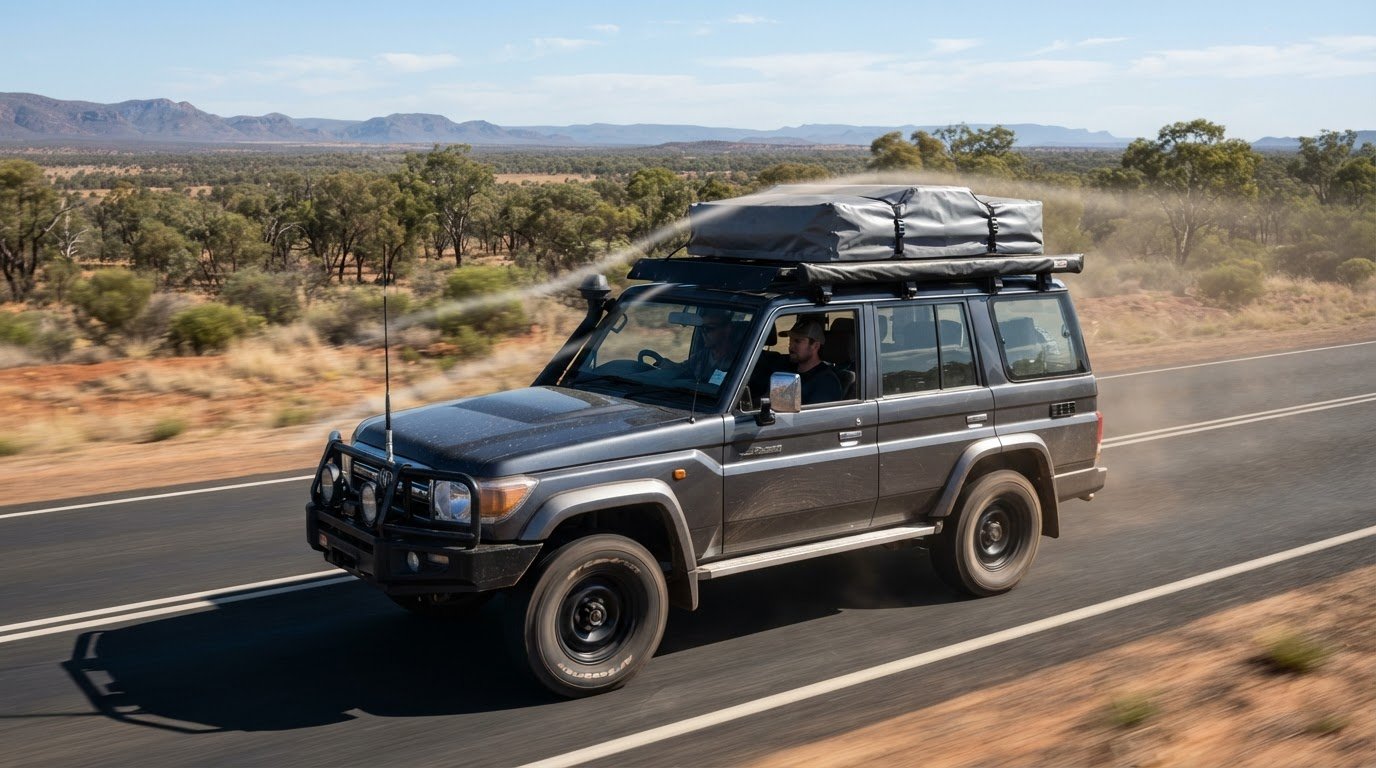
Next, reduce drag. Roof racks, roof boxes and other external accessories create aerodynamic resistance, so remove them when they aren’t needed. Check the roof before departure and pack bulky gear inside, secured safely. Less drag means the engine works less, particularly as speed rises on open highways.
Speed matters, too. Fuel consumption tends to increase at higher speeds because aerodynamic drag rises. Some travellers recommend 90 km/h on highways, but a fixed target doesn’t suit every vehicle, road or towing setup. Use the vehicle computer to find an economical cruising speed, then hold it where conditions allow. Ease into acceleration and look ahead to avoid hard braking.
Cruise control can help maintain a steady pace on long, relatively flat roads. On hills, it may use more fuel by accelerating to hold the set speed. Take manual control on steep or winding sections, and respond smoothly to terrain and traffic. Attentive, steady driving supports fuel economy without making speed the only consideration.
Route planning can reduce both kilometres and fuel use. If you’ll stay in one region for weeks, stock up locally and group errands instead of repeatedly driving between towns. Fewer kilometres mean fewer refuelling stops. Before leaving, plan supplies and activities around your base, while considering route conditions and access.
Trim other travel costs alongside fuel. Review subscriptions before departure and pause services you won’t use on the road. Check that your phone plan suits your itinerary, including the data you need for navigation, and remove extras that add no value. This won’t change fuel consumption, but it can free up budget for essential touring costs.
2. Choosing fuel and using loyalty discounts
Petrol, diesel or LPG isn’t automatically cheapest for every Australian touring vehicle. Compare the pump price with your vehicle’s consumption: multiply the price per litre by litres used per 100 kilometres. Then compare the resulting cost per 100 kilometres for fuels your vehicle is designed to use. A lower pump price can still mean higher travel expenses if that fuel requires more litres.
Use the petrol grade required by your vehicle manufacturer. Choosing a lower octane rating than required isn’t a safe way to cut expenses. Check the owner’s manual or the vehicle’s fuel information, then use that requirement when comparing stations. A discount doesn’t make an unsuitable fuel grade the right choice.
Supermarket-linked fuel vouchers can reduce the bowser price. Keep eligible shopping dockets or loyalty offers handy, and compare the discounted price with nearby options before changing your route.
Check each voucher’s conditions before relying on it. The saving applies only when the offer matches your purchase, fuel type and chosen station. Compare the final price per litre, not just the discount. A detour costs fuel and time, so a lower advertised price may not reduce your trip’s total cost.
Timing your stop can also affect the price. Petrol can generally be 5% to 15% cheaper on Tuesdays than on other days, so consider refuelling on Tuesday or Wednesday instead of the weekend. Use that pattern as one planning factor, not a reason to risk running low. On a regional route, safe access to fuel takes priority over waiting for a preferred day.
Speed affects fuel use as well as your choice of station. Higher speeds increase aerodynamic drag, and the most economical cruising speed depends on the vehicle, load and road conditions. Use your vehicle computer to find a steady, efficient pace, then maintain it when traffic and conditions allow. Look ahead and ease off early to avoid hard acceleration and heavy braking.
On long, flat highway stretches, cruise control can help hold a consistent speed when traffic allows. On hilly roads, it may use extra fuel by accelerating uphill to maintain its setting. Adjust your driving to the terrain instead. A steady pace helps, but it doesn’t mean driving at one fixed speed on every Australian road.
Before setting off, compare suitable fuel choices, current station prices and available loyalty discounts. Calculate cost per 100 kilometres using your vehicle’s actual consumption, then plan refuelling around your route. That simple comparison helps us choose fuel for economy without compromising the manufacturer’s requirements or a safe touring plan.
3. Fuel costs while towing a caravan around Australia
Fuel use varies with the vehicle, load, route and whether you’re towing. The examples here range from 8 L/100 km for a road-trip vehicle to 13–14.5 L/100 km for one touring setup. A large 4WD towing a full-size caravan may use 18 L/100 km at best, and more typically 22–28 L/100 km. Treat these as examples, not fixed figures for every rental car or campervan.
For your own estimate, use the vehicle’s recorded fuel consumption and multiply it by the planned distance. A 1,000 km road trip at 8 L/100 km requires about 80 litres. For a towing setup, use its towing consumption rather than the vehicle’s solo figure, then update the estimate as your route and fuel prices change.
A national lap adds up quickly. One example estimates 35,000 km for a typical lap, with fuel use of 15 L/100 km costing A$10,500. These examples show how pace of travel affects monthly budgeting, even when distance and consumption assumptions stay consistent.
Actual towing costs can rise when fuel prices climb. Use your vehicle’s consumption and planned route to build a budget, rather than relying on another traveller’s total.
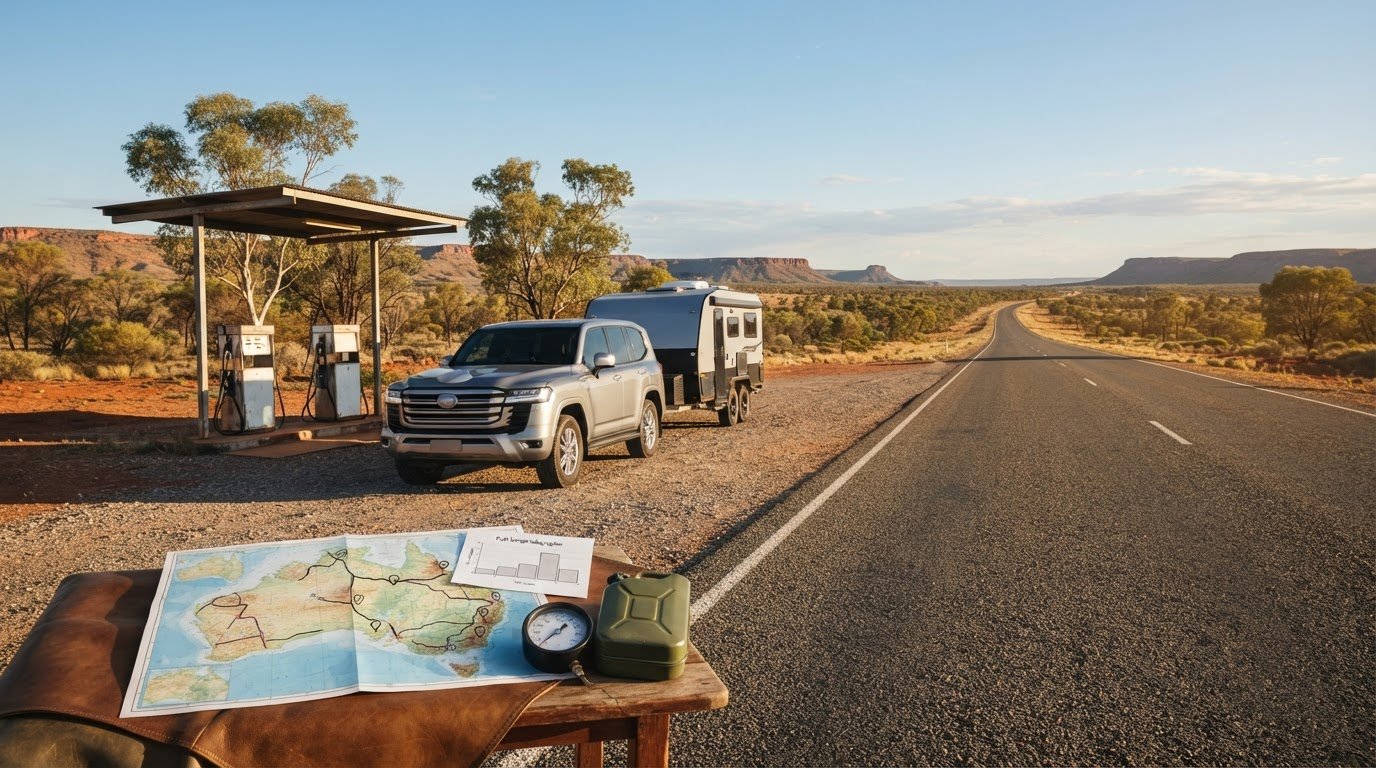
Remote distances matter as much as the price per litre. Fuel stations can be hundreds of kilometres apart in remote Australia, so mark suitable stops before setting out. Estimate the litres needed for each leg using your towing consumption, then compare that with your usable fuel capacity. Keep a reserve for detours, road conditions and changes to your plans. Don’t treat the distance between towns as a simple fuel calculation.
Sharing a lift can divide fuel expenses when people are travelling the same way. Agree on the route, pickup points and how to split fuel costs before departure. It works best when the shared trip fits everyone’s plans, rather than adding unnecessary kilometres.
For a more accurate long-trip estimate, break the route into legs, apply the relevant consumption rate to each one, and use the expected fuel price at its stops. This makes load, towing habits and route choices useful parts of your touring fuel budget.
4. Fuel prices in remote areas
There isn’t one fuel price that applies across every Australian state. Prices vary between towns, suburbs and remote locations. Compare the actual stops on your route rather than budgeting from a city price alone.
That gap can change the cost of a long remote leg, especially for a 4WD or a vehicle towing a caravan. Before leaving a larger centre, note the available stations and their listed prices along your route. If a remote stop is considerably dearer, filling up beforehand may reduce how much fuel you buy there, provided your tank and route allow it.
Fuel price comparison apps can help you spot differences between stations along a planned route. Enter the towns or stops you expect to pass, then compare listed prices and station locations. Treat the app as a planning aid: a cheaper station only helps if it fits your route and has the fuel your vehicle needs. Avoid unnecessary detours that use extra fuel.
Compare like with like. Check the price per litre for the correct fuel type, then consider how far you must travel to reach the station. A lower price shown in an app may not be the better choice if getting there means leaving your route, using more fuel or missing a suitable stop before a remote stretch.
Build the comparison into your itinerary. For each planned stop, record the town, expected fuel price, distance from the previous stop and the next available station. Then consider your vehicle’s fuel economy and expected consumption for that leg. A 4WD towing a caravan needs a different allowance from a lightly loaded car, so use the setup’s own consumption rather than a general estimate.
Prices can change between locations, so check them again before leaving a major town. Compare current options against your route, not against a price you remember from an earlier stop. If a remote station is the only practical option, plan for that purchase rather than making an unsuitable detour to find cheaper fuel.
Keep a simple route note on your phone or in a travel notebook. Record station names, locations, fuel type and the price shown when you checked. This makes your next comparison easier and helps you see where a higher remote price is unavoidable. Pair the notes with your planned fuel stops, so fuel economy and access guide your choices across regional Australia.
The cost depends on the specific stops along your route.
5. Planning fuel stops on regional and remote routes
On remote Australian highways, missing a fuel stop can leave a long gap before the next station. Stations may be hundreds of kilometres apart, so map suitable stops before setting out. Opening hours matter too: a station that’s closed when you arrive isn’t a usable stop. Plan around each station’s location and published hours, rather than waiting for the fuel warning light.
Start with a route map and mark every station along your planned road, including the next option after each stop. Note the distance between stations and consider whether your vehicle can cover each leg with fuel in reserve. Use your own fuel consumption, especially when towing or carrying a heavy load. This gives you a practical plan instead of a guess based on city driving.
Before leaving a larger town, check which stations lie ahead and when they’re open. A price comparison app can help locate stops, but route access and opening hours matter just as much as price. If an app shows a cheaper station off-route, weigh the detour against the extra kilometres and fuel it requires. A lower price isn’t a saving if getting there adds unnecessary driving.
- Mark each stop: Record the town, station and next available option on your route.
- Allow for the leg: Compare the distance with your vehicle’s fuel consumption and usable fuel.
- Plan for closures: Check operating hours before departure and avoid arriving after closing.
These steps are especially useful across Western Australia and the Northern Territory, where outback journeys can include long distances between services. Carrying extra fuel in a fuel can before travelling into the outback is a recommended option, particularly in those regions. Include it in your route planning and account for the extra load when estimating fuel use.
Keep your plan flexible without relying on an unplanned stop. Road conditions, a changed itinerary or a closed station can affect where you refuel. Note an alternative stop before leaving each town, and keep enough fuel to reach it. Prioritise access and preparation over chasing the cheapest bowser on the map.
To save money, combine stop planning with realistic distance planning. Group nearby errands before leaving a town, avoid backtracking for supplies, and compare prices at stations already on your route. These steps reduce unnecessary kilometres while keeping fuel availability central to your itinerary.
Planning an outback route? Explore Australian adventure ideas as you shape a trip around sensible fuel stops and responsible travel.
Adventurerz: Roof top tents reviews and recommendations
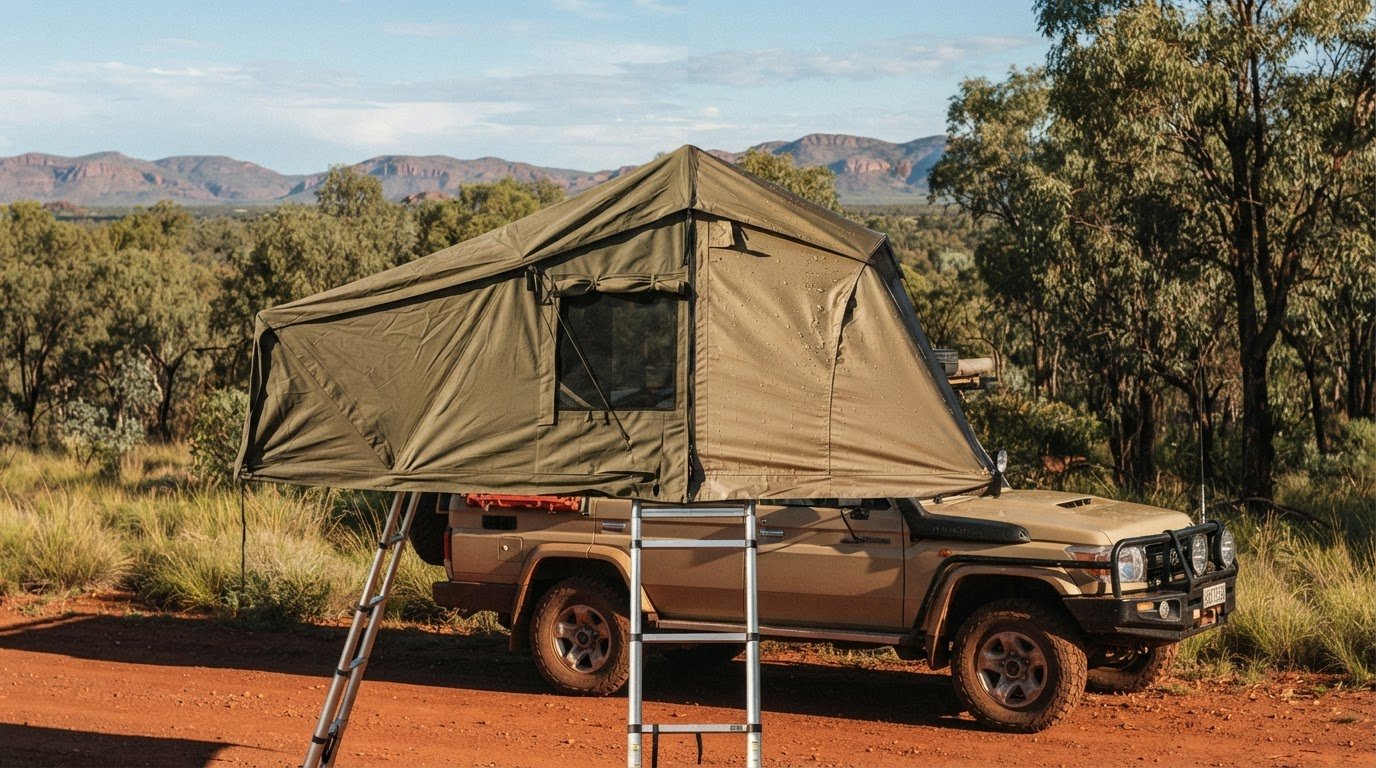
Adventurerz offers roof top tent reviews and recommendations for travellers planning a self-reliant Australian touring setup. If you’re weighing up how camping gear fits your vehicle and travel style, its camping equipment reviews and recommendations can help you explore options before packing for the road. You can also find 4WD awning reviews and hiking equipment recommendations, alongside adventure ideas and camping information for Australia.
Use these resources as you plan your setup, then consider what you’ll genuinely need on your route. A considered gear list can help you avoid carrying unnecessary equipment and keep your trip practical, whether you’re taking regional highways or preparing for remote travel.
Explore Adventurerz for outdoor reviews and information to help plan your Australian adventures.
Make your next Australian trip count
A well-planned touring setup can make it easier to travel at your own pace and spend less time reacting to avoidable costs. As you plan your next route, consider how your vehicle, camping gear and daily plans work together. Saving money on fuel while touring Australia is part of a broader approach: carry what supports your journey, make deliberate choices and leave room to adapt responsibly.
Adventurerz offers roof top tent reviews and recommendations, 4WD awning reviews and recommendations, and camping equipment reviews and recommendations to help you explore setup options for Australian travel. Use those resources as you prepare for the conditions and style of trip you have in mind.
Visit Adventurerz for Australian adventure ideas and outdoor reviews, and take your next trip one considered step closer.
Frequently Asked Questions
How can I save money on fuel while travelling Australia?
Plan each travel day around essential stops, rather than making separate drives for meals, supplies and sightseeing. For example, combine a grocery run with a planned town visit, then choose nearby activities before moving on. Keep a simple record of distance and fuel purchased. Comparing similar driving days can show how towing, terrain or a changed load affects your vehicle’s consumption.
Do hybrid cars use less fuel than petrol cars?
Hybrid cars can use less petrol than comparable conventional petrol cars, particularly in slower driving with frequent stops, when regenerative braking can recover energy. The difference depends on the vehicle, route, load and driving style. For touring, compare specific models’ fuel consumption in conditions like yours, including highway travel and any towing. A hybrid’s advantage in town may not carry over equally to every long-distance route.
Does air conditioning use more fuel?
Running the air conditioning can increase fuel use because the system draws power from the vehicle. The effect varies with outside temperature, cabin setting, vehicle and driving conditions. On a hot Australian travel day, choose a comfortable setting rather than making the cabin colder than needed. At low speeds, opening windows may be practical. At highway speeds, the added aerodynamic drag can also affect consumption.
Does carrying extra weight use more fuel?
Added load makes a vehicle work harder, especially during acceleration and on hills. Before departure, remove items that don’t serve the trip, such as duplicate cooking gear or unused accessories. Keep essential recovery equipment and supplies suited to the route. Pack heavy items securely and within the vehicle’s load limits, and reassess after major stops so unnecessary gear doesn’t stay onboard for the whole tour.
Does cruise control save fuel?
Cruise control can help maintain a consistent speed on a flat, open road, reducing repeated acceleration from uneven throttle input. But it isn’t automatically economical in every setting. On steep climbs, winding roads or in changing traffic, it may respond poorly to conditions or accelerate firmly to hold its setting. Choose manual control when it lets you respond more smoothly and appropriately to the road.
Does premium petrol improve fuel economy?
Not by itself. Premium petrol is useful when the vehicle manufacturer requires a higher octane rating. Using a lower grade than required can be unsuitable. If your vehicle is designed for regular petrol, premium fuel doesn’t automatically improve economy enough to justify choosing it. Check the owner’s manual or fuel label, then select the recommended grade rather than assuming a higher price means better performance.
Does tyre pressure affect fuel economy?
Tyres below the vehicle’s recommended pressure create greater rolling resistance, making the engine work harder. Check pressures when the tyres are cold, using the vehicle’s tyre placard or owner’s manual for the appropriate setting. Recheck after a substantial change in load, as touring with passengers and equipment may call for different recommended pressures. Include the spare in your pre-trip inspection.
How can I use less fuel in stop-start traffic?
Leave a generous gap, watch traffic ahead and ease off early instead of accelerating hard toward a queue. Smooth inputs reduce repeated bursts of acceleration and braking. If traffic has stopped for an extended period, follow the vehicle manufacturer’s guidance on idling and restart systems. Consolidate trips where possible, since a series of short journeys can involve more stop-start driving than one combined errand.