You’ve just spent a glorious morning pulling flathead from a glassy estuary, but now you’re staring at a 45kg plastic beast that needs to go onto your 4WD roof, which is already crowded by a bulky roof top tent. It’s the classic Aussie angler’s dilemma where the gear we love starts to feel like a burden. We’ve all felt that pang of doubt while watching the swell pick up offshore, wondering if our rig is actually stable enough for the run back to the beach.
Finding the best fishing kayaks for our unique conditions requires a balance of stability, stealth, and smart transport solutions. We know that a kayak isn’t just a boat; it’s a vital part of your total adventure ecosystem. We promise to help you navigate the 2026 market to find a craft that fits your specific fishing environment without compromising your camping setup.
In this guide, we explore the latest 2026 technology for ultimate stability and stealth. We compare the newest pedal versus paddle systems and provide expert tips on integrating your new rig into a 4WD setup. Whether you’re chasing bass in remote creeks or snapper in the big blue, we have the specialized gear advice you need to explore responsibly.
Key Takeaways
- Discover how 2026’s high-tensile composite materials are making vessels lighter and more durable for remote Aussie expeditions.
- Learn to match specific hull designs to your target environment, whether you’re navigating tight mangrove creeks or tackling rugged offshore swells.
- Explore our expert selection of the best fishing kayaks for 2026, featuring the latest stealth technology and propulsion systems.
- Solve the transport puzzle by mastering side-mount and rear-loading techniques that allow you to carry your kayak alongside a roof top tent.
- Adopt advanced “Leave No Trace” water-based ethics to ensure our unique Australian fisheries remain healthy for the next generation of explorers.
Table of Contents
The Evolution of Kayak Fishing in 2026
2026 marks a massive turning point for our community. We’ve moved beyond simple plastic shells into an era defined by “stealth and access”. The fish in our heavily pressured systems are getting smarter, and the spots that hold them are getting harder to reach. This is why the best fishing kayaks this year are focusing on high-tensile composite materials. These new builds are significantly lighter than older rotomolded models, which is a win for anyone who’s ever struggled to lift a boat onto a high 4WD rack.
A modern fishing kayak is a different beast compared to a standard recreational craft. While the history of kayak fishing is rooted in basic transport, today’s models are floating command centers. They come standard with integrated electronics pods, dedicated transducer scuppers, and internal wiring routes for side-scan sonar. We’re seeing a total fusion of technology and tradition that lets us hunt with more precision than ever before.
Why Choose a Kayak Over a Motorboat?
We often hear the question: why ditch the tinny? For us, it’s about the silence. A kayak offers a “stealth factor” that a motorboat simply can’t match. When you’re sliding into a snag to target wary Barra or Murray Cod, the lack of motor vibration is your best friend. Kayaks also give us unrivaled access to shallow-water estuaries and remote billabongs where even a small outboard would bottom out. It’s a cleaner way to explore too. With zero fuel requirements and lower maintenance costs, we can focus our budget on better tackle and longer trips.
Modern Hull Design and Stability
Stability used to be the trade-off for speed, but 2026 hull geometry has changed the game. We now see a dominance of catamaran and tunnel hulls that offer enough primary stability for us to stand and cast all day. This is crucial for sight-fishing in clear Australian flats. Because we deal with some of the harshest UV levels on earth, the latest models use advanced UV-stabilized polyethylene to prevent the hull from becoming brittle over time. Most importantly, 2026 designs have vastly improved secondary stability. This keeps the craft upright and predictable when you’re tackling offshore swells or wind-chop, providing that extra layer of safety we need in open water. When we’re hunting for the best fishing kayaks, we also look for hulls that are light enough to pair with roof top tents without exceeding our roof load limits.
Choosing Your Vessel: Key Features for Australian Waters
Selecting from the best fishing kayaks isn’t just about picking the most expensive model on the showroom floor. It’s about matching the hull to your specific playground. If you’re stalking bream in glassy estuaries, a shorter, nimble boat is king. Heading offshore for snapper? You’ll need a long, narrow hull with high displacement to slice through the swell. For those of us chasing Murray Cod in snag-heavy rivers, durability is the priority. A shorter, wide hull provides the stability needed when you’re wrestling a monster out of the timber.
Remote expeditions require serious storage. We look for kayaks with large bow hatches and expansive rear tank wells. You need space for dry bags, camping gear, and enough water for the trip. Safety is non-negotiable in the unpredictable Australian climate. Features like high-visibility hulls, scupper plugs that actually drain, and recessed deck lines are essential when a southerly buster hits unexpectedly.
Pedal vs. Paddle: Which Drive is Right for You?
The propulsion debate usually heats up around the campfire. Pedal drives are revolutionary for hands-free fishing. They allow us to maintain position in a current while keeping our hands on the rod. However, don’t write off the traditional paddle just yet. Paddle kayaks are lighter, simpler, and far better for shallow, rocky rivers where a pedal drive would just get smashed. In 2026, we’re also seeing the rise of integrated electric micro-motors. These are game-changers for long-distance scouting, allowing us to cover massive distances without burning out before the first cast.
Essential Fishing Ergonomics
Comfort is king. If your back is screaming after two hours, you aren’t fishing effectively. The 2026 standard includes adjustable high-back seating with breathable mesh. We also look for “plug-and-play” accessory systems. Gear tracks let us slide rod holders and camera mounts exactly where we need them without drilling holes in our hulls. Modern boats now feature dedicated transducer mounts and battery compartments, making it easy to install the latest side-scan tech. If you’re planning a multi-day trip, check out our guide on roof top tents to see how to pair your kayak with the ultimate campsite setup.
The Best Fishing Kayaks of 2026: Top Picks for Every Angler
Choosing from the best fishing kayaks depends entirely on your mission. We’ve spent the season testing hulls across the country to see which rigs actually stand up to the hype. Our team at Adventurerz focuses on gear that doesn’t just look good in a catalog but survives the corrugations on the way to a remote launch. Here are our top-rated picks for the 2026 season:
- The Best All-Rounder: We look for a 12-foot pedal drive that balances speed with a stable casting platform. These models are the sweet spot for those who split their time between lakes and sheltered bays.
- The Offshore Specialist: For the big blue, the Hobie Mirage Pro Angler 14 360 XR remains a dominant force. Its 14-foot hull and high-entry bow are designed specifically to handle swell and wind.
- The Lightweight Explorer: The Vibe Shearwater 125 stands out for anglers who need a high-performance deck without the back-breaking weight. It’s a fantastic option for solo launches.
- The Budget Performer: The Lifetime Tamarack Angler 100 continues to prove that you don’t need to spend a fortune to get on the water safely. It’s a rugged, no-frills plastic build that takes a beating.
- The Inflatable Innovator: 2026 drop-stitch technology has made inflatables nearly as rigid as hard-shells. These are the ultimate “boot-space” solutions for those without roof racks.
- The Adventurerz Choice: We curate these selections based on how well they integrate into a broader 4WD and camping ecosystem, ensuring your gear never limits your exploration.
Top Picks for Offshore and Coastal Fishing
When we head past the breakers, we prioritize hulls that are 14 feet or longer. A long waterline helps with tracking in cross-winds and provides the speed needed to outrun a changing tide. Look for high-entry bows that shed water during a surf launch rather than diving into the wave. Safety is paramount here; ensure your choice has self-draining scupper holes and watertight hatch integrity. A reliable rudder system is a must-have for maintaining your course when the afternoon sea breeze kicks in.
Best Compact and Portable Options
Sometimes the best fishing happens in a tiny creek that requires a 500-metre hike through the scrub. For these missions, 10-foot ‘throw-and-go’ kayaks are unbeatable. We’re also seeing a huge surge in fishing-specific Stand Up Paddleboards (SUPs) for 2026. These offer a birds-eye view for sight-casting and are incredibly light. If you’re already carrying roof top tents, weight-saving designs are your best friend. A lighter kayak means you’re more likely to actually use it at the end of a long day of driving.
Rigging for Remote Exploration: 4WD and Camping Integration
The challenge of the Australian outback isn’t just the destination; it’s the logistics of getting there. When we’re choosing between the best fishing kayaks, the physical size and weight of the hull become the most critical factors for our 4WD setups. Most of us are already pushing our roof load limits with recovery gear and camping equipment. It’s a delicate puzzle of physics and weight distribution that requires a methodical approach to ensure we don’t compromise our vehicle’s safety or performance.
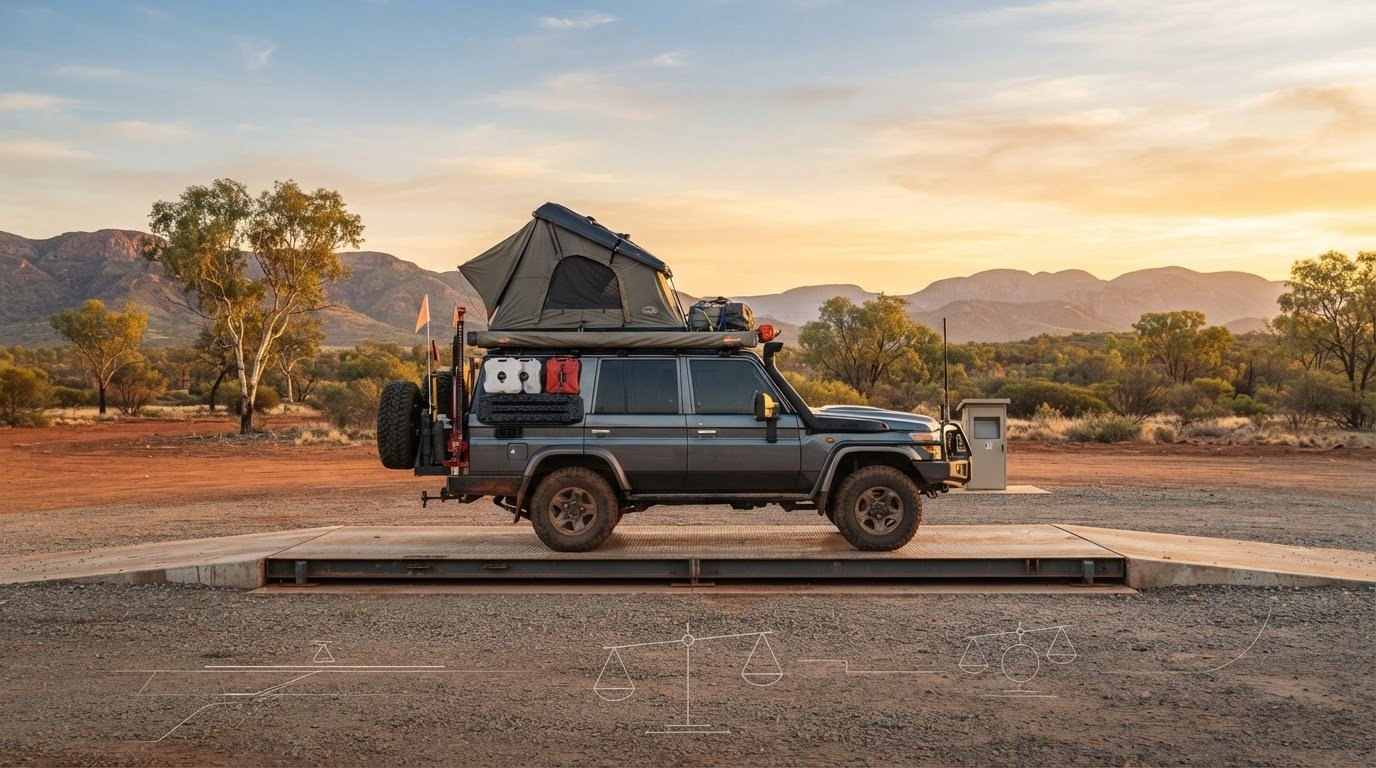
Gross Vehicle Mass (GVM) and dynamic roof load limits are non-negotiable. Most common 4WD roof rack systems are rated for a dynamic load of 75kg to 100kg. If your setup is already carrying a heavy tent, adding a 40kg fishing kayak can easily put you over the limit. We recommend keeping heavy accessories like batteries, tackle crates, and motors inside the vehicle during transit. This lowers your center of gravity and keeps your roof load within safe parameters for those corrugated tracks in the Kimberley or the Simpson Desert.
Security is another vital consideration for remote travel. We use high-tensile locking cables threaded through the scupper holes to secure our boats to the vehicle chassis or the rack itself. It’s a simple step that provides peace of mind when you’re away from camp exploring a nearby trail.
Kayaks and Roof Top Tents: The Ultimate Setup
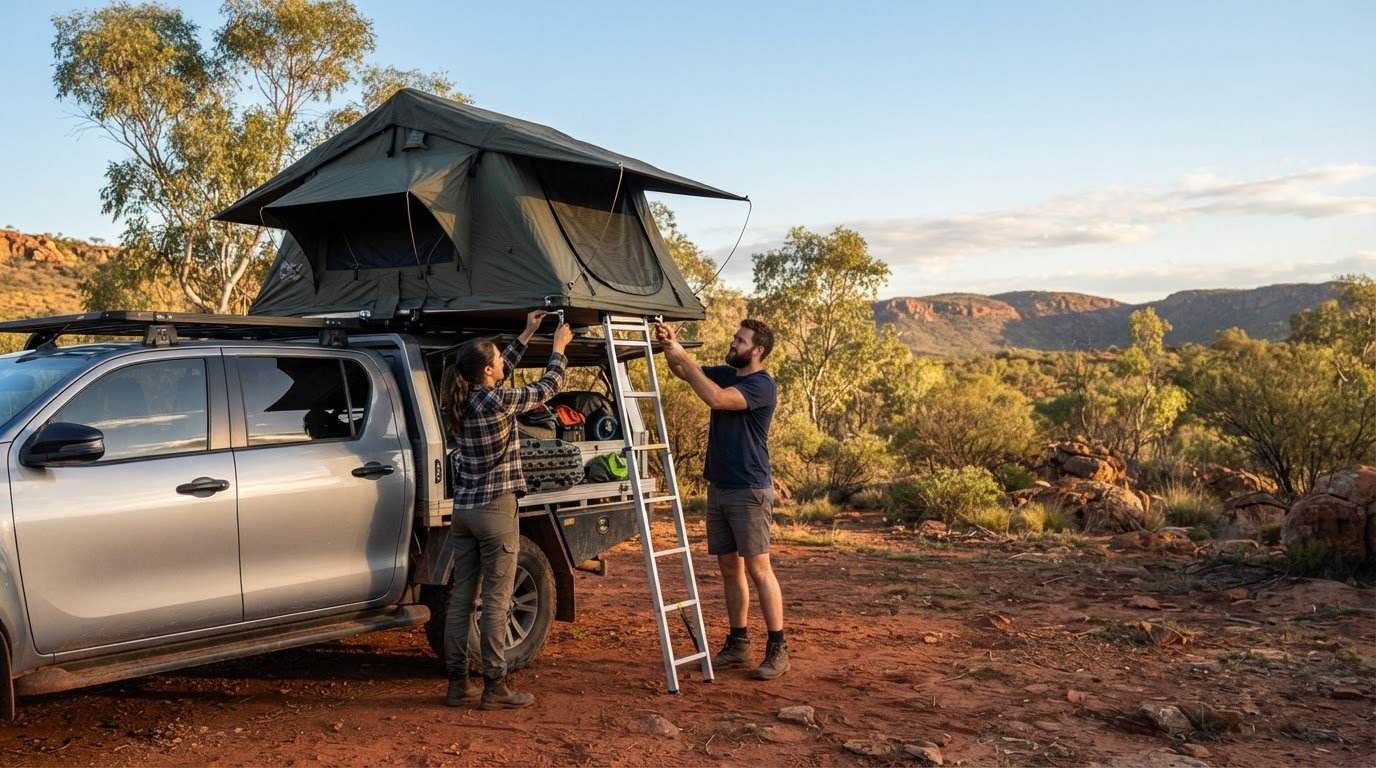
Combining a kayak with roof top tents is the gold standard for Australian adventure, but it requires specialized hardware. T-load hitch bars are a game-changer here. These bars extend from your tow hitch to support the rear of the kayak, effectively lengthening your carrying platform and taking the stress off your roof rack. For those with wider tents, side-mount kayak carriers or rack offsets allow the boat to sit snugly beside the tent. Solo-loading a heavy hull onto a lifted Patrol or LandCruiser is a recipe for a back injury, so we always suggest using a roller system or a side-loading assist tool to make the process effortless.
Essential Accessories for the Remote Angler
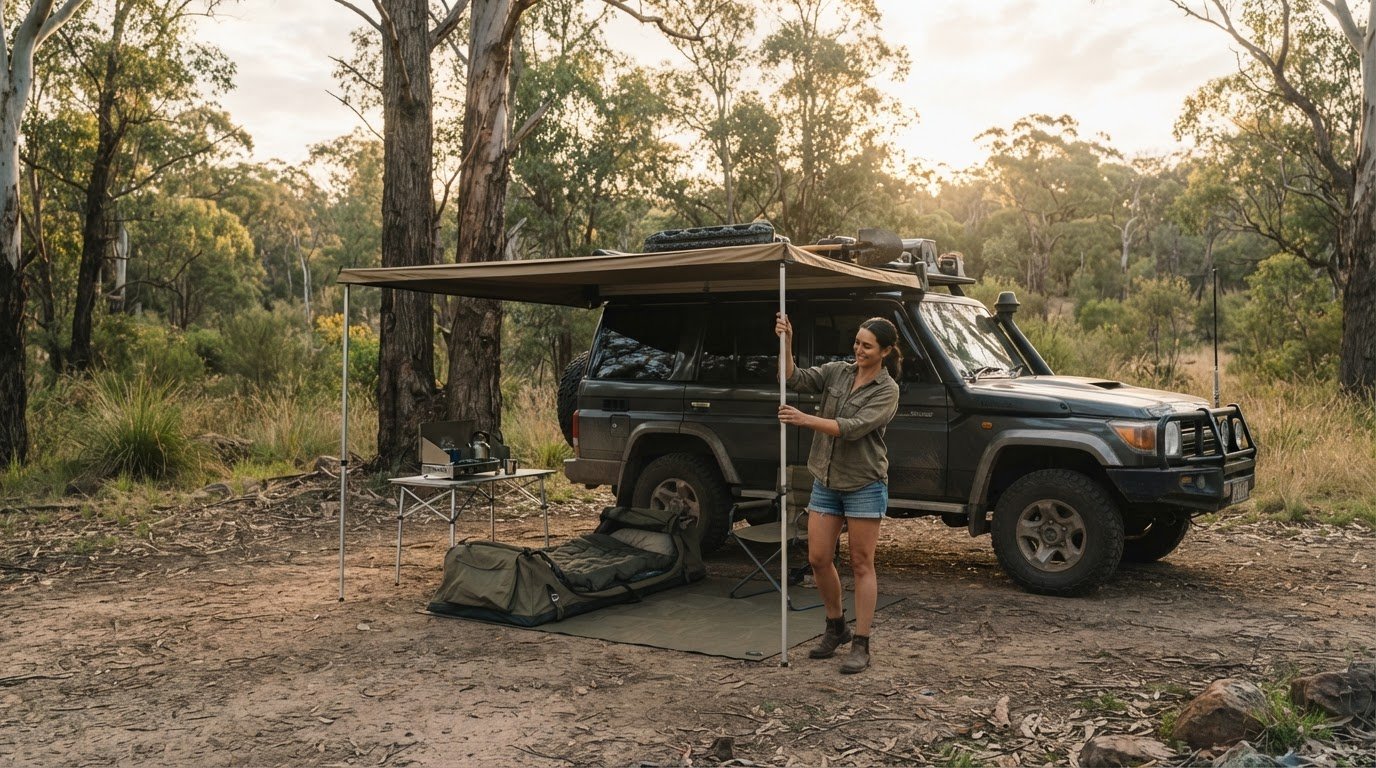
Once you arrive at that remote billabong, the real work begins. A heavy-duty kayak trolley with balloon tires is essential for hauling your rigged boat over soft sand or mud. We also suggest protecting your expensive electronics with high-capacity portable power banks and waterproof cases. To create the perfect lakeside basecamp, try pairing your kayak with one of the latest 4WD awnings. Having a shaded spot to rig your lures or clean your catch makes a massive difference in the heat of the day. Complete your adventure rig by exploring our latest reviews on the best roof top tents for Australian conditions.
Sustainable Angling: Protecting Our Waterways
As we venture deeper into the wild heart of Australia, we carry a responsibility that goes beyond our own enjoyment. The best fishing kayaks of 2026 aren’t just tools for extraction; they are our platforms for stewardship. We believe in applying the same “Leave No Trace” ethics to the water as we do to our 4WD campsites. This means ensuring that every piece of plastic, every length of discarded fluorocarbon, and every lure packet comes home with us. We are custodians of these places, not just visitors.
Responsible catch and release is vital for the health of our fisheries. In Western Australia, for example, new demersal fishing rules including changes to bag and size limits took effect on June 1, 2026, to protect vulnerable stocks. When we release a prize fish, we use wet hands, keep them in the water as much as possible, and utilize circle hooks to minimize gut hooking. Switching to lead-free weights and biodegradable lures further reduces our impact on these fragile ecosystems.
Biosecurity is another major concern for the modern explorer. Whether you’re moving between dams in Queensland or river systems in the Murray-Darling, cleaning your hull is essential. Invasive species like Tilapia or noxious weeds can hitch a ride on a damp hull or in a wet bilge. A quick wash-down with fresh water before you move to a new location helps protect our pristine waterways for everyone. It’s a simple habit that preserves the fishing for the next generation.
Ethical Wildlife Interaction
We share our waterways with incredible creatures. It’s our job to maintain a safe distance from nesting shorebirds on our coastlines and marine life in our bays. By choosing a kayak, we already reduce noise pollution, allowing us to observe wildlife without causing distress. We also encourage our community to record sightings for citizen science apps. Monitoring waterway health while we fish turns a hobby into a meaningful contribution to conservation.
Durability as Sustainability
Sustainability also means choosing gear that lasts. Investing in one of the best fishing kayaks is a vote against the throwaway culture that fills our landfills with cracked, low-grade plastic. A high-quality, UV-stabilized hull can easily serve you for over a decade if maintained properly. We take pride in keeping our remote launch sites cleaner than we found them. It’s about ensuring that the next generation of Aussie explorers can experience the same rugged beauty that we enjoy today.
Launch Your Next 2026 Remote Escape
Choosing from the best fishing kayaks isn’t just about comparing the specs on a screen; it’s about finding a vessel that survives the corrugations and enhances your time in the wild. We’ve explored how high-tensile composites and specialized hull designs are revolutionizing access to Australia’s most secluded spots. By integrating your rig thoughtfully with your 4WD and camping gear, you ensure that every launch is seamless and every session on the water is productive. Our community-vetted recommendations are built on years of rugged outback travel, focusing on durable gear that respects our unique environment.
We’re here to guide you through every step of the preparation process. Whether you’re chasing trophy fish offshore or stalking quiet estuaries, the right equipment makes all the difference. To start mapping out your route and ensuring your setup is ready for the long haul, Explore the Ultimate Adventure Travel Planner for your next kayak expedition. We can’t wait to see where your next journey takes you. Tight lines and safe travels!
Frequently Asked Questions
Is a pedal drive or paddle kayak better for Australian estuaries?
Pedal drives are generally superior for estuaries because they allow hands-free fishing while holding position in tidal currents. This is vital when casting at snags or flats. However, if you’re exploring extremely shallow mangrove creeks or rocky upper reaches, a paddle kayak is lighter and less likely to snag on debris. We often suggest choosing based on the specific depth and structure of your local system.
How do I safely carry a fishing kayak on a 4WD with a roof top tent?
You should use a side-mount carrier or a T-load hitch bar to avoid exceeding your vehicle’s dynamic roof load limit. Most 4WD racks are rated for 75kg to 100kg; a heavy tent and a kayak together often push this boundary. By using a hitch-mounted support, you distribute the weight and make solo loading much easier. Always check your vehicle’s specific GVM before heading out on corrugated tracks.
What are the legal safety requirements for fishing kayaks in Australia?
Legal requirements vary by state, but you must carry a lifejacket (PFD) and a waterproof torch at a minimum. In many jurisdictions, a whistle or horn and a bailer are also mandatory. If you’re heading more than two nautical miles offshore, you’ll likely need an EPIRB or PLB. We recommend checking with your local maritime authority, such as Service NSW or Maritime Safety Victoria, to ensure you’re fully compliant before launching.
Can I use a fishing kayak for offshore ocean adventures?
Yes, but you need a specific offshore hull, typically 14 feet or longer, designed for stability in swell. The best fishing kayaks for ocean use feature high-entry bows to shed water and a narrow waterline for better tracking. Safety is the priority here; never head out without a VHF radio and a clear understanding of the local weather forecast. We always suggest a trial run in sheltered water first.
What is the best way to store a kayak at a remote campsite to prevent theft?
Use a high-tensile locking cable threaded through the scupper holes and secured to your vehicle’s chassis or a permanent tree. Don’t just leave it on the shore; drag it up into your campsite under your 4WD awning where it’s less visible. Removing expensive electronics and your pedal drive unit at night also makes the rig a much less attractive target for opportunistic thieves in remote areas.
Do I need a license to use a small electric motor on my fishing kayak?
In most Australian states, adding any form of motor, even a micro-electric one, requires the kayak to be registered and the operator to hold a boat license. For example, in NSW and Victoria, registration is mandatory once a motor is fitted. Rules differ slightly in places like Queensland for low-powered motors, so it’s essential to verify the current 2026 regulations with your state’s transport or fisheries department.
How much weight can a standard fishing kayak safely carry?
Most 12-foot fishing kayaks have a weight capacity between 150kg and 250kg, but you should never load them to the absolute limit. For optimal stability and performance, we recommend staying under 70% of the maximum capacity. This includes your body weight, tackle, battery, and any fish you plan to keep. Overloading a kayak significantly reduces its secondary stability, making it much easier to flip in choppy conditions.
What are the most important safety items to carry in a kayak?
Beyond a PFD, you should always carry a personal locator beacon (PLB), a sharp knife, and a handheld VHF radio. A bilge pump and a paddle leash are also critical for self-rescue. We also suggest packing a basic first aid kit and plenty of water, especially for remote Aussie adventures where help might be hours away. Being prepared for the worst-case scenario is part of being a responsible explorer.